


T2 Short Return Eligibility and Filing Requirements for Nil Corporations in Canada | Corp Nil Filing for $300
TLDR: T2 Short return eligibility is generally available for nil corporations that have no income or tax payable during the fiscal year, making the filing process simpler under Canadian tax laws. Corp Nil Filing for $300 helps businesses meet all T2 Short filing requirements Canada-wide efficiently and accurately.
Quick Summary
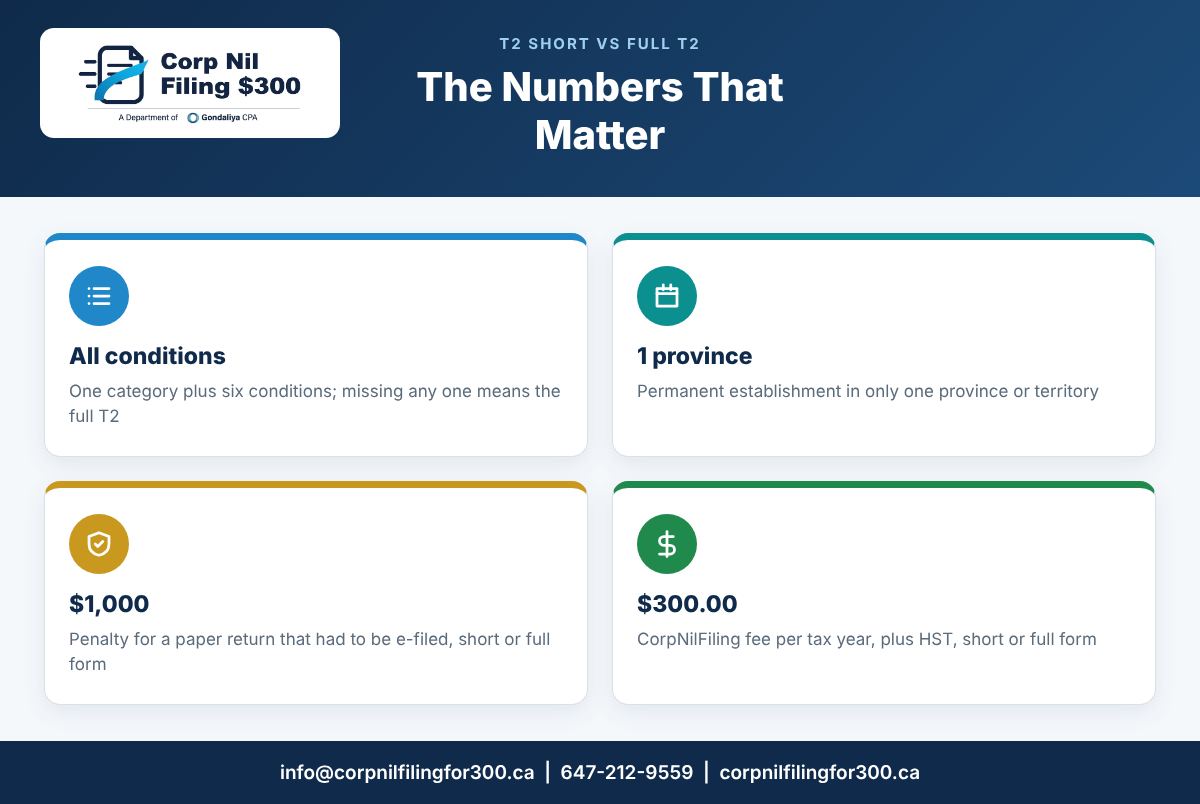
The T2 Short is a shorter CRA form for the same T2 return. A corporation can use it if it is a CCPC all year with nil net income or a loss, or is exempt from tax under section 149, and it also meets every other condition: a permanent establishment in only one province or territory, no refundable credits other than an instalment refund, no taxable dividends paid or received, Canadian-dollar reporting, and no Ontario transitional tax debit or section 34.2 amount. Missing any one means the full T2.
- A nil year does not by itself make a corporation eligible.
- A dividend paid or received rules the T2 Short out for that year.
- Schedule 50 still goes in on a T2 Short.
- The deadline, e-filing rule and penalties are the same for both forms.
Reading time: 28 minutes.
Table of Contents
The Numbers That Matter
This article covers Canada, with Ontario and Toronto context, and reflects CRA guidance current to 2026, including the T2 Short Return form for 2019 and later tax years. It is written for owners of nil, inactive, dormant and holding corporations deciding which T2 form applies. CorpNilFiling is a department of Gondaliya CPA Professional Corporation, which performs compilation engagements under CSRS 4200 and does not offer audit or review engagements. This is educational information only and not tax or legal advice; eligibility depends on each year’s facts.
Understanding T2 Corporation Income Tax Returns in Canada
Understanding T2 Returns
The Return
T2 Corporation Income Tax Return Overview
The T2 Corporation Income Tax Return is a key form for corporations in Canada. It has two versions: the full T2 and the T2 Short return. Which one you use depends on rules from the Canada Revenue Agency (CRA). A corporation eligible for the T2 Short usually must be a Canadian-controlled private corporation (CCPC) all year and have nil net income or a loss for income tax purposes.
The CRA calls the T2 Short return a simpler version of the full corporate tax return. It cuts down on paperwork but still follows federal tax rules. This form helps some corporations file their taxes without extra hassle.
Mandatory Filing Requirements for Corporations in Canada
Every corporation must file a yearly income tax return, even if it did nothing that year. For those looking at T2 Short filing requirements, keep these points in mind:
- You have six months after your fiscal year ends to file.
- Missing this deadline can lead to late-filing penalties, and a return filed on paper when it had to be e-filed draws a $1,000 penalty.
- For tax years starting after 2023, most corporations must file electronically using CRA-approved software, unless they qualify for an exemption.
These rules make sure all businesses follow Canada’s tax laws properly.
Resident and Non-Resident Corporations: Filing Obligations
Filing duties change based on whether a corporation is resident or non-resident. A nil corporation might qualify to file the T2 Short if it fits these conditions:
- It’s a CCPC during its whole tax year.
- It has nil net income or a loss for income tax purposes.
- It claims no refundable tax credits except refunds from instalments paid.
- It doesn’t pay or receive taxable dividends that year.
Also, Section 149 exemptions mainly apply to nonprofits and some public bodies. They don’t pay taxes but still file a T2, and can use the T2 Short if they meet its other conditions.
Importance of Filing a Corporate Income Tax Return Annually
Even if your business had no activity, filing a corporate income tax return every year matters. Using the nil T2 Short return keeps you in good standing with authorities like CRA.
Filing helps keep clear records about your business operations over time. It also gives everyone involved a true picture of your financial state—even if you didn’t earn or spend anything.
In short, knowing these points helps you follow rules and make smart choices about your corporation’s taxes in Canada.
T2 Short vs Regular T2: Key Differences Explained
T2 Short vs Regular T2
The Forms
The T2 Short is a simpler form of the full T2 Corporation Income Tax Return. It’s made for certain corporations that meet specific rules. The full T2 corporate tax return is longer and needs more detailed info. The simplified corporate tax return Canada has fewer sections but still follows CRA rules.
Here’s how they differ:
- Form Length: The T2 Short has fewer pages and sections than the full T2.
- Who Can Use It: Only some corporations can file with the short form. Others must do the full return.
- Schedules Needed: A few key schedules like Schedule 1, Schedule 8, and Schedule 50 apply to the T2 Short. Many other attachments are skipped unless needed.
- Provincial Filing: The T2 Short covers both federal and provincial returns—except in Quebec and Alberta, where separate provincial forms are needed.
- How to File: Both forms usually need to be filed electronically for tax years after 2023.
This lets eligible corporations, including nil ones, file quickly without extra work. Still, deadlines and core rules stay the same as with a full corporate tax return.
Eligibility Criteria for Filing a T2 Short Return
To file a T2 Short, corporations must meet six CRA criteria listed on T2SHORT. They are:
- Be either:
- A Canadian-controlled private corporation (CCPC) for the whole year with nil net income or a loss; or
- A corporation exempt from income tax under section 149 of the Income Tax Act.
- Have a permanent establishment in only one Canadian province or territory during the fiscal year.
- Claim no refundable tax credits except refunds on instalments paid.
- Report all amounts only in Canadian dollars.
- Not have received or paid taxable dividends that year.
- Have no Ontario transitional tax debit balance or amounts under section 34.2 of the Income Tax Act.
If any rule isn’t met, the corporation can’t use this form and must file a full return (CRA source).
Even if a company has no activity, it doesn’t automatically qualify as nil corporation T2 Short return eligible. All conditions matter here (CorpNilFiling guide).
Situations When a Full T2 Return Is Required
A full T2 corporate tax return becomes necessary when:
- The corporation has more than one permanent establishment across provinces.
- It claims refundable tax credits other than instalment refunds.
- It received or paid taxable dividends during the year.
Also, non-resident firms and those reporting in a functional currency other than Canadian dollars can’t use the short form, and section 149-exempt groups can use it only if they meet the other conditions (Income Tax Act sections 150(1),149).
Most taxpayers must e-file starting from tax years after 2023. If they don’t comply with CRA mandatory E-filing rules, a $1,000 penalty applies to each return filed on paper (CRA penalty notice).
These rules apply whether filing short or full returns.
A Brampton numbered company had filed the T2 Short with nil amounts for four years, then received a $2,500 dividend on shares it held in a friend’s company. That one dividend ruled the short form out: the year went on the full T2 with Schedule 3, and the following year, with no dividend, it returned to the T2 Short. Figures changed for privacy.
Impact of Filing T2 Short on Tax Assessment and Compliance
Using CRA’s official T2 SHORT PDF form holds the same legal weight as filing a regular corporate income tax return.
The shorter form doesn’t lower audit chances or change how CRA reviews returns since financial info stays consistent when correct schedules come with filings (like Schedule 1).
Electronic filing through approved software ensures CRA gets your return on time. But:
- Corporations who must e-file but file on paper instead face a $1,000 penalty for each return (CRA EFILE FAQ).
- Sending only scanned PDFs won’t cut it. The software sends data directly from filled forms—not just images.
To sum up: picking between these two forms mainly affects ease of filing but keeps deadlines and compliance intact. For example, first-time filers might still need to attach Schedule 24 regardless of form length.
Eligibility and Conditions for Filing a T2 Short Return (Nil Return)
Eligibility and Conditions
Who Qualifies
The T2 Short return eligibility depends on rules set by the Canada Revenue Agency (CRA). They allow certain corporations to file a simpler tax return. To use this, a corporation must meet specific conditions the CRA outlines. These rules mainly apply to companies with no income or limited business activity. This section explains who can file a T2 Short and what to watch out for.
Detailed Eligibility Requirements for T2 Short Return Filing
To qualify for a T2 Short return in Canada, a corporation must meet six clear criteria from the CRA:
- The company is a Canadian-controlled private corporation (CCPC) all year with zero income or a loss, or it’s exempt under section 149 of the Income Tax Act.
- It has a permanent establishment in only one province or territory.
- No refundable tax credits are claimed except refunds of instalment payments.
- It didn’t receive or pay any taxable dividends during the year.
- All amounts reported are in Canadian dollars.
- It has no Ontario transitional tax debit or amounts calculated under section 34.2.
If even one rule is broken, the company must file the full T2 corporate tax return (CRA T2SHORT form page).
These conditions help ensure only simple financial cases use the short form while keeping tax reporting correct.
Filing a Nil Return for Corporations with No Income or Activity
A nil corporation T2 Short return fits companies that had no income, expenses, assets, liabilities, or shareholder activity during the year. This kind of filing shows no business action happened, though Schedule 50 still goes in and special rules may add more, like first-year filing needing Schedule 24.
Filing nil returns is straightforward and saves time. But zero revenue alone doesn’t guarantee eligibility; all other conditions must also be met (see What a Nil T2 Return Is).
Companies that use this method can stay compliant without much hassle. Services like Corp Nil Filing offer flat fees and include electronic filing regardless of form choice.
Restrictions and Exceptions to T2 Short Return Eligibility
Some actions stop corporations from using the T2 Short form. Instead, they must file the full corporate tax return:
- Claiming refundable credits other than instalment refunds disqualifies short filing.
- Paying or receiving taxable dividends requires full reporting because dividends are reported on Schedule 3.
- Having more than one permanent establishment in different provinces means you can’t use this single-province form.
These limits keep tax reporting accurate when complex transactions exist (CRA guide T4012, Income Tax Act sections 149 & 150).
Companies should check these rules carefully before choosing their filing method to avoid errors and penalties.
Considerations for CCPCs and Limited Activity Corporations
Canadian-Controlled Private Corporations (CCPCs) can file a T2 Short only if they have nil net income or a loss for the year and are CCPCs all year and meet other criteria above.
Dormant or limited activity firms holding assets but not actively operating often qualify but must verify yearly. Changes like dividend payments or opening offices in other provinces mean they must file full returns (CRA Corporation Internet Filing FAQ).
Choosing between short or full forms depends on facts each year. Don’t assume past eligibility carries forward without review.
Key Stat: Missing mandatory electronic filing can lead to a $1,000 penalty for tax years starting after 2023 (CRA Mandatory E-filing page).
CRA Requirement: To use T2Short, you must fit one category fully; otherwise file the full T2 return per CRA instructions.
Risk Warning: Just having “nil” does not qualify you; dividends or multiple provinces block short-form usage instantly.
Pro Tip: Check your permanent establishment locations early every year before picking your form with our T2 Short eligibility checker.
Sources:
- Canada Revenue Agency – T2SHORT Form Page
- Mandatory Electronic Filing – CRA Mandatory E-filing
- Income Tax Act sections 149(1), 150(1), 34.2
Filing Procedures and Compliance for T2 Short Returns in Canada
Filing Procedures
How to File
Corporations eligible for the T2 Short return must follow specific CRA rules. The T2 Short is its own form, a shorter version of the full T2 Corporation Income Tax Return. It helps reduce paperwork while staying compliant. Corporations that qualify—like Canadian-controlled private corporations (CCPCs) with nil or loss net income or those exempt under section 149—need to file properly.
The CRA says companies should use certified software for electronic filing unless they have an exception. This keeps things accurate and timely across Canada, including Ontario, where provincial rules mostly match federal ones.
Accepted Filing Methods: Electronic Filing vs Paper T2 Short PDF
Starting with tax years after 2023, the CRA wants most corporations to file electronically using certified software. That includes those filing a nil corporation T2 Short return. Paper forms usually aren’t accepted except from the exempt categories, such as insurance corporations and corporations exempt under section 149.
Certified software sends data straight to the CRA’s system. It doesn’t just upload a scanned PDF. This method cuts errors and speeds up processing. Missing mandatory e-filing costs a corporation a $1,000 penalty per return.
Key Stat: A $1,000 penalty applies if you miss mandatory e-filing CRA Mandatory E-Filing Requirements.
Using Tax Preparation Software and CRA’s Electronic Filing Options
CRA supports several certified tax preparation software options. They prepare full or short versions of Form T2 returns. These programs help filers complete required schedules based on their company’s details and eligibility for a nil corporation T2 Short return.
Electronic filing checks your entries before sending them and gives quick confirmation once accepted by the CRA. For tax years starting after 2023, this is required unless your corporation qualifies for statutory exemptions like certain exempt entities under section 149.
Software submits data files formatted per CRA rules; it doesn’t send PDFs. You still need to keep copies of your forms for records, but official receipt depends on electronic submission.
Deadlines for Filing T2 Short Returns and Payment Obligations
Every corporation must file their tax return within six months after their fiscal year ends. This deadline applies whether they use the full or short form because both represent one legal filing requirement.
Payment deadlines don’t change either. Any taxes owed must be paid on time regardless of which form you file. Late filings or payments can lead to interest charges or penalties from the CRA.
CRA Requirement: Six-month deadline applies equally; late filings risk penalties Income Tax Act s150(1).
Reporting Requirements and Necessary Documentation for Nil Returns
Nil corporation T2 Short returns still need certain schedules:
- Schedule 1: Reconciles accounting income to net income for tax purposes, where needed.
- Schedule 8: Shows capital cost allowance when it applies.
- Schedule 50: Lists each shareholder holding 10% or more of the common or preferred shares, even when line 280 says the corporation is inactive.
- GIFI Schedules 100, 125 & 141: Summarize financial statements even if numbers are zero—unless line 280 “inactive” box is checked and no other reporting is needed.
These documents help maintain transparency even if the company had no income or losses. They keep filings consistent nationwide, except in Quebec and Alberta where provinces have separate rules.
Keeping good records makes audits easier if questions come up about eligibility or completeness later.
Common Filing Errors and How to Avoid Them
| Error | Impact | How To Avoid |
|---|---|---|
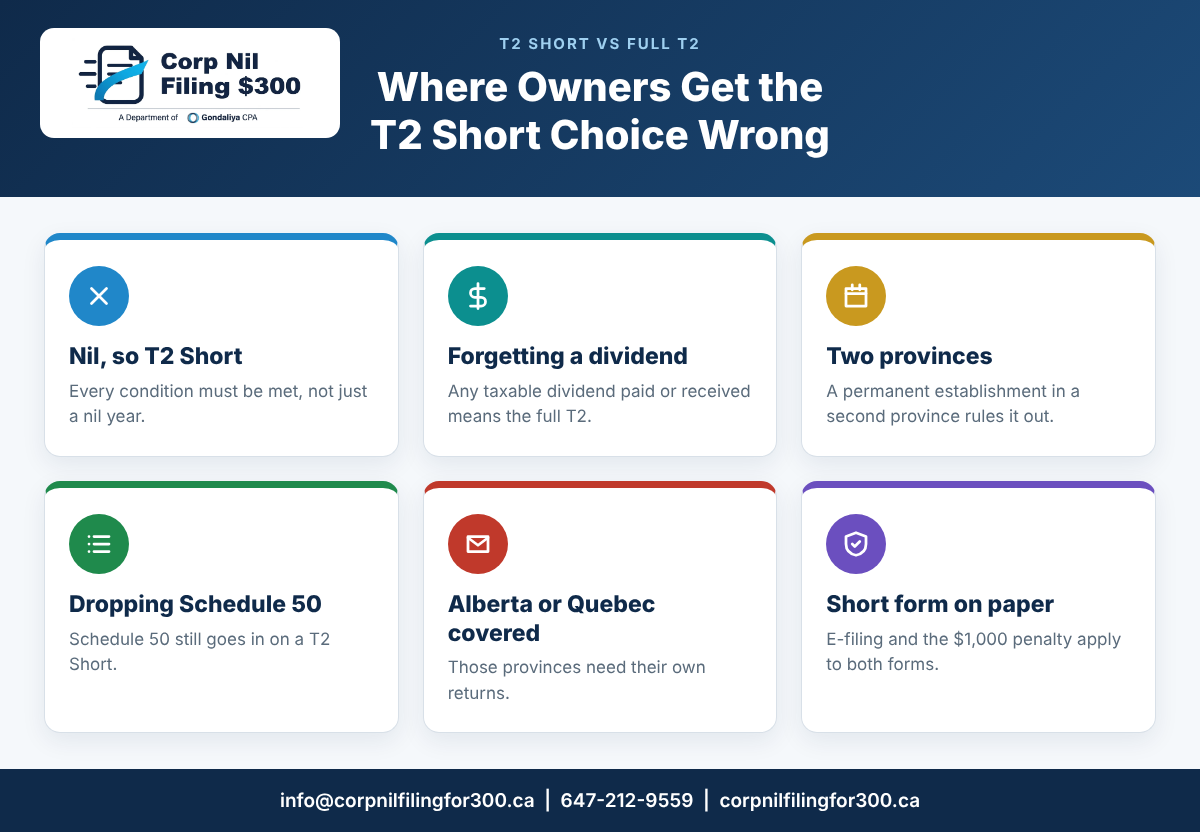
| Assuming nil net income alone means you qualify | Wrong form causes rejection | Check all six conditions carefully before choosing |
| Forgetting taxable dividends received or paid | Disqualifies short form, causing delays | Double-check dividend activity each year |
| Not verifying province when multiple establishments exist | Need full return; wrong filing risks penalty | Confirm only one province before filing |
| Leaving out Schedule 50 | Incomplete info can bring CRA follow-up | Include Schedule 50 every year for each 10% shareholder |
| Assuming Alberta/Quebec covered by federal short form | Must file separate provincial returns; missing these fines | File provincial returns along with federal ones |
Pro tip: Keep annual logs confirming your eligibility checks before submitting your return.
Avoiding these mistakes keeps compliance solid and cuts down on costly refiling later in your tax cycle.
The owner of an inactive Calgary corporation had filed the T2 Short each year and assumed it also covered Alberta. It covers every province and territory except Quebec and Alberta, so the corporation also owed an Alberta AT1 return for each year. We filed the missing AT1 returns alongside that year’s T2 Short. Figures changed for privacy.
Penalties, Consequences, and Relief Related to T2 Short Filing
Penalties and Relief
Penalties
Corporations that file a T2 Short return need to follow the CRA’s T2 Short filing requirements Canada-wide. Not meeting these rules can bring penalties, interest, and other problems under Canadian tax law. Knowing these risks helps companies stay on the right side of the CRA and avoid extra costs or trouble.
Penalties for Late or Non-Filing of T2 Short Returns
Starting with tax years after 2023, the CRA requires electronic filing for most corporate tax returns. This includes nil corporation T2 Short returns filed using certified software. If a company misses the deadline or doesn’t file electronically, penalties kick in.
Here’s what you should know:
- The CRA charges a $1,000 penalty if a corporation subject to mandatory e-filing does not send its return electronically.
- This rule applies to both full T2 corporate tax returns and CRA T2 Short return forms.
- Late or missing filings can delay refund processing, like instalment overpayments.
- Non-compliance may also draw extra attention from CRA auditors.
Filing late or not at all is risky. The $1,000 penalty hits per missed electronic filing where required.
Interest Charges and Repercussions of False Statements or Omissions
If a corporation owes taxes and pays late, interest builds daily on unpaid amounts. Even though many nil corporations report no income and owe nothing, wrong info can cause reassessments with extra taxes plus interest.
When filling corporate tax return forms Canada-wide, it’s important to be accurate. Both full and short returns need proper Schedule 1 adjustments and reconciliations. False statements or omissions can lead to reassessment under section 152(4) of the Income Tax Act.
Remember:
- Accuracy matters whether filing a full T2 corporate tax return or a nil T2 Short version.
- Mistakes carry financial consequences until corrected amounts get paid in full.
Voluntary Disclosures Program and Options to Cancel or Waive Penalties
If a company finds out it missed something on its CRA T2 Short return, it can use Canada’s Voluntary Disclosures Program (VDP). This program lets taxpayers fix past mistakes, with the most relief before the CRA has made contact and less after.
Key points about VDP:
- Penalties for late filing or errors can be waived in whole or in part.
- Taxes owed still must be paid, with part of the interest relieved.
- The program covers both short-form filers and those using full returns.
- Disclosures must be complete and truthful.
- Partial disclosures won’t stop enforcement actions if they already started.
The VDP offers relief but only if done properly.
CRA Enforcement on Electronic Filing Non-Compliance
For tax years starting after 2023, the CRA strictly enforces mandatory electronic filing rules. Corporations using nil corporation T2 Short returns must submit through certified software unless an exception applies (e.g., insurance companies).
Non-compliance means:
- A $1,000 penalty per missed electronic submission.
- Possible delays in assessment processing.
- Increased risk of audits focused on repeated failures.
Note that mailing paper copies instead of filing electronically won’t avoid penalties during these years. The CRA expects data transmissions via approved channels only.
Legal Consequences for Misrepresentation and Tax Avoidance Reporting
Intentionally misstating facts on corporate income tax forms Canada accepts leads to serious legal trouble. Directors, officers, and sometimes shareholders face penalties beyond fines.
Under Income Tax Act subsection 163(2) and section 239:
- A false statement made knowingly or through gross negligence brings a penalty of 50% of the understated tax, and a conviction for tax evasion brings fines of 50% to 200% of the tax evaded and up to five years in prison.
- Criminal prosecution referrals may follow depending on how bad the case is.
Misreporting may include claiming exemptions wrongly or hiding tax avoidance schemes. CRA uses audits comparing declared data with third-party info and Schedule 50 shareholder reports to spot issues.
Corporations must file either full or short returns honestly. Errors can cause big problems later during reviews by regional offices across provinces like Ontario.
Start your nil corporation’s annual filing carefully with expert help if needed. You’ll avoid surprises while meeting all T2 Short filing requirements Canada demands properly.
Sources:
- CRA Corporation Internet Filing
- Income Tax Act Sections
- Canada.ca Voluntary Disclosures Program
- CRA Mandatory Electronic Filing Requirements
- Current T4012 Corporate Income Tax Guide
Corp Nil Filing for $300 – Services and Benefits for Nil Corporations
How We Help
Our Service
Corp Nil Filing helps nil corporations file their T2 Short return in Canada. We focus on corporations that have no activity or income. Knowing T2 Short return eligibility and meeting T2 Short filing requirements Canada makes the process easier. Our service cuts down on paperwork and hassle, helping you stay compliant with CRA rules.
Why Choose Corp Nil Filing for $300 for Your T2 Short Return
Choosing Corp Nil Filing means you get a clear, affordable way to handle your nil corporation T2 Short return. We take care of preparing and filing your CRA T2 Short return with care. Our Ontario CPA firm works to file on time and follow all CRA rules. This way, your nil corporation meets its tax duties without extra costs or wait times.
Step-by-Step Process for Filing a T2 Short Return with Corp Nil Filing for $300
Filing a T2 Short return is different from filing a full T2. Here’s how we help:
- Check if your company fits T2 Short vs full T2 criteria.
- Use certified software that meets CRA’s mandatory electronic filing rules.
- Attach needed schedules like Schedule 1, Schedule 8, and Schedule 50 if needed.
- File electronically through our EFILE system before the six-month deadline after your fiscal year ends.
- Send you confirmation within three business days once the CRA accepts the return.
We make sure to follow all CRA guidelines and avoid penalties linked to late or wrong filings.
Support Services for Corporate Nil Returns and Related Tax Filings
We don’t just fill out forms; we explain things so you understand:
- Confirm if your corporation qualifies as a corporation eligible for T2 Short.
- Warn if refundable tax credits or taxable dividends mean you must file a full return.
- Help avoid mistakes with simplified corporate tax returns in Canada.
- Prevent the $1,000 penalty for not filing electronically when it is required.
We also guide you on keeping records that meet GIFI standards required by Canadian tax laws.
Advantages of Professional Nil Return Filing Assistance
Getting help from experts lowers your risk of errors:
- Makes sure all corporate tax return forms Canada are done right, including important schedules like 1, 8, and 24 (for first-timers) plus line 280.
- Helps dodge the penalty for skipping mandatory electronic filing by using approved software.
- Offers peace of mind since CPAs review your return before sending it off—especially now with new rules starting after 2023 tax years.
A fixed fee service saves you time and headaches while keeping things accurate.
Client Experiences and Testimonials with Corp Nil Filing for $300
Our clients appreciate our straightforward $300 plus HST price per year. They like how our CPA-reviewed filings fit nil corporations’ needs well. This includes those who file a nil corporation T2 Short return yearly without extra fees for schedules.
With 1300+ 5-star Google reviews from Toronto and beyond—including places like Mississauga and Ottawa—our work shows reliability. We handle tricky cases too, such as companies catching up on unfiled years or switching between short and full returns.
Next Steps: How to Get Started with Filing Your T2 Short Return Today
Your corporation must file its federal income tax return within six months after the fiscal year ends. This applies even if there was no business activity. Missing this deadline can bring penalties and a CRA demand to file, whichever form you qualify for under strict rules from CRA.
To get started:
- Call us at 647‑212‑9559 or email info@corpnilfilingfor300.ca
- Gather documents like financial statements, share registers, prior notices
- Start early so we have time to check everything before deadlines
You can file your nil T2 return knowing experts are guiding you through Canada’s rules nationwide—including Ontario.
Verdict: A nil corporation can use the T2 Short only when it meets every condition on the form, not because its year was nil. A CCPC with nil income, one province, no dividends and no refundable credits qualifies; one dividend, a second province or a non-Canadian reporting currency sends that year to the full T2. Either way the deadline, e-filing rule and Schedule 50 are the same.
2026 Update: For returns filed in 2026, the T2 Short Return for 2019 and later tax years still applies, with the same eligibility conditions, and it still serves as the provincial return everywhere except Quebec and Alberta. Electronic filing is required for tax years starting after 2023 whichever form is used, and the Voluntary Disclosures Program now has unprompted and prompted streams.
Frequently Asked Questions (FAQs) on T2 Short Return Eligibility and Filing
Frequently Asked Questions
FAQ
What are the T2 Short eligibility criteria for nil corporations?+
Corporations must be Canadian-controlled private corporations (CCPCs) or exempt under section 149. They need nil net income or a loss, a permanent establishment in only one province or territory, no taxable dividends paid or received, no refundable credits except instalment refunds, and amounts reported in Canadian dollars.
Who qualifies as a corporation eligible for T2 Short filing?+
Only corporations meeting all CRA conditions, including having a permanent establishment in only one province or territory and reporting only in Canadian dollars, can use the T2 Short form.
Can a nil corporation file a CRA T2 Short return without income or expenses?+
Yes. A nil T2 Short return applies to corporations with no financial activity but that meet all eligibility rules set by CRA.
Are corporate tax return forms Canada standardized for short and full returns?+
Yes. The forms comply with CRA regulations. The short form requires fewer schedules and less detail than the full return.
Is electronic filing mandatory for all corporations using the T2 Short return?+
Starting from tax years after 2023, most corporations must file electronically using CRA-certified software unless exempted.
Industry Spotlights: Which Form Each Sector Usually Files
Industry Spotlights
Most quiet corporations can use the T2 Short, but each sector has its own usual way of falling off it: a dividend, a second province, or a credit claim.
| Sector | Usually Qualifies When | Usually Falls to the Full T2 When |
|---|---|---|
| Real estate holding companies | Between purchases, with no rent | Rent produces net income |
| Property developers holding land | Land held with no income | A sale or interest income |
| Physician and dental professional corporations | A first year before billing starts | Billing produces net income |
| Technology startups before revenue | Pre-launch, with a loss | A refundable SR&ED credit is claimed |
| E-commerce brands not yet launched | Before the first sale | Sales produce net income |
| Consultants between contracts | A year with no billings | Billings return |
| Skilled trades | Paused in one province | Work in a second province |
| Restaurants not opened or closed | A closed location with no activity | Assets sold at a gain |
| Transportation owner-operators | A parked company | Permanent establishments in two provinces |
| Family investment holding companies | Shares held with no income | Any taxable dividend received |
| Non-resident-owned Canadian companies | Rarely; most are not CCPCs | Not a CCPC, so the full T2 |
- Real estate holding companies: Between purchases with no rent, the T2 Short usually fits; rent that produces net income moves the year to the full T2.
- Property developers holding land: Land held with no income can be filed on the T2 Short until a sale or interest income arrives.
- Physician and dental professional corporations: A first year before billing can use the T2 Short, with Schedule 24 attached.
- Technology startups before revenue: A pre-launch loss qualifies, but claiming a refundable SR&ED credit rules the short form out.
- E-commerce brands not yet launched: Before the first sale the T2 Short fits; sales with net income end that.
- Consultants between contracts: A year with no billings can use the T2 Short.
- Skilled trades: A paused company in one province qualifies; a permanent establishment in a second province does not.
- Restaurants not opened or closed: A closed location with no activity can file the T2 Short; assets sold at a gain usually mean the full T2.
- Transportation owner-operators: A parked company qualifies; permanent establishments in two provinces do not.
- Family investment holding companies: Any taxable dividend received rules the T2 Short out for that year.
- Non-resident-owned Canadian companies: A corporation controlled by non-residents is usually not a CCPC, so it files the full T2.
Professional Guidance & Quick Reference
Quick Reference
Key Points on T2 Short Return and Corporate Tax Filing
- Corporations must meet strict eligibility criteria before choosing the T2 Short form.
- Only CCPCs with nil or loss income qualify alongside specific exempt entities under section 149.
- Nil T2 Short returns show no activity but still require proper schedules like Schedule 1 and Schedule 50 if applicable.
- Filing deadlines remain six months after fiscal year-end regardless of form type.
- Missing mandatory electronic filing results in a $1,000 penalty per return filed on paper.
- All corporate tax return forms Canada use must be accurate and reflect true financial status to avoid reassessments.
- Corporations with multiple provinces or taxable dividend activity must file a full T2 return.
- Certified tax software is required for electronic submission to comply with CRA’s e-filing mandates.
Contact Corp Nil Filing at info@corpnilfilingfor300.ca or call 647‑212‑9559 for expert assistance with your nil T2 Short return filing today.
Quick Answers
At a Glance
| Question | Answer |
|---|---|
| Who can use the T2 Short | A CCPC all year with nil net income or a loss, or a section 149 tax-exempt corporation, meeting every other condition |
| Can a loss year use it | Yes, if the other conditions are met |
| Province test | Permanent establishment in only one province or territory |
| Dividends | Any taxable dividend paid or received rules it out |
| Refundable credits | None, other than a refund of instalments |
| Provincial return | Included, except Quebec and Alberta |
| Schedule 50 | Still required |
| Deadline and e-filing | The same as the full T2 |
Who This Is For / Not For
Fit Check
- For: owners of nil, inactive, dormant and holding corporations choosing between the T2 Short and the full T2.
- For: corporations filing a nil final return before dissolution that want to know which form applies.
- Not for: non-resident corporations, which are not CCPCs and file the full T2.
- Not for: corporations reporting in a functional currency.
People Also Ask
Related Questions
Can a corporation with a loss use the T2 Short?+
Yes. A CCPC with nil net income or a loss can use it, as long as it meets the other conditions.
Does the T2 Short cover Ontario corporation tax?+
Yes. It serves as the provincial or territorial return everywhere except Quebec and Alberta, which have their own returns.
Can a non-profit use the T2 Short?+
A corporation exempt from tax under section 149, such as a non-profit organization, can use it if it also meets the other conditions.
Is the T2 Short due on a different date?+
No. It is due six months after the end of the tax year, the same as the full T2.
Does filing the T2 Short cost less with CorpNilFiling?+
No. The fee is $300.00 plus HST per tax year whichever form your corporation qualifies for.
Glossary of Key Terms Related to the T2 Short Return
Definitions
- T2 Short: A shorter CRA form of the T2 return for eligible CCPCs and section 149 tax-exempt corporations.
- Full T2: The regular T2 Corporation Income Tax Return, required whenever a T2 Short condition is not met.
- CCPC: A Canadian-controlled private corporation.
- Section 149 exemption: The Income Tax Act provision that exempts non-profits and certain other bodies from tax.
- Permanent Establishment: A fixed place of business that decides which province or territory taxes the corporation’s income.
- Refund of instalments: The only refundable amount a T2 Short filer may claim.
- Line 280: The line on which a corporation states that it was inactive during the year.
- Schedule 50: Shareholder information for each shareholder holding 10% or more of the common or preferred shares.
Want a checklist to work from? You can download the free T2 Short eligibility checklist before you start your filing.
This quick self-check shows which form your corporation is likely to need. Please answer the five questions below.
T2 Short Eligibility Check
Five quick questions on your tax year. No fee shown.
Points that rule out the T2 Short:
This is a general prompt, not tax or legal advice or a quote. Eligibility depends on each year’s full facts.
Choosing the Right T2 Form: How CorpNilFiling Can Help
Start with your business number, your year-end and your share register
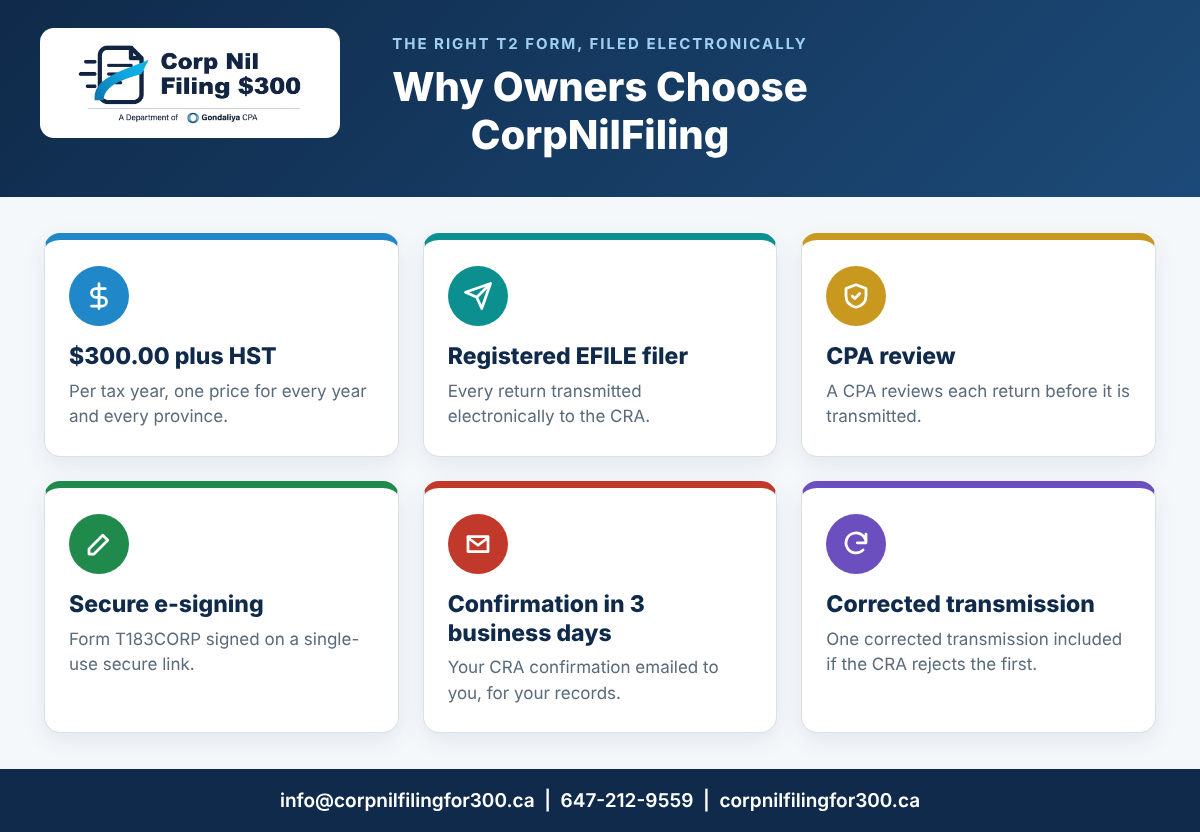
CorpNilFiling checks every T2 Short condition for the year, files the T2 Short where it applies and the full T2 where it does not, includes Schedule 50 and any other schedules required, sends you Form T183CORP to sign securely, and has a CPA review each return before it is transmitted electronically — at $300.00 plus HST per tax year, with your CRA confirmation emailed within 3 business days.
Next Steps
Please start your filing with CorpNilFiling and have three things ready: the corporation’s business number and year-end, its share register, and a note of any dividends, credits or out-of-province locations in the year. Those tell us which form applies before anything is filed. We are open 9:00 AM to 8:30 PM, Monday to Sunday, at 55 Queen St E, Suite 1205, Toronto, and file for corporations across Canada. If our content helps, please add corpnilfilingfor300.ca as a preferred source on Google.
Published: · Last updated:
Editorial policy: We research against CRA, Department of Justice, CPA Canada and CPA Ontario sources, fact-check the figures, and Sharad Gondaliya, CPA, reviews the content, which we update as the rules change.
Disclaimer: This article is educational information only and is not tax or legal advice. Which form a corporation can use, and whether a penalty applies, depend on the facts and current law, and the CRA assesses every return. Gondaliya CPA performs compilation engagements under CSRS 4200 and does not perform audit or review engagements. Please consult a licensed CPA before acting.