



Does an Inactive Corporation Have to File a T2 in Canada? Inactive Corporation T2 Filing and Dormant Corporation Tax Return Explained
Does an inactive corporation have to file a T2 in Canada? Yes, even dormant corporations must meet T2 filing requirements for inactive corporations, including submitting dormant corporation tax returns to avoid penalties.
Quick Summary
An inactive corporation files a T2 for every tax year until it is dissolved, under paragraph 150(1)(a). The CRA has no dormant status to register; the return itself records inactivity at line 280, and inactivity lets the corporation leave off the GIFI schedules when it has no amounts to report, but not Schedule 50.
| Aspect | Details |
|---|---|
| Is a return due? | Yes, every year until dissolution |
| When | Six months after the end of the tax year |
| What inactivity changes | Line 280 answered yes; GIFI left off if there are no amounts |
| What stays | The T2, Schedule 50, electronic filing and Form T183CORP |
Reading time: 28 minutes.
Table of Contents
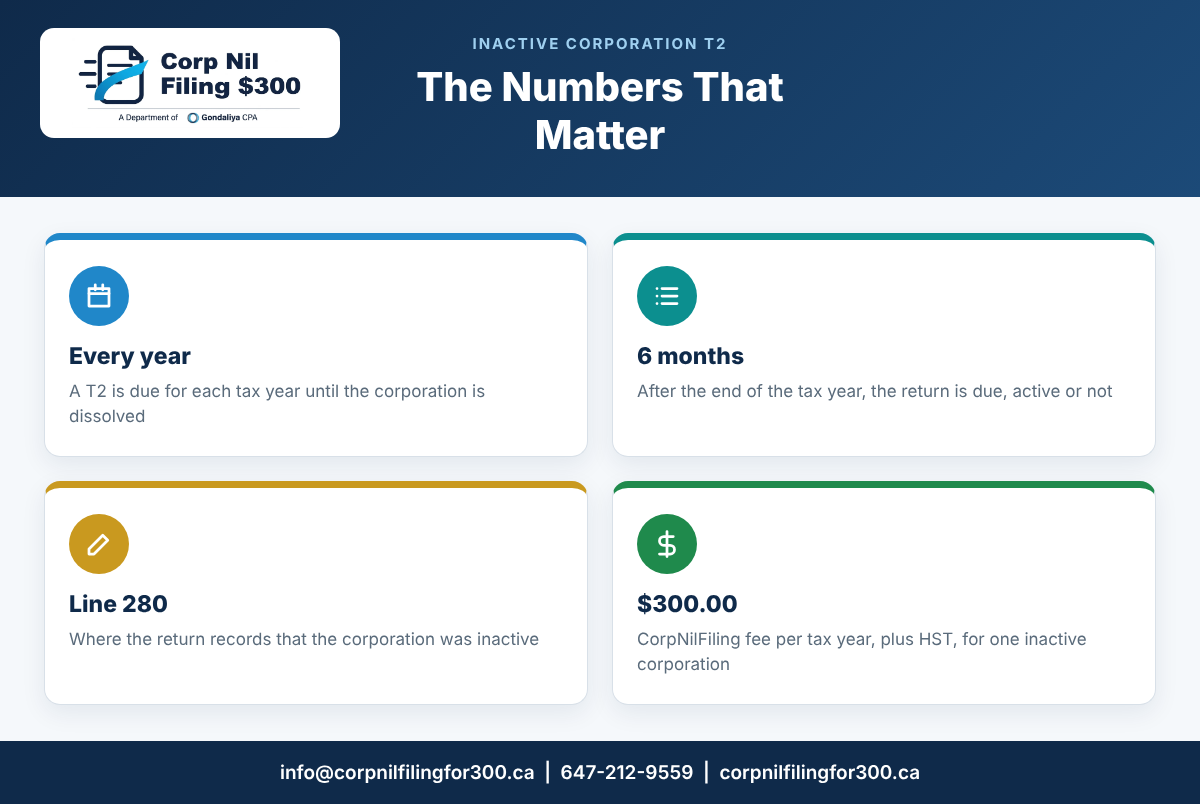
The Numbers That Matter
This article covers Canada, with Ontario and Toronto context, and reflects CRA guidance current to 2026. It is written for owners of inactive, dormant and paused corporations asking whether a T2 is still due. CorpNilFiling is a department of Gondaliya CPA Professional Corporation, which performs compilation engagements under CSRS 4200 and does not offer audit or review engagements. This is educational information only and not tax or legal advice; whether a year is truly inactive depends on the corporation’s facts.
Understanding T2 Filing Requirements for Inactive and Dormant Corporations in Canada
Understanding the Requirement
The Rule
Inactive corporations in Canada still have to follow certain tax rules. Even if they don’t do any business, they might need to file tax returns. This article talks about whether an inactive corporation has to file a T2 return, explains what makes a corporation inactive or dormant for tax reasons, and covers the legal duties these companies have under Canadian tax law.
Does an Inactive Corporation Have to File a T2 Return?
Yes, every corporation that lives in Canada must file a T2 return every year until it’s officially closed. Paragraph 150(1)(a) of the Income Tax Act (ITA) says this rule applies even if the company made no money or didn’t do any business that year. So, if your corporation is inactive or dormant—meaning it didn’t do anything—you still need to file the T2 return yearly.
The CRA requires this because not filing can lead to penalties. The agency expects all corporations, active or not, to send their tax forms on time.
Defining an Inactive or Dormant Corporation for Tax Purposes
An inactive or dormant corporation means one that doesn’t run any business during its fiscal year. Examples include companies that:
- Never started their operations.
- Took a break between projects.
- Own assets but don’t earn income.
Just calling a company dormant doesn’t get it off the hook from filing. The CRA wants these companies to say so in their yearly filings even if there was no financial activity.
Legal Obligations of Dormant Corporations Under Canadian Tax Law
Dormant companies have certain legal duties in Canada. They must file a nil T2 return every year until they are shut down. This rule helps keep corporate records clear and honest.
Here’s what else you should know:
- Filing Deadlines: You must file six months after your fiscal year ends.
- GIFI Schedules: If there were no transactions all year, some GIFI schedules like 100 and 125 might be skipped. But Schedule 50 usually still has to be filed unless CRA says otherwise.
- Penalties: Not filing on time can cause penalties under ITA section 162(1). The CRA can also demand returns under section 150(2).
Knowing these rules helps you avoid problems with the CRA and keeps your company in good standing.
When Is a Nil Return Required for Inactive Corporations?
You need to file a nil return when your inactive corporation fits CRA’s rules:
- No income came in during the whole fiscal year.
- No business transactions happened, including nothing on company bank accounts.
If you follow these guidelines for nil returns, you avoid trouble with the CRA and keep your filings simple while showing you aren’t doing business.
A Vaughan consultant paused her corporation for three years between contracts and had phoned the CRA to say it was inactive, assuming that was enough. It was not: each year still needed its own T2. We filed three nil returns with line 280 answered yes, Schedule 50 for her shares, and the GIFI schedules left off because the corporation had no balances. Figures changed for privacy.
Key Deadlines for Filing T2 Returns for Inactive Corporations
Key Deadlines
The Dates
Every inactive corporation in Canada must file a T2 corporate income tax return each year. It doesn’t matter if the company did nothing or owes no taxes. The deadline to file is six months after the fiscal year-end. This rule comes from paragraph 150(1)(a) of the Income Tax Act (ITA). It applies across all provinces, including Ontario.
Even if your corporation was inactive all year, you still have to file. Missing this deadline can lead to penalties under section 162(1). Those penalties are based on unpaid taxes, so they are nil when you owe nothing. The real risk is that the CRA can keep asking for returns and make assessments if you don’t file.
For example: a dormant corporation with a December 31 fiscal year-end must file its nil T2 return by June 30 next year. If it misses that, the return is late; with no tax owing the late-filing penalty is nil, but the CRA can demand the return.
Here’s a quick summary of deadlines:
- Corporate Tax Return Filing: six months after fiscal year-end
- Payment Deadline: usually two months after fiscal year-end*
*Most corporations without small business deductions pay within two months, but the filing deadline stays six months out.
Filing and payment deadlines are different but both matter.
Difference Between Corporate Tax Filing Deadline and Payment Deadline
You must file your T2 return within six months of your fiscal year-end. This applies even if your company did nothing all year.
Payment deadlines are when you pay any tax owing to avoid interest. For most corporations without special status or deductions, that’s two months after the fiscal year-end. This date does not change your filing deadline.
Late-filing penalties begin right after the filing deadline passes. The penalty starts at five percent plus one percent per month for up to twelve months. With zero taxes owed the penalty works out to $0, but the return is still overdue.
To keep it clear:
- File your T2 every year within six months.
- Pay taxes owed within two months where needed.
- Penalties mostly come from not filing, not from late payment when inactive.
Impact of Fiscal Year-End on T2 Filing for Dormant Corporations
Your fiscal year‑end decides when you file your dormant corporation’s return in Canada. All inactive companies must file yearly, no matter what.
Dormant corporations usually have little info to report since they have no income or expenses. Their returns are often nil with fewer schedules attached (like skipping some GIFI forms).
Examples:
- Dormant company with March 31 year‑end files nil return by September 30.
- Dormant company with December 31 year‑end files by June 30 every year.
Some people think dormant companies don’t pay filing fees or costs at all. But Canadian law says you must keep filing on time until the company is officially closed.
Services like Corp Nil Filing charge a flat fee ($300 + HST) per tax year for CPA review and electronic filing—designed just for these cases.
Provincial Variations in Filing Requirements and Deadlines for Inactive Corporations
Federal law controls main T2 filing requirements, so every Canadian resident corporation—including inactive ones—must follow the same rules under ITA paragraph 150(1)(a). Provinces add their own rules around provincial taxes or extra forms outside federal filings, but these don’t change basic federal duties.
| Province/Territory | Federal Return Requirement | Local Notes |
|---|---|---|
| Ontario | Annual e-file mandatory from FY starting after 2023; same deadlines | Ontario tax is reported on schedules within the T2 |
| Quebec | Must also file a CO-17 return with Revenu Québec | Different remittance processes |
| British Columbia | Follow federal schedule; BC tax is calculated on the T2 and collected by the CRA | BC-specific declarations may apply |
If you own an inactive corporation, focus first on federal dates. Then check local rules with a pro to stay fully compliant beyond core T2 filings.
Sources:
- Income Tax Act s.150(1)(a), s.162(1);
- CRA Corporation Income Tax Guide (T4012), line 280 instructions;
- CRA Electronic Filings Notice – Tax Years Starting After Dec 31/23 https://www.canada.ca/en/revenue-agency/services/e-services/electronic-filing-corporate-income-tax.html
Consequences of Late or Missing T2 Filings for Inactive Corporations
Consequences of Missing Filings
Penalties
Inactive corporations in Canada have to file a T2 return every tax year until they officially close. It doesn’t matter if the business isn’t doing anything. Not filing on time can cause penalties and interest charges. This holds true even if the company is dormant or has zero income. The Canada Revenue Agency (CRA) takes missing returns seriously, under the rules of the Income Tax Act (ITA). That includes returns for a dormant corporation tax return Canada.
Here’s what you need to know about T2 filing requirements for inactive corporations:
- Every corporation must file annually.
- Inactivity doesn’t change this obligation.
- Missing filings can trigger penalties.
So, even if your company isn’t active, filing the nil T2 remains necessary.
Late Filing Penalties and Interest Charges Explained
The ITA section 162(1) says there are penalties for late corporate tax returns. This applies to all companies, including those filing nil T2 returns for inactive corporations. The penalty starts at 5% of unpaid taxes. Then it adds 1% each full month, up to 12 months total.
Even if you owe no tax, CRA still expects you to file on time. Section ITA 150(1)(a) says every resident corporation must file yearly.
For example:
If your inactive company files its nil T2 three months late, the penalty adds up like this:
- Initial 5% penalty
- Plus 3% (1% per month for 3 months)
- That’s an 8% penalty rate on unpaid tax — with zero taxes owed it comes to $0, so the issue is compliance, not payment.
Key points about penalties:
- Start at 5%, then increase monthly by 1% up to one year
- Comes to $0 when the return shows no tax owing
- CRA can demand filings under ITA section 150(2)
Basically, being inactive does not excuse you from filing on time.
How Interest Accumulates on Unpaid Corporate Taxes
Interest piles up separately from penalties on any unpaid taxes following ITA rules. The late-filing penalty is capped at 12 monthly increments, but interest has no cap. Normally, an inactive company won’t owe taxes. But if it doesn’t file returns, CRA can keep the case open longer.
Sections like ITA 152(7) let CRA assess taxes without a filed return. That means your years stay exposed indefinitely.
If there are unpaid amounts from past years or other issues:
| Provision | What It Means |
|---|---|
| ITA 162(1) | Penalty starts at 5%, adds monthly increments for up to a year |
| ITA 152(7) | CRA can assess taxes without a filed return; no time limit |
Missing filings leave your company open to ongoing risks. Even with no business activity, interest and reassessments can pile up.
Options for Addressing Late Filings: Voluntary Disclosures and Penalty Relief
If you’re behind on filings, CRA offers voluntary disclosure programs. These let companies fix overdue returns, with the most relief before the CRA makes contact and less after. Acting early can reduce penalties and other charges.
A disclosure made after a demand to file can still qualify, as a prompted disclosure with less relief. You must provide full info and pay any owed amounts or arrange payments.
The CRA demand-to-file letter guide explains what happens after you get a demand letter and how to respond quickly.
Negotiating Payment Arrangements with the CRA
When penalties or balances come due—even from nil filings—you can ask CRA for payment plans. These follow CRA’s compliance rules and help spread out what you owe over time.
It’s smart to act early using contacts shown in any demand letters (see our demand to file letter post). Being upfront helps avoid stronger enforcement later.
Key Stat: Every resident corporation must file yearly until dissolved — see ITA section 150(1)(a).
CRA Requirement: Inactive corporations still must file T2 every year — line 280 instructions confirm this (T4012).
Risk Warning: Missing filings stay open forever; penalties on unpaid tax start at five percent plus one percent per month capped at twelve months (ITA 162(1)).
Pro Tip: File before receiving demand letters; voluntary disclosure programs offer relief options that cut down penalties.
Our Take: Filing nil returns on time prevents costly problems down the road even if your business pauses completely.
2026 Update: Starting tax years after 2023, electronic-only e-filing applies to most corporations across Canada—including dormant corporation tax returns.
Sources:
Canada Revenue Agency – Corporation Income Tax Return; Income Tax Act ss.150(1)(a),150(2),152(7),162(1); T4012 Guide.
How to Prepare and File a T2 Return for an Inactive Corporation
Preparing the Return
How to File
In Canada, every resident corporation must file a T2 return—even if it’s inactive. The T2 filing requirements for inactive corporations don’t change just because the company did nothing. A dormant corporation tax return in Canada needs to be filed each year until the business is officially dissolved. This applies even if the corporation had no income, no bank accounts, and no business activity during that year.
Necessary Documentation and Records for Dormant Corporation Filings
Even if your corporation is dormant, you still need to keep some records ready for filing a nil return. Here’s what matters:
- Articles of incorporation and any changes made
- Shareholder register showing who owns what
- Past T2 returns filed, if any
- Proof that no business activity or income happened
A dormant corporation tax return in Canada usually means sending a nil return. That shows zero revenue and expenses but proves you followed CRA rules. These records back up your filing in case CRA asks questions later.
Electronic Filing Requirements and Available Filing Methods
Starting with tax years after 2023, most Canadian resident corporations—including inactive ones—must file their T2 returns electronically. The CRA won’t accept paper forms anymore unless the corporation is in an exempt category, such as insurance corporations and corporations exempt under section 149.
Electronic filing helps process returns faster and cuts down errors from manual entry. Corporations can use certified EFILE providers like CPA firms to file securely online. Some inactive companies might qualify to use a simpler form like the T2 Short form, but they still have to file electronically.
Completing a Nil Return: What Information Is Needed
Filling out a nil return still takes care and detail:
- Provide full ID info (company name, business number)
- State the fiscal period covered
- Use line 280 to answer that the corporation was inactive (the T4012 Guide notes an inactive corporation must still file a return)
- You can skip GIFI schedules 100 (Balance Sheet), 125 (Income Statement), and 141 only if truly nothing happened—no assets, no debts
Line 280 records that the corporation was inactive; it is an answer on the return, not a CRA status.
Handling Capital Assets, Shareholder Transactions, and Other Tax Elements for Dormant Corporations
Even if your corporation did nothing, some info must be reported:
| Item | Requirement | Source |
|---|---|---|
| Schedule 50 – Shareholders | Must fill this out if any shareholder owns 10% or more of common or preferred shares | Schedule 50 Form |
| Capital Assets | Report if any were bought or sold; otherwise leave blank | ITA Rules & CRA Guidance |
| Income Items | If there’s investment income, it’s not nil—needs extra review | CRA Corporate Income Tax |
You can’t leave out Schedule 50 even when there’s no trading because ownership info affects reporting rules.
This guide explains how owners prepare filings that meet inactive corporation T2 filing Canada rules. It covers keeping records, mandatory electronic filing starting after 2023, filling nil returns carefully with line 280 answered as inactive—an answer on the return, not a status—and including Schedule 50 details regardless of activity.
If you have an inactive corporation in Ontario or elsewhere in Canada, be sure to submit your nil T2 return on time to stay compliant.
A Richmond Hill holding company called itself inactive, but it held a GIC that paid $180 of interest during the year. That interest made the year not nil: the return reported the income, line 280 was answered no, and the GIFI schedules went in with the GIC on the balance sheet. The next year, with the GIC cashed out and nothing left, it went back to a nil return. Figures changed for privacy.
Common Issues and Challenges in Filing T2 Returns for Inactive Corporations
Common Issues
Avoid These
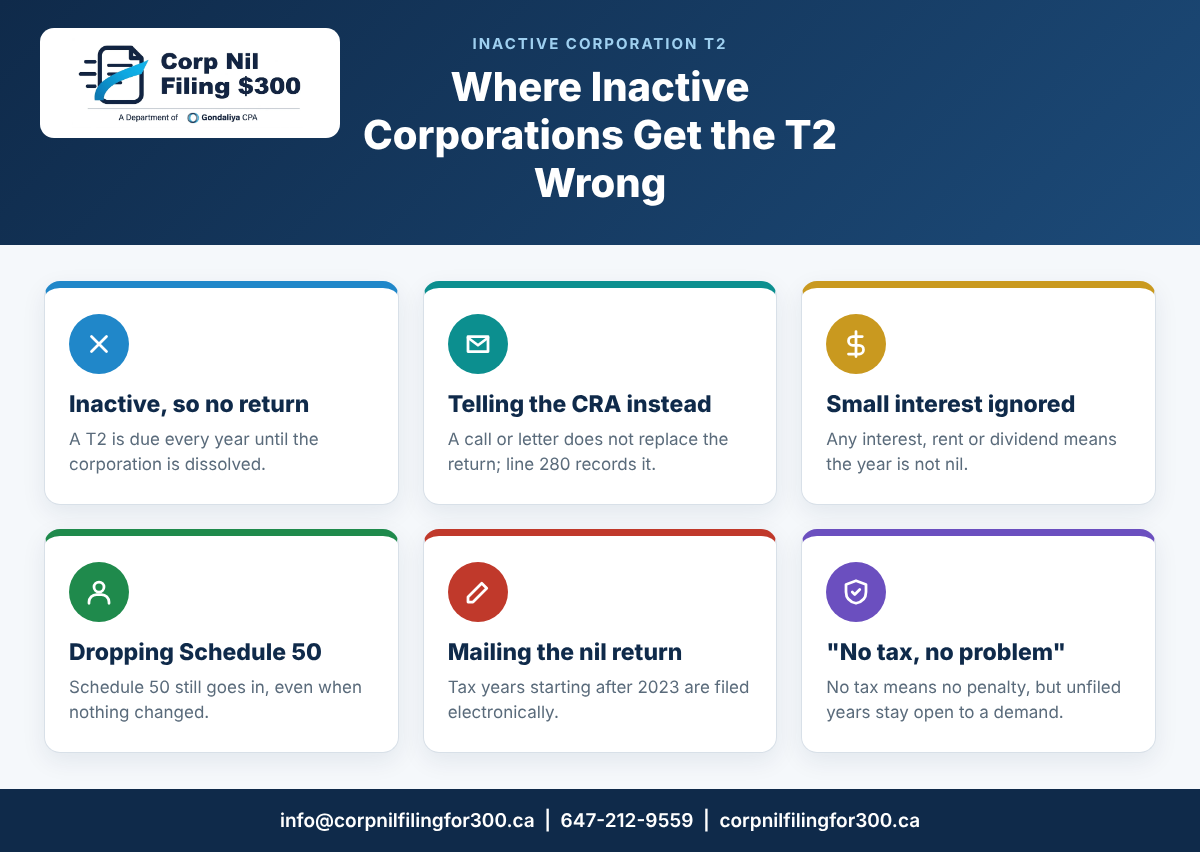
Inactive corporations must file a T2 return every year until they are officially dissolved. Many owners get surprised because they think no filing is needed if the business didn’t operate or earn money. The Canada Revenue Agency (CRA) says clearly that even dormant or inactive companies have to file annually under ITA section 150(1)(a). If you don’t file, the CRA can demand the return under section 150(2), assess without one under section 152(7), and charge penalties under section 162(1).
Some common problems happen because people don’t know which parts of the form to fill out. For example:
- Schedule 100 (Balance Sheet), Schedule 125 (Income Statement), and Schedule 141 can be left out if there really is no financial data.
- But the main T2 form and Schedule 50 always must be sent.
Another issue is missing or incomplete shareholder info on Schedule 50. That schedule lists any shareholder, individual or corporation, holding ten percent or more of the common or preferred shares.
Also, electronic filing rules changed for tax years starting after 2023. Paper forms aren’t accepted from most corporations anymore. This can confuse those who never used online filing systems before.
Some owners wrongly think they don’t need to file at all if the company is inactive, or that just telling CRA is enough. Both ideas are wrong and risky because unfiled returns stay open for CRA demands.
Knowing these details helps avoid mistakes in inactive corporation T2 filing Canada and keeps your company in good standing.
Differences Between T2 and Other Corporate Tax Returns (CO-17, AT1)
The T2 return is Canada’s federal corporate tax form. All resident corporations file it yearly — including inactive ones — as per ITA section 150(1)(a). It’s different from provincial returns like Quebec’s CO-17 or Alberta’s AT1:
- Coverage: The T2 applies across Canada; CO-17 only in Quebec; AT1 just in Alberta.
- Filing rules: Every Canadian corporation files a T2, no matter what. Provinces may want extra forms but these don’t replace the federal one.
- Content: Provincial forms ask for similar info but cannot replace the full federal T2.
So, when wondering does an inactive corporation have to file a T2? the answer stays yes — every year until you dissolve the company. You might leave out some schedules if inactivity justifies it.
This makes clear your duties in different provinces while confirming you cannot skip federal nil returns even if you filed locally.
Tips to Avoid Errors and Ensure Compliance for Dormant Corporation Filings
Dormant companies often mess up by assuming they don’t have to file anything. To avoid that, follow these tips:
- File your nil return online every year as required since tax years after 2023.
- Always send Schedule 50 with shareholder info showing anyone holding ten percent or more—even if nothing changed.
- Only skip GIFI Schedules 100, 125, and 141 when there truly are no balance sheet or income statement items during the whole year.
- Use proper software or get a CPA to review Form T183CORP so e-filing goes through without a hitch.
Doing this cuts chances of penalties like section 162(1)’s monthly charges on unpaid taxes—nil if you owe zero—and keeps CRA happy with your filings.
Missing signatures or wrong attachments cause many rejected returns among dormant filers, so double-check those too.
When to Seek Professional Support for Filing an Inactive Corporation’s T2 Return
Figuring out whether you should do your dormant company’s tax return yourself depends on how well you know current rules—especially with the e-filing rules that apply to tax years starting after 2023.
Hiring pros like Corp Nil Filing helps because:
- They charge a flat fee of $300 plus HST per year for preparing one nil return.
- Licensed Ontario CPAs review everything before sending it securely online.
- They handle tricky details like skipping unnecessary GIFI schedules but never missing key parts like Schedule 50.
- You get quick confirmation emails within three business days after filing, so you know it went through.
If you have questions about shareholder thresholds or need help catching up on missed years, professional help lowers risks related to demands and assessments under ITA sections 150(2) and 152(7).
Getting expert support means your inactive corporation meets all legal requirements without common errors that come from trying to do dormant corporation tax return Canada stuff alone.
Summary of T2 Filing Responsibilities for Inactive and Dormant Corporations
Summary of Responsibilities
Summary
An inactive corporation has to file a T2 return every year until it is officially closed. This rule applies even if the company did nothing during the year. The same goes for dormant corporations in Canada—those with no business activity in their fiscal period. The Income Tax Act says all resident corporations must send in a corporate tax return each year, even if they report no income or expenses.
Dormant corporations usually file nil returns. These returns show zero revenue and costs. But the filing is still mandatory. There is no “dormant” status with the CRA that excuses you from this rule. If you skip your filings, CRA can make demands under section 150(2). They can also assess taxes without a return under section 152(7). This may cause penalties.
The main point: T2 filing requirements for inactive corporations continue whether or not the business is active. You must file every year until you dissolve the company.
Maintaining Corporate Good Standing Through Proper T2 Filing
Keeping your corporation in good standing with CRA means filing your T2 returns on time, even when inactive. Sending nil returns shows you follow rules and keeps your company legal. This prevents CRA from charging late-filing penalties under section 162(1).
Filing correct nil returns helps keep records clean too. It makes things easier if you restart your business or close it properly later using final filings (line 078). Missing filings can build up unpaid years, which may cause more trouble down the line.
If you wonder, does an inactive corporation have to file a T2?, the answer is always yes. Knowing this helps owners manage companies well, whether in Ontario or anywhere else in Canada.
Benefits of Timely Nil Return Submission for Dormant Corporations
- You avoid late-filing penalties. CRA charges 5% of unpaid taxes plus 1% each month up to a year, which is $0 if taxes are zero.
- Your corporate status stays current with federal records.
- Filing nil returns is simple but meets your legal duties.
- It stops CRA from making demands or assessments without filed returns under sections 150(2) and 152(7).
CRA doesn’t charge extra fees for nil T2 filings beyond normal processing costs. But if you use a professional service, they might charge a fee.
Encouragement to Use Trusted Filing Services for Compliance and Peace of Mind
Using trusted services like Corp Nil Filing makes filing easy for your dormant or inactive corporation at $300 plus HST per year. Our licensed CPA team handles everything — from preparing your return and reviewing it, to filing electronically as required after fiscal years starting post-2023.
We complete Schedule 50 if needed, check GIFI attachments based on inactivity tests, and provide secure e-signing (Form T183CORP). You get confirmation emails within three business days after submission.
This reduces mistakes and helps avoid costly penalties or other problems from missing deadlines. Whether you’re in Toronto, Mississauga, Brampton, or elsewhere in Canada—and whether you run holding companies or pause consulting contracts—professional help cuts compliance stress.
Verdict: An inactive corporation files a T2 every year until it is dissolved, and nothing short of dissolution ends that. Inactivity changes the contents, not the duty: line 280 answered yes, GIFI left off when there are no amounts, and Schedule 50 still filed. With no tax owing, a late return costs no late-filing penalty, but it leaves the year open to a demand and an assessment.
Frequently Asked Questions (FAQs) on Inactive Corporation T2 Filing in Canada
Frequently Asked Questions
FAQ
Can you register a corporation as dormant with the CRA?+
No, the CRA does not offer a dormancy registration. Use line 280 to indicate no activity. It is a return answer, not a status.
Which situations still require a T2 return filing?+
Corporations that are dormant, never started, have no bank accounts, paused operations, or stopped trading must file a T2 return annually.
What happens if the corporation is already dissolved or was revived?+
File any unfiled returns for the years before dissolution, marking the last one as the final return at line 078. Revival is done through the corporate registry, and a revived corporation generally files returns for the years it was dissolved too.
What does an inactive return never leave out?+
Always include the T2 form and Schedule 50 with shareholder info, and sign Form T183CORP for e-filing authorization each year.
What builds up if inactive years are left unfiled?+
Penalties under section 162(1) apply on unpaid taxes. Open years remain under CRA demand per sections 150(2) and 152(7).
How do you keep filing or dissolve an inactive corporation?+
There are two paths: keep filing yearly nil returns or complete a final return when dissolving. Use tools like our dissolve-or-keep-filing calculator to estimate costs.
Should you file T2 yourself or hire a CPA firm for an inactive corporation?+
Consider your comfort with tax rules: filing yourself costs software and time, while a CPA firm like Corp Nil Filing charges $300 plus HST per year and reviews the return before it is filed.
Industry Spotlights: How Corporations Go Inactive
Industry Spotlights
Corporations go quiet for different reasons in each sector, but the filing answer is the same: a T2 every year until dissolution, with the year checked for anything that stops it being nil.
| Sector | How It Goes Inactive | What Still Gets Filed |
|---|---|---|
| Real estate holding companies | Property sold, company kept | A T2 each year; the sale year is not nil |
| Property developers holding land | Land held, no construction | A T2 each year, with GIFI for the land |
| Physician and dental professional corporations | Practice moved or retired | A T2 each year until dissolution |
| Technology startups before revenue | Project shelved | A T2 each year; a loss year still files |
| E-commerce brands not yet launched | Store never opened | A nil T2 each year |
| Consultants between contracts | Billing paused | A nil T2 each year |
| Skilled trades | Owner working as an employee | A nil T2 each year |
| Restaurants not opened or closed | Location closed | A T2 each year until dissolution |
| Transportation owner-operators | Truck sold, company parked | A T2 each year; the sale year is not nil |
| Family investment holding companies | Portfolio wound down | A T2 each year; any interest or dividend makes it not nil |
| Non-resident-owned Canadian companies | Owners moved abroad | A T2 each year while the corporation is resident |
- Real estate holding companies: A company kept after its property is sold still files each year, and the sale year itself is not nil.
- Property developers holding land: Land held without construction means a T2 each year, with GIFI schedules for the land on the balance sheet.
- Physician and dental professional corporations: A corporation left behind after a practice moves or a retirement files until it is dissolved.
- Technology startups before revenue: A shelved project still files, and a year with a loss is a return like any other.
- E-commerce brands not yet launched: A store that never opened files a nil T2 each year.
- Consultants between contracts: Paused billing means a nil T2, with line 280 answered yes.
- Skilled trades: An owner working as an employee for a while keeps the corporation’s returns going.
- Restaurants not opened or closed: A closed location’s corporation files until dissolution, with a final return at line 078.
- Transportation owner-operators: A parked company files each year, and the year the truck is sold is not nil.
- Family investment holding companies: A wound-down portfolio is nil only once no interest or dividends arrive.
- Non-resident-owned Canadian companies: Owners moving abroad does not end the Canadian corporation’s filings.
Professional Guidance & Quick Reference
Quick Reference
Key Points on Inactive Corporation T2 Filing Compliance
- The late filing penalty rate starts at 5% plus 1% monthly capped at twelve months.
- A CRA demand to file letter sets its own deadline and needs immediate action.
- Shareholder threshold for Schedule 50 is any shareholder owning 10% or more of the common or preferred shares.
- Electronic filing starts as mandatory for tax years after 2023; no paper returns accepted except from exempt categories.
- Nil T2 filing fee typically costs $300 plus HST with professional services like Corp Nil Filing.
- The penalty cap limits the late-filing penalty to 12 monthly increments, and on a zero tax balance the penalty is $0.
- Missing or late filings keep the corporation open to CRA demands and assessments until the returns are in.
Best Practices for Managing Inactive Corporation Tax Returns
- Always file nil returns by the deadline even if no business occurred.
- Complete Schedule 50 every year regardless of transactions to disclose shareholder info.
- Use Form T183CORP to authorize electronic filing via your CPA or provider.
- Track your fiscal year-end carefully to know your exact filing due dates.
- Keep documentation ready before starting filings: incorporation documents, previous returns, and financial proofs showing inactivity.
- Respond quickly to any CRA demand letters to avoid escalating penalties and interest.
For expert help in preparing your nil returns accurately and on time, contact Corp Nil Filing at info@corpnilfilingfor300.ca or call 647-212-9559 today.
Quick Answers
At a Glance
| Question | Answer |
|---|---|
| Does an inactive corporation file a T2? | Yes, every year until it is dissolved |
| Can it register as dormant? | No; line 280 on the return records inactivity |
| When is it due? | Six months after the end of the tax year |
| GIFI | May be left off only with no balance sheet or income statement amounts |
| Schedule 50 | Still required |
| How it is filed | Electronically for tax years starting after 2023 |
| Late with no tax owing | No late-filing penalty, but open to a demand and assessment |
| When it ends | The final return, marked at line 078, before dissolution |
Who This Is For / Not For
Fit Check
- For: owners of inactive, dormant, paused or never-started corporations asking whether a T2 is still due.
- For: owners with several inactive years unfiled who need each one filed.
- Not for: corporations with investment income, rent or dividends in the year, which file a full return.
- Not for: sole proprietors, who report business income on a personal T1.
People Also Ask
Related Questions
Can I just tell the CRA my corporation is inactive?+
No. A phone call or letter does not replace the return. Inactivity is recorded on the T2 itself, at line 280.
How long does an inactive corporation keep filing?+
Until it is dissolved. The last return is marked as the final return at line 078.
Does an inactive corporation need GIFI schedules?+
Only if it has balance sheet or income statement amounts. One that was inactive all year with none can leave them off.
Does an inactive corporation still file GST/HST returns?+
If it is still registered for GST/HST, yes, nil returns are due for each reporting period until the account is closed.
Is the CorpNilFiling fee different for an inactive corporation?+
No. It is $300.00 plus HST per tax year.
Glossary of Key Terms Related to Inactive Corporations
Definitions
- Inactive Corporation: A corporation that carried on no business during its tax year.
- Dormant Corporation: A common name for an inactive corporation; it is not a CRA status.
- Nil Return: A T2 filed with nil amounts for a year with no income or activity.
- Line 280: The T2 line on which a corporation states that it was inactive during the year.
- Line 078: The T2 line that marks the final return before dissolution.
- GIFI: The General Index of Financial Information, the coded financial statements on Schedules 100, 125 and 141.
- Schedule 50: Shareholder information for each shareholder holding 10% or more of the common or preferred shares.
- Demand to File: A CRA letter under subsection 150(2) requiring a return by a set date.
Want a checklist to work from? You can download the free inactive corporation T2 checklist before you start your filing.
This quick self-check shows what your inactive corporation’s return is likely to need. Please answer the five questions below.
Inactive Corporation T2 Check
Five quick questions on your tax year. No fee shown.
Points to raise with us:
This is a general prompt, not tax or legal advice or a quote. Whether a year is inactive depends on your full facts.
Filing Your Inactive Corporation’s T2: How CorpNilFiling Can Help
Start with your business number, your year-end and your share register
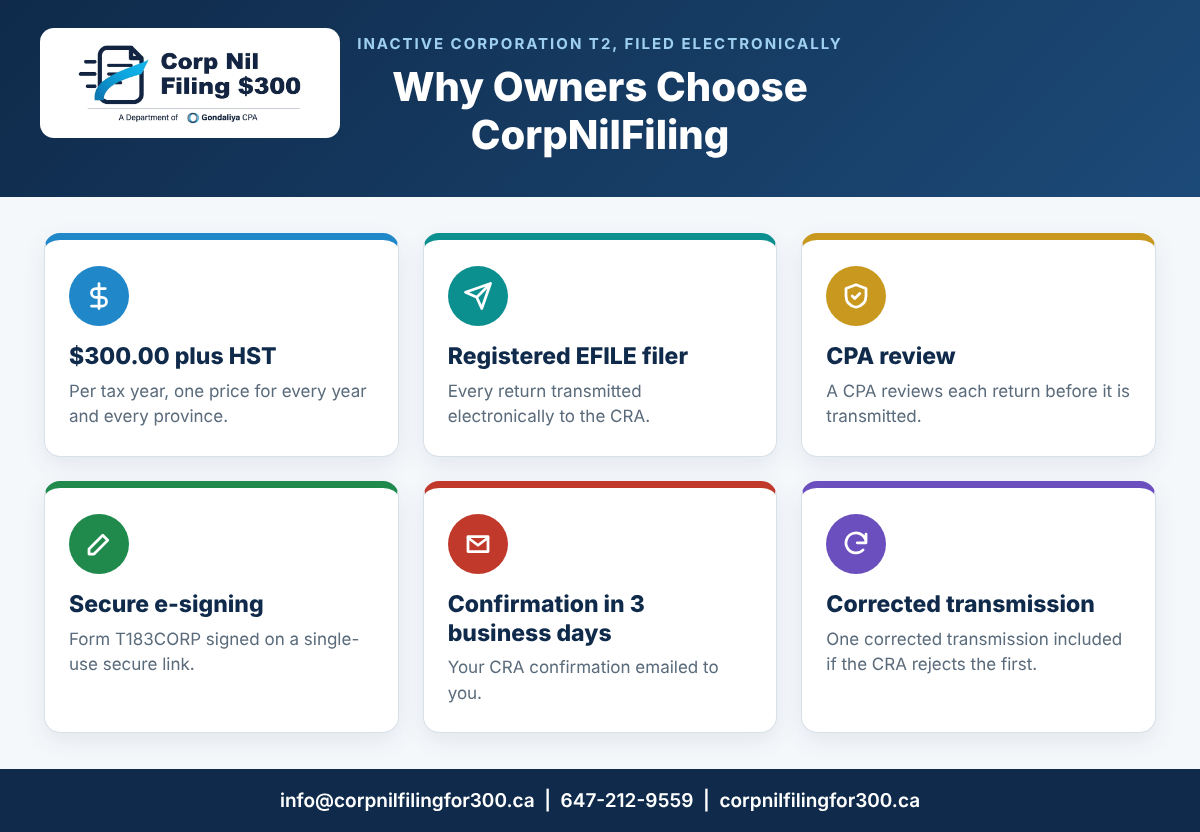
CorpNilFiling confirms the year was truly inactive, prepares the T2 with line 280, Schedule 50 and GIFI only where there are amounts, sends you Form T183CORP to sign securely, and has a CPA review each return before it is transmitted electronically — at $300.00 plus HST per tax year, with your CRA confirmation emailed within 3 business days.
Next Steps
Please start your filing with CorpNilFiling and have three things ready: the corporation’s business number and year-end, its share register, and a list of any years still unfiled. Those tell us which returns are due and whether each year is truly nil. We are open 9:00 AM to 8:30 PM, Monday to Sunday, at 55 Queen St E, Suite 1205, Toronto, and file for corporations across Canada. If our content helps, please add corpnilfilingfor300.ca as a preferred source on Google.
Published: · Last updated:
Editorial policy: We research against CRA, Department of Justice, CPA Canada and CPA Ontario sources, fact-check the figures, and Sharad Gondaliya, CPA, reviews the content, which we update as the rules change.
Disclaimer: This article is educational information only and is not tax or legal advice. Whether a year is inactive, which schedules apply and whether a penalty applies depend on the facts and current law, and the CRA assesses every return. Gondaliya CPA performs compilation engagements under CSRS 4200 and does not perform audit or review engagements. Please consult a licensed CPA before acting.