


Corporate tax filing deadline Canada: Complete guide to nil T2 filing deadline by Corp Nil Filing for $300
TLDR: The corporate tax filing deadline Canada includes clear timelines for the nil T2 filing deadline, which Corp Nil Filing for $300 helps you meet efficiently. Knowing the nil corporate tax return deadline Canada and T2 filing deadline after fiscal year-end keeps your business in good standing with tax authorities.
Quick Summary
A T2 return, nil or not, is due six months after the end of the corporation’s tax year under paragraph 150(1)(a). A year ending on the last day of a month is due on the last day of the sixth month; any other year-end is due on the same day of the sixth month. A due date on a weekend or CRA-recognized holiday moves to the next business day. Payment runs on a separate, earlier clock: the balance-due day, two or three months after year-end.
- Count six months from your own year-end, not from December 31.
- No tax owing does not move the filing date.
- The balance-due day is a payment date, not a filing date.
- A CRA demand to file sets its own date for the year it names.
Reading time: 29 minutes.
Table of Contents
The Numbers That Matter
This article covers Canada, with Ontario and Toronto context, and reflects CRA guidance current to 2026. It is written for owners of inactive, dormant, holding and new corporations working out when their nil T2 is due. CorpNilFiling is a department of Gondaliya CPA Professional Corporation, which performs compilation engagements under CSRS 4200 and does not offer audit or review engagements. This is educational information only and not tax or legal advice; due dates depend on each corporation’s own tax year, and the CRA decides whether a return was filed on time.
Understanding Corporate Tax Filing Deadlines in Canada
Understanding the Deadlines
The Date
Corporate tax filing deadline and payment deadline explained
The corporate tax filing deadline is when a company must send in its T2 return. The payment deadline is when the tax owed needs to be paid. In Canada, the T2 filing deadline after fiscal year-end usually comes six months after your corporation’s fiscal period ends. The balance-due day for payment is often two or three months after year-end. This depends on whether the corporation is a Canadian-controlled private corporation (CCPC).
Knowing these deadlines matters because missing the filing deadline can cause penalties and missing the payment deadline brings interest. For example, late filings may bring penalties under subsection 162(1) of the Income Tax Act.
Defining the fiscal year-end for corporations
What is a fiscal year-end?
A fiscal year-end marks the end of a company’s financial period. It may not follow the calendar year. A tax year can last up to 53 weeks, with no CRA approval needed. A new corporation picks its own first fiscal year-end, so its first tax year can be shorter than 12 months.
How to determine your corporation’s fiscal year-end
You choose your fiscal year-end based on your business needs and industry norms. Changing this date later needs CRA approval, following rules in section 249.1(7). Your tax deadlines depend on this chosen date.
Differences between nil T2 filing deadline and regular corporate tax return deadlines
What qualifies as a nil T2 return?
A nil T2 return means your corporation made no income in that tax period and owes no taxes. Still, you must file it by its nil T2 return due date, which follows the six-month rule like all other returns.
When to file a nil T2 versus a regular return
If your company did nothing during the period, you must file a nil return anyway. This holds true even if you receive a demand to file letter from CRA asking for compliance.
Impact of fiscal year-end on T2 filing deadline after year-end
Calculating your filing deadline based on fiscal year-end
Start counting from your fiscal period’s end-date and add six months. If that date falls on a weekend or holiday, CRA pushes it to the next business day.
For example:
- Fiscal year ending March 31 means filing due September 30.
- If September 30 lands on Saturday or Sunday, the deadline moves to the following Monday (October 2 or October 1).
This system helps keep track of deadlines properly.
Timeline examples
Here are some examples showing how weekends or holidays shift deadlines:
| Fiscal Year-End | Original Due Date | Adjusted Due Date |
|---|---|---|
| April 30, 2026 | October 31, 2026 (Saturday) | November 2, 2026 |
| August 31, 2026 | February 28, 2027 (Sunday) | March 1, 2027 |
| November 15, 2026 | May 15, 2027 (Saturday) | May 17, 2027 |
These shifts show why knowing holiday schedules matters when planning your submissions.
Grasping these basics about corporate tax deadlines in Canada helps avoid trouble later on and keeps your filings smooth and timely.
A Mississauga holding company with an April 30 year-end had nothing to report, and the owner planned to file “by October 31”. That date fell on a Saturday, so the return was transmitted on Monday, November 2, and was on time. We noted the next year’s date the same day, so the following return was not left to the last weekend. Figures changed for privacy.
Filing Requirements and Eligibility for Nil T2 Returns
Filing Requirements
Who Files
In Canada, all corporations must file a T2 corporate income tax return every year. This applies whether or not the company made money or owes taxes. The nil T2 filing deadline means you have to send in your return within six months after your fiscal year ends. You can’t skip it just because there’s no tax to pay. This rule is nationwide, including places like Ontario, and it follows the Income Tax Act and CRA rules.
Who Must File a Corporation Income Tax Return in Canada
If your corporation lives in Canada, you must file a T2 return every year. This includes active businesses, dormant companies, or holding corporations—even if you didn’t make money or spend any. The nil corporate tax return deadline Canada sets means all these companies must file on time to avoid penalties.
Non-resident corporations that do business here also have to file returns. Their rules might be a bit different because of where they live or treaties with other countries. Still, the corporate tax filing deadline Canada usually stays at six months after the fiscal year ends unless the CRA says otherwise.
Conditions for Filing a Nil T2 Return
You file a nil T2 return when your corporation has no income, expenses, credits, or taxes to report. But even if everything is zero, the law still requires you to file. Under paragraph 150(1)(a), every corporation must send in its return within six months of the fiscal year-end.
The nil T2 filing deadline doesn’t change just because you owe nothing. It stays fixed by law but may move if it falls on a weekend or holiday per CRA rules (see T4012). You can’t mix up payment deadlines with filing deadlines or delay filing because you think there won’t be penalties.
Special Cases: Resident vs Non-Resident Corporations
Resident corporations follow normal deadlines set by paragraph 150(1)(a). But non-resident corporations working through Canadian permanent establishments may have special rules based on treaties and withholding taxes.
If the CRA sends you a demand to file letter under subsection 150(2), that creates a new deadline separate from the usual six months. This demand overrides regular timelines and needs quick attention. Ignoring it can cause bigger problems with enforcement.
Rental Income, Treaty Exemptions, and Withholding Tax Considerations
If your corporation earns rental income, you must include it on your return—even if the business is mostly inactive otherwise. Treaty exemptions may change how much tax you pay but don’t excuse you from filing correctly.
Withholding taxes work separately but still affect how you handle your filings when cross-border payments happen. These rules show why even minimal activity needs a timely return filed for each fiscal period, and a year with rental income is not nil.
Eligibility for T2 Short Return and Related Forms
Corporations with short first-year periods—tax years can last up to 53 weeks under Income Tax Act section 249.1(1)—file on the same forms as any other year, including the T2 Short Return if they qualify.
This makes filing easier while still following federal rules for periods shorter than 12 months. Short years happen when companies start mid-year or change their fiscal year-end under section 249.1(7). Even then, companies must stick to their six-month deadline counting from their adjusted year-end.
Sources:
- Canada Revenue Agency – When To File Your Corporation Income Tax Return
- Income Tax Act RSC 1985 c 1 (5th Supp) ss 150(1)(a),150(2),249.1
How to File Your Corporate Tax Return
How to File
E-Filing
You must file your corporate tax return by the nil T2 filing deadline, even if your corporation has no taxable income. In Canada, the corporate tax filing deadline Canada sets the due date at six months after your fiscal year ends. Filing on time helps you avoid penalties and keeps you in good standing with the CRA.
Mandatory electronic filing and available options
For tax years starting after 2023, the CRA requires most corporations to file T2 returns electronically. These CRA Regulations make electronic filing mandatory unless you meet specific exceptions.
You can submit electronically by:
- Using certified tax preparation software
- Hiring authorized service providers registered as EFILE filers
Paper or fax filings aren’t accepted except from the categories the CRA exempts: insurance corporations, non-resident corporations, corporations reporting in a functional currency and corporations exempt from tax under section 149.
Using certified tax preparation software and CRA services
You need certified software approved by the CRA for EFILE transmission of your T2 return. Registered EFILE filers, like CPA Ontario Registered Firm members, help ensure your return meets all rules.
Working with a CPA Ontario Registered Firm adds a layer of review before submission. This reduces mistakes, especially when you file a nil corporate tax return close to deadlines. Once filed electronically, the CRA sends a confirmation receipt. Keep this receipt as proof you filed on time.
T2 Auto-fill service and Corporation Internet Filing overview
The Corporation Internet Filing system lets eligible corporations submit their T2 returns online through secure CRA portals.
It links with the T2 Auto-fill service to pre-fill parts of your return using info already on file at the CRA. This saves time and improves accuracy.
Still, check all data carefully before submitting. Errors could cause delays or requests for more info later on.
Filing without a web access code
A corporation filing its own T2 through Corporation Internet Filing uses a web access code, which it can request from the CRA online. But sometimes getting this code isn’t possible right away.
In those cases, authorized representatives can file using certified software and their EFILE number and password. Both methods meet the mandatory e-file rule for tax years starting after 2023.
Where to file paper returns if electronic filing is not possible
Paper or fax returns are no longer accepted in normal situations for tax years starting after 2023. Exceptions exist only for the categories the CRA exempts, such as non-resident and insurance corporations.
If your corporation is in one of those categories, mail the paper return to the tax centre the CRA lists for your corporation’s location.
Don’t send a paper return if your corporation must e-file—it draws the $1,000 penalty under subsection 162(7.2) even if you owe no taxes.
Incorporating NAICS codes and other essential information
You must include accurate NAICS codes on your nil corporate tax return. These codes classify your business sector consistently across government data systems.
Besides NAICS codes, provide correct corporation ID numbers, exact fiscal period dates matching your records, and any required schedules—even if reporting zero activity. This info helps the CRA process your return smoothly and on time.
Payment Deadlines and Instalment Requirements
Payment Deadlines
Paying
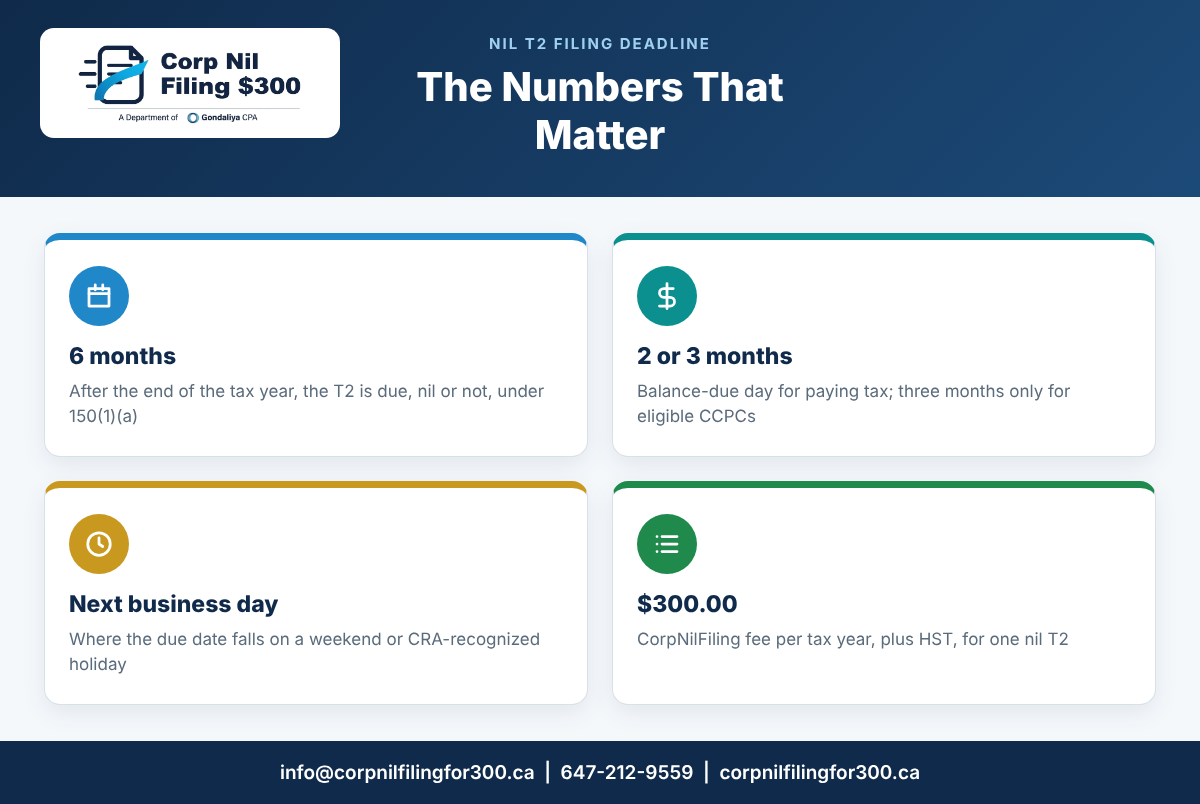
Corporations in Canada need to know the difference between filing deadlines and payment deadlines for corporate income tax. The nil T2 filing deadline means you must submit your return within six months after your fiscal year-end, even if you owe no tax. But the balance-due day is a separate deadline. It’s when you have to pay any taxes owing. This split helps keep things clear: one date to file, another to pay.
When and How to Pay Corporate Income Tax
The balance-due day is the legal deadline for paying your corporate income tax. If you miss it, you’ll owe interest charges. Most corporations must pay within two months after their fiscal year ends (Income Tax Act 157(1)(b)). However, Canadian-controlled private corporations (CCPCs) that meet certain rules get three months instead.
Remember, the nil T2 filing deadline requires submitting your return within six months after year-end. But this doesn’t change when you have to pay taxes. If you owe nothing, filing a nil return on time satisfies your requirement without any payment.
You can pay electronically through CRA’s My Business Account or at financial institutions authorized by CRA. Just make sure it’s before or on the balance-due day. Miss that, and interest starts adding up daily from the day after the due date until you pay in full.
Instalment Due Dates and Balance-Due Day Explained
Corporations whose tax payable is more than $3,000 in the current or previous year generally make monthly instalment payments, or quarterly payments if they are eligible small CCPCs (CRA – Corporation Instalments). These instalments are different from both the nil T2 filing deadline and final balance-due day but help reduce what’s owed at year-end.
Your final balance-due day stays fixed relative to your fiscal year-end—usually two months later, or three for qualifying CCPCs—even if you made instalments during the year. If you don’t pay enough in instalments, expect extra interest penalties separate from late-filing ones.
For instance: a corporation with an August 31 fiscal year-end has its nil T2 filing deadline on February 28 but must pay taxes by October 31 (balance-due day) unless it qualifies as a CCPC with extended terms.
Extended Payment Deadlines and Qualifying Conditions
Some corporations get extra time beyond two months after their fiscal year ends for paying taxes. This applies under certain rules in Income Tax Act section 157(1)(b). Mainly, CCPCs claiming small business deductions who meet taxable income limits get three months instead of two.
Note this extension only applies to payment deadlines—not your nil T2 filing deadline or other reporting rules set by CRA. Filing deadlines remain strict: returns must be filed within six months no matter what.
Check eligibility every year since qualification depends on the small business deduction claim and the previous year’s taxable income, according to CRA guidelines.
Impact of Late Payments on Penalties and Interest Charges
Paying late doesn’t cause late-filing penalties directly but triggers daily compounded interest starting right after your corporation’s balance-due day until full payment is made (Income Tax Act subsection 161(1) & CRA policy).
Missing the nil T2 filing deadline may lead to late-filing penalties related only to unfiled returns—not unpaid amounts. Meanwhile, failure to pay tax on time adds interest costs whenever an amount is owed.
Interest rates reflect prescribed rates updated quarterly by CRA. They apply evenly across all unpaid balances with no grace period beyond official extensions—which don’t include waiting for CRA notices or calls instead of paying on time (CRA Avoiding Penalties).
Corporations should handle both deadlines carefully: file accurate nil returns by nil T2 filing deadlines and fully pay all taxes by the balance-due day, ahead of corporate tax return deadlines Canada, to avoid extra charges.
Penalties for Late Filing of Corporate Tax Returns Including Nil Returns
Penalties for Late Filing
Penalties
The nil T2 filing deadline means corporations must file their tax return within six months after the fiscal year ends. This applies even if no tax is owed. The Income Tax Act section 162(1) says a late-filing penalty kicks in when returns come in late. The penalty is 5% of any unpaid tax at the deadline, plus 1% for each full month after, up to a year.
If no tax is owing, like with most nil returns, the penalty amount is zero. Still, you have to file on time. Missing the nil corporate tax return deadline Canada can lead to CRA notices or a demand to file, even without money owed. So skipping or delaying filing invites more scrutiny and trouble.
Remember: The late-filing penalty is 5% initially plus 1% monthly for up to 12 months (Income Tax Act s.162(1)).
Consequences of Non-Compliance With Mandatory Electronic Filing
For tax years starting after 2023, CRA requires corporate tax returns to be filed electronically, apart from the exempt categories. You must use approved EFILE software or an authorized representative.
Ignoring mandatory e-file rules brings a $1,000 penalty under subsection 162(7.2) for each return filed on paper, and can cause delays and flag your file for non-compliance. That may slow assessments or bring extra CRA follow-ups. Your options include filing yourself through certified platforms or hiring CPA firms who handle electronic submissions and get confirmation receipts.
Even if you submit a nil T2 return, make sure it meets these electronic standards well before the deadline. Paper filings no longer work for tax years starting after 2023, outside the exempt categories.
CRA rule: Corporation income tax returns for tax years starting after December 31, 2023 must be filed electronically, with limited exceptions (Canada.ca).
Penalties Related to False Statements, Omissions, and Misrepresentation
Late-filing penalties only apply to timing issues. They don’t cover false statements or missing information on your return. Those are separate offences under Canadian law.
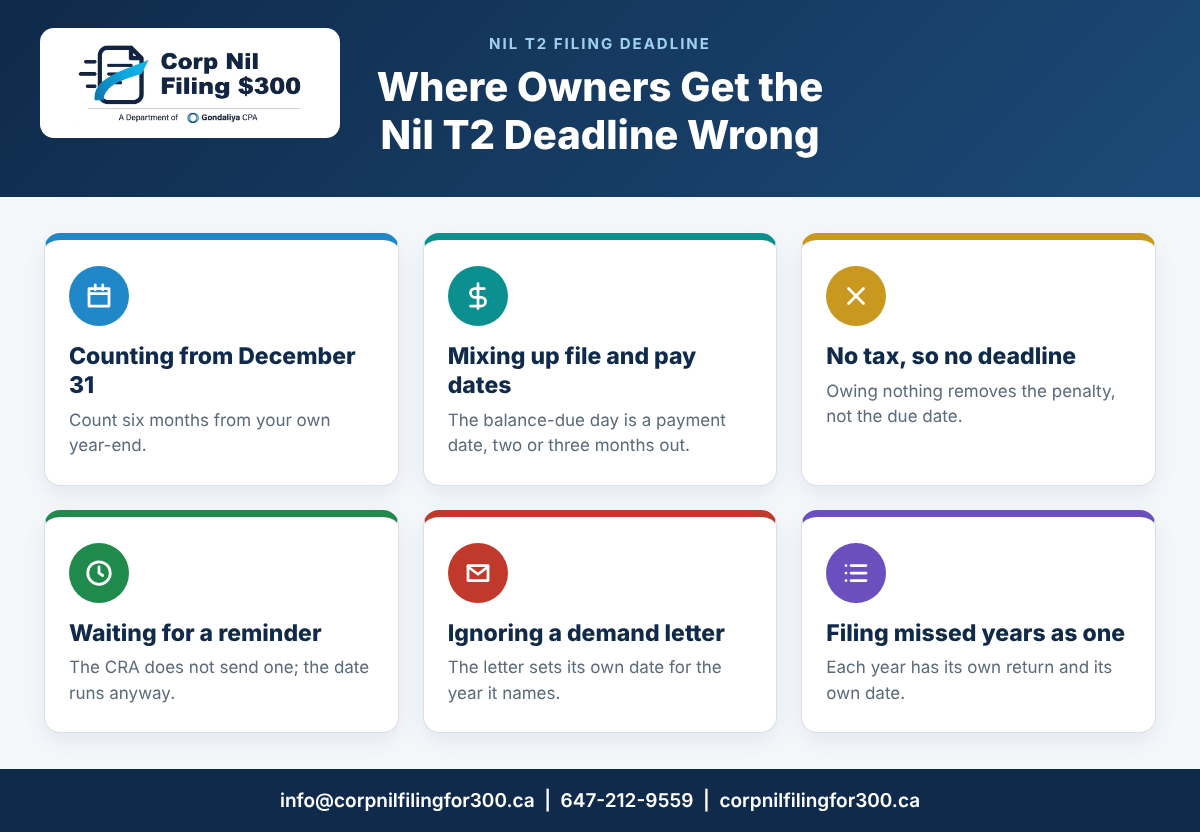
When CRA sends a demand to file letter under Income Tax Act section 150(2), it sets a special filing deadline that’s different from the usual six months. Missing this date can bring the larger repeat-failure penalty under subsection 162(2) where a failure-to-file penalty was also assessed in any of the three previous years.
If you get such a letter, treat it seriously. The deadline matters more than the regular one, and failing to meet it could increase your risks beyond normal late-filing penalties.
Procedures for Canceling or Waiving Penalties and Interest
Late filing usually triggers penalties if taxes weren’t paid on time. But if you owe nothing—like with nil returns—no monetary penalty applies (ITA s.162(1)). Still, the requirement to file remains.
If you missed several deadlines across years, each missed return has its own six-month clock based on its fiscal year-end date. Catching up means handling every overdue filing separately; you can’t lump them together as one case.
CRA may cancel or waive penalties sometimes but does so case-by-case. Being proactive helps but there’s no guarantee relief will happen just because your return shows no tax owing (CRA Avoiding Penalties).
Overview of the Voluntary Disclosures Program and How It Applies
The Voluntary Disclosures Program lets taxpayers fix past mistakes and get relief from some penalties and interest—with the most relief for unprompted disclosures made before the CRA has made contact, and less for prompted disclosures made after. Eligibility depends on being complete and timely—not just about missing deadlines (Canada.ca VDP).
A CRA demand-to-file letter sets its own filing deadline that overrides usual schedules. Ignoring this increases risks far beyond normal late filings (CorpNilFiling Demand Post).
Choosing between doing it yourself or hiring a CPA affects how well you handle these rules and deadlines:
- File Yourself
- Cheaper
- Riskier without know-how
- Use Licensed CPA Firm
- Experts review your return
- More expensive ($300 plus HST per year)
Bottom line: Professionals help reduce risk around tricky deadlines like demand letters while keeping up with changes such as mandatory e-filing for tax years starting after 2023.
Contact us at info@corpnilfilingfor300.ca or call 647-212-9559 for guidance tailored specifically toward inactive, dormant, holding companies requiring compliant yet affordable solutions.
Sources
- Income Tax Act RSC1985 c1 (5th Supp) ss150(1)(a),150(2),157(1)(b),162(1)
- Canada Revenue Agency – Corporation income tax guide – When To File Your Return https://www.canada.ca/en/revenue-agency/services/tax/businesses/topics/corporations/when-file-corporation-income-tax-return.html
- Canada Revenue Agency – Mandatory Electronic Filing https://www.canada.ca/en/revenue-agency/programs/about-canada-revenue-agency-cra/electronic-services/electronic-business-services-mandatory-electronic-filings.html
- Department of Justice – Income Tax Act https://laws-lois.justice.gc.ca/eng/acts/I-3.3/
After Filing: Managing Reassessments and Record Keeping
After Filing
Records
Normal and extended reassessment periods by the CRA
The Canada Revenue Agency (CRA) usually has three years to reassess a CCPC’s return, and four years for other corporations, counted from the date of the original notice of assessment. This includes nil returns. But if the CRA sends a demand to file letter under Income Tax Act 150(2), it sets a special deadline that replaces the usual six-month nil T2 filing deadline. If you file late past these deadlines, penalties kick in under section 162(1). These penalties are based on unpaid taxes at the due date, plus monthly charges for up to twelve months. For nil returns with no tax owed, penalties calculate to zero, but you still must file on time. Missing deadlines may lead to further enforcement even if no tax is owing.
How to request a reassessment or dispute a decision
If your corporation wants a reassessment, you can ask within the normal reassessment period. To formally dispute an assessment, file a notice of objection within 90 days after the date of the notice of assessment. Remember, if the CRA sends a demand-to-file letter, it gives a firm deadline. Missing this date can lead to prosecution and an assessment without a return—even for nil T2 returns with no tax owing. Keep clear records that back up your case when disputing.
Keeping accurate records and reporting obligations
Corporations must keep full, accurate books and records throughout their fiscal year and afterward — even when filing nil returns or having no activity. If the filing due date falls on a weekend or CRA-recognized holiday, the deadline moves to the next business day automatically. Since tax years starting after 2023 require mandatory electronic filing, corporations need to follow CRA’s e-filing rules for all T2 returns, including nil ones. Ignoring these can cause processing delays or rejected filings.
Resources and support for corporate tax filing questions
If you have questions about Canadian corporate tax deadlines, call Corp Nil Filing at 647-212-9559 or email info@corpnilfilingfor300.ca. This CPA Ontario Registered Firm focuses on affordable nil T2 filings across Canada, especially around Toronto. They help inactive or dormant companies stay compliant with federal rules without hassle.
Encouragement to meet deadlines efficiently with professional assistance from Corp Nil Filing for $300
Filing your corporation’s nil T2 return by the deadline avoids problems like demands from CRA or repeated late penalties—even if you owe nothing. You can file yourself or hire pros depending on your comfort with tracking deadlines and new rules like mandatory e-filing starting after 2023 fiscal years. Using professional help gives you a structured process that keeps records neat and reviewed by CPAs before sending—all for $300 plus HST per year.
An owner found three years of nil returns unfiled for a company that had stopped trading, and assumed they could go in as one filing. Each year had its own six-month date and its own return, so we prepared three T2s, each with its own year-end and Schedule 50, and transmitted them together. With no tax owing, no late-filing penalty applied to any of the three. Figures changed for privacy.
Summary of key takeaways regarding nil T2 filing and corporate tax deadlines in Canada
A nil T2 return must be filed within six months after your corporation’s fiscal year-end according to Income Tax Act 150(1)(a). This applies even if no taxes are due or your company is inactive. CRA source Late-filing penalties under section 162(1) only apply if there’s unpaid tax; they do not apply just because you file late with zero balance.Income Tax Act Still, missing deadlines risks CRA issuing demand letters with new deadlines that override normal rules.CRA Demand Letter Keeping good records and following updated electronic filing requirements helps keep things smooth across Canada.
Verdict: A nil T2 is due on the same day as any other T2: six months after the corporation’s own year-end, moved to the next business day only when that date falls on a weekend or CRA-recognized holiday. Owing nothing removes the late-filing penalty, not the deadline, and a demand to file replaces the date for the year it names.
2026 Update: For returns filed in 2026, the six-month rule, the weekend and holiday shift and the two- or three-month balance-due day are unchanged. Electronic filing is required for tax years starting after 2023, and the Voluntary Disclosures Program now has unprompted and prompted streams, with less relief once the CRA has made contact.
Sources:
- Canada Revenue Agency – When To File Your Corporation Income Tax Return
- Income Tax Act sections: 150(1)(a),150(2),162(1) [Justice Laws Website]
Frequently Asked Questions (FAQs)
Frequently Asked Questions
FAQ
What is the nil T2 filing deadline according to Income Tax Act 150(1)(a)?+
The nil T2 filing deadline requires all corporations to file their T2 return within six months after their fiscal year-end, even with no tax owing.
How does CRA count six months from your corporation’s year-end?+
CRA counts six full calendar months from your fiscal year-end date. If the deadline falls on a weekend or holiday, it shifts to the next business day.
What if the due date falls on a weekend or holiday?+
The filing deadline moves to the next CRA-recognized business day automatically without penalty.
When is a short first tax year due under Income Tax Act 249.1(1)?+
A short first tax year return must be filed within six months after the end of that short fiscal period, which can be up to 53 weeks.
What happens to deadlines when your corporation changes its fiscal year-end?+
Deadlines adjust based on the new fiscal year-end date approved by CRA under section 249.1(7). The six-month rule applies from the new year-end.
When is the final corporate tax return due after dissolution or wind-up?+
The final return is due six months after the corporation’s last fiscal period before dissolution or wind-up as per standard rules.
Is the balance-due day the same as the corporate tax filing deadline?+
No, balance-due day refers to when tax payments are due, usually two or three months after fiscal year-end, separate from the six-month filing deadline.
What does missing the nil T2 filing deadline cost when nothing is owed?+
With zero balance owing, the late-filing penalty is nil because it is a percentage of unpaid tax, but late filing can bring a demand to file, and continued non-filing can lead to prosecution.
Does a CRA demand to file letter change your filing deadline?+
Yes, a demand letter under Income Tax Act 150(2) sets a new firm deadline different from the usual six-month rule.
How must corporations submit their T2 returns under the mandatory e-file rules?+
Corporations must file electronically using certified software or authorized representatives as per CRA regulations for tax years starting after 2023.
Should you file your nil T2 return yourself or use a CPA firm?+
DIY filing saves money but risks errors; CPA firms like Corp Nil Filing offer expert review before filing for $300 plus HST.
How do you catch up if several corporate tax deadlines have passed?+
Each missed return requires separate filings based on its fiscal year-end with possible penalty requests and possible voluntary disclosure submissions.
Industry Spotlights: Sectors and Their Year-Ends
Industry Spotlights
Every sector files on the same six-month rule, but the year-ends owners choose, and the quiet years that make a deadline easy to forget, differ by sector.
| Sector | Common Situation | Deadline Point |
|---|---|---|
| Real estate holding companies | A property company between purchases | A quiet year is due on the same six-month date |
| Property developers holding land | Several quiet years before construction | Each year has its own due date |
| Physician and dental professional corporations | A first year shorter than 12 months | Six months from the first year-end, not from incorporation |
| Technology startups before revenue | A year-end picked at incorporation | The first return is due six months after it |
| E-commerce brands not yet launched | Set up before the store opens | No sales does not move the date |
| Consultants between contracts | A year with no billings | A nil return is due like any other |
| Skilled trades | A company paused between jobs | The pause does not pause the deadline |
| Restaurants not opened or closed | A closed location awaiting dissolution | Returns stay due until dissolution |
| Transportation owner-operators | A company parked after a truck sale | The sale year has its own date and is not nil |
| Family investment holding companies | A non-calendar year-end chosen years ago | Count from that year-end, not December 31 |
| Non-resident-owned Canadian companies | Owners abroad | Mail can miss them; diary the date |
- Real estate holding companies: A property company between purchases can have a nil year, and its return is due on the same six-month date as a busy year.
- Property developers holding land: Land held before construction can leave several quiet years, each with its own due date.
- Physician and dental professional corporations: A first year shorter than 12 months is due six months from that first year-end, not from incorporation.
- Technology startups before revenue: The year-end picked at incorporation sets the first due date, six months after it.
- E-commerce brands not yet launched: A brand with no sales still files by the date.
- Consultants between contracts: A year with no billings is due like any other year.
- Skilled trades: A company paused between jobs still has a deadline every year.
- Restaurants not opened or closed: A closed location’s corporation keeps filing by its dates until it is dissolved.
- Transportation owner-operators: The year the truck is sold is not nil, and it is due on the usual date.
- Family investment holding companies: A non-calendar year-end chosen years ago sets the date; count from it, not from December 31.
- Non-resident-owned Canadian companies: Owners abroad can miss CRA mail, so the due date belongs in a calendar, not a mailbox.
Professional Guidance & Quick Reference
Quick Reference
Best Practices for Meeting Nil T2 Filing Deadlines
- Mark your corporation’s fiscal year-end clearly and calculate six months ahead for your nil T2 deadline.
- Monitor weekends and holidays that could shift your due date forward.
- Use certified software or CPA services compliant with CRA mandatory e-filing rules.
- Keep complete records including NAICS codes and exact fiscal periods for accuracy.
- Respond immediately if you receive a CRA demand to file letter.
- Consider professional help from Corp Nil Filing for $300 to avoid late penalties.
- Review past filings regularly to ensure no missed deadlines remain.
- File electronically early enough to resolve any potential submission issues.
Why Trust Corp Nil Filing and Sharad Gondaliya, CPA?
Sharad Gondaliya holds CPA Ontario credentials plus US CPA licenses in Washington and Montana. Our registered firm provides expert nil T2 filings nationwide with 1300+ 5-star Google reviews. We specialize in timely filings aligned with CRA’s six-month rule, demand letters, and mandatory e-filing regulations—helping you avoid penalties affordably.
Contact Corp Nil Filing today at info@corpnilfilingfor300.ca or call 647-212-9559 for reliable corporate tax return services focused on Canada’s nil T2 filing deadlines and compliance needs.
Quick Answers
At a Glance
| Question | Answer |
|---|---|
| When a nil T2 is due | Six months after the end of the tax year, under paragraph 150(1)(a) |
| Month-end year-ends | The last day of the sixth month (March 31 to September 30) |
| Other year-ends | The same day of the sixth month (September 23 to March 23) |
| Weekend or holiday | On time if received or postmarked by the next business day |
| Balance-due day | Two months after year-end; three for eligible CCPCs |
| Late with no tax owing | No late-filing penalty, but the return is still overdue |
| Demand to file | The date in the letter applies to the year it names |
| How it is filed | Electronically for tax years starting after 2023 |
Who This Is For / Not For
Fit Check
- For: owners of inactive, dormant, holding and new corporations working out when a nil T2 is due.
- For: corporations with past due dates already missed that need each year filed.
- Not for: individuals looking for the personal T1 deadline.
- Not for: GST/HST, payroll or annual-return deadlines, which are separate filings.
People Also Ask
Related Questions
Is there one T2 deadline for every corporation?+
No. Each corporation’s T2 is due six months after its own year-end, so the date depends on the year-end it chose.
When is a nil T2 due for a December 31 year-end?+
June 30. Any tax owing would have been due earlier, on the balance-due day.
Can I get an extension for a nil T2?+
The CRA does not offer routine extensions for T2 returns. The weekend and holiday shift is the only standard movement in the date.
Is the deadline different for an Ontario corporation?+
No. Ontario corporation tax is reported on the same federal T2, so the due date is the same.
Can I file a nil T2 before the deadline?+
Yes. The return can be filed any time after the year-end, and filing early leaves time to fix a rejected transmission.
Glossary of Key Terms Related to Corporate Tax Filing
Definitions
- Six-month rule: Filing T2 returns within six months post-fiscal year-end under ITA 150(1)(a).
- Weekend/Holiday shift: Deadline moves forward if it falls on non-business days following CRA rules.
- Balance-due day: The date when corporate income taxes must be paid, often two or three months post-year-end (ITA 157(1)(b)).
- Late filing penalty: Penalties under ITA 162(1), starting at 5% plus 1% per month on unpaid taxes at filing deadline.
- Demand to file letter: CRA notice imposing special filing deadlines under ITA 150(2).
- Short first-year limit: Maximum initial fiscal period length of up to 53 weeks allowed by ITA 249.1(1).
- Mandatory e-file: CRA mandate requiring electronic submission of T2 returns for tax years starting after 2023.
- CRA Regulations: Rules governing electronic filings and deadlines for Canadian corporations.
Want a checklist to work from? You can download the free nil T2 deadline checklist before you start your filing.
This quick self-check shows what your deadline position is likely to need. Please answer the five questions below.
Nil T2 Deadline Check
Five quick questions on your year-end. No fee shown.
Points to raise with us:
This is a general prompt, not tax or legal advice or a quote. Your due date depends on your corporation’s own tax year.
Meeting Your Nil T2 Deadline: How CorpNilFiling Can Help
Start with your business number and your year-end
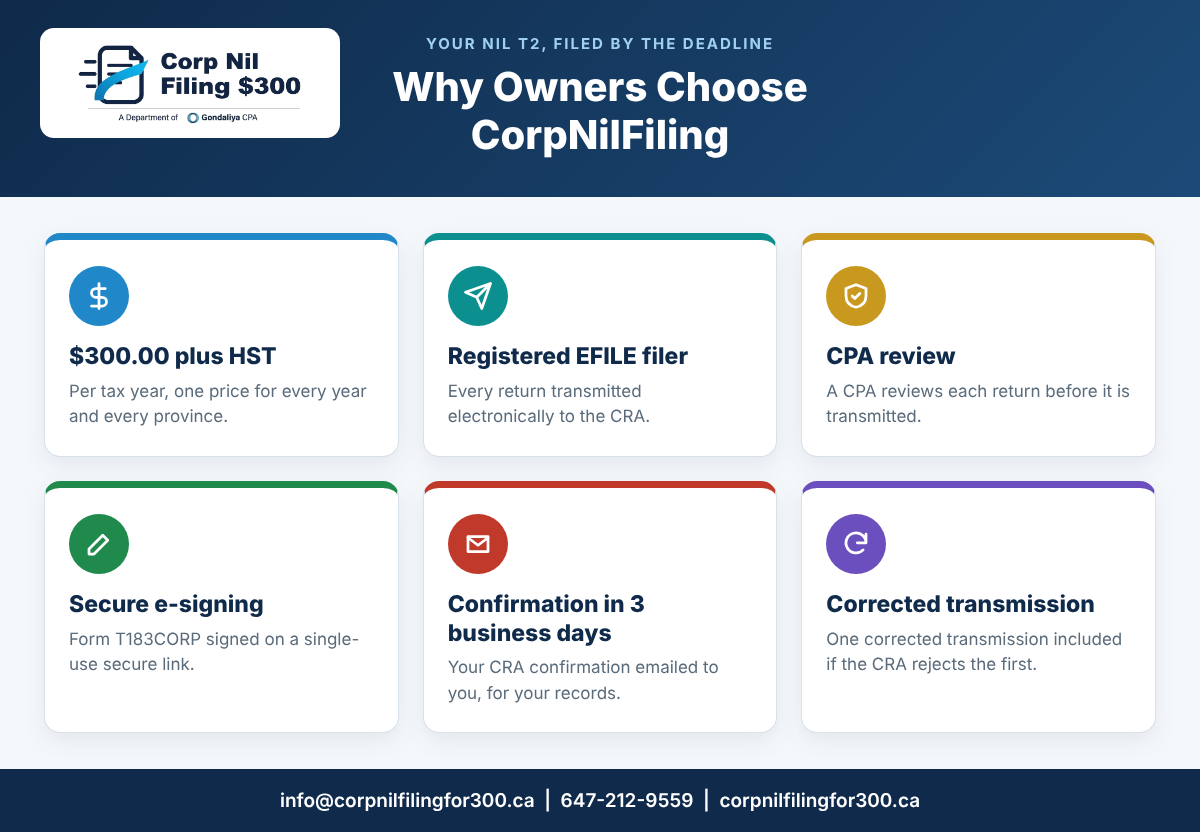
CorpNilFiling works out your due date from your year-end, prepares the nil T2 with Schedule 50 and any other schedules required, sends you Form T183CORP to sign securely, and has a CPA review each return before it is transmitted electronically — at $300.00 plus HST per tax year, with your CRA confirmation emailed within 3 business days.
Next Steps
Please start your filing with CorpNilFiling and have three things ready: the corporation’s business number, its year-end, and a list of any earlier years still unfiled. Those three tell us when each return is due and which to file first. We are open 9:00 AM to 8:30 PM, Monday to Sunday, at 55 Queen St E, Suite 1205, Toronto, and file for corporations across Canada. If our content helps, please add corpnilfilingfor300.ca as a preferred source on Google.
Published: · Last updated:
Editorial policy: We research against CRA, Department of Justice, CPA Canada and CPA Ontario sources, fact-check the figures, and Sharad Gondaliya, CPA, reviews the content, which we update as the rules change.
Disclaimer: This article is educational information only and is not tax or legal advice. Due dates depend on each corporation’s own tax year, and whether a penalty applies or is waived depends on the facts and current law. Gondaliya CPA performs compilation engagements under CSRS 4200 and does not perform audit or review engagements. Please consult a licensed CPA before acting.