



Schedule 50 T2 Canada: Complete Guide to Shareholder Information and the 10% Shareholder Rule for T2 Schedule 50 Filing
Schedule 50 T2 Canada requires detailed shareholder information, especially for those owning 10% or more under the 10% shareholder rule Canada. Corp Nil Filing offers an affordable Nil t2 service to simplify T2 Schedule 50 filing, ensuring compliance with all shareholder disclosure requirements.
Quick Summary
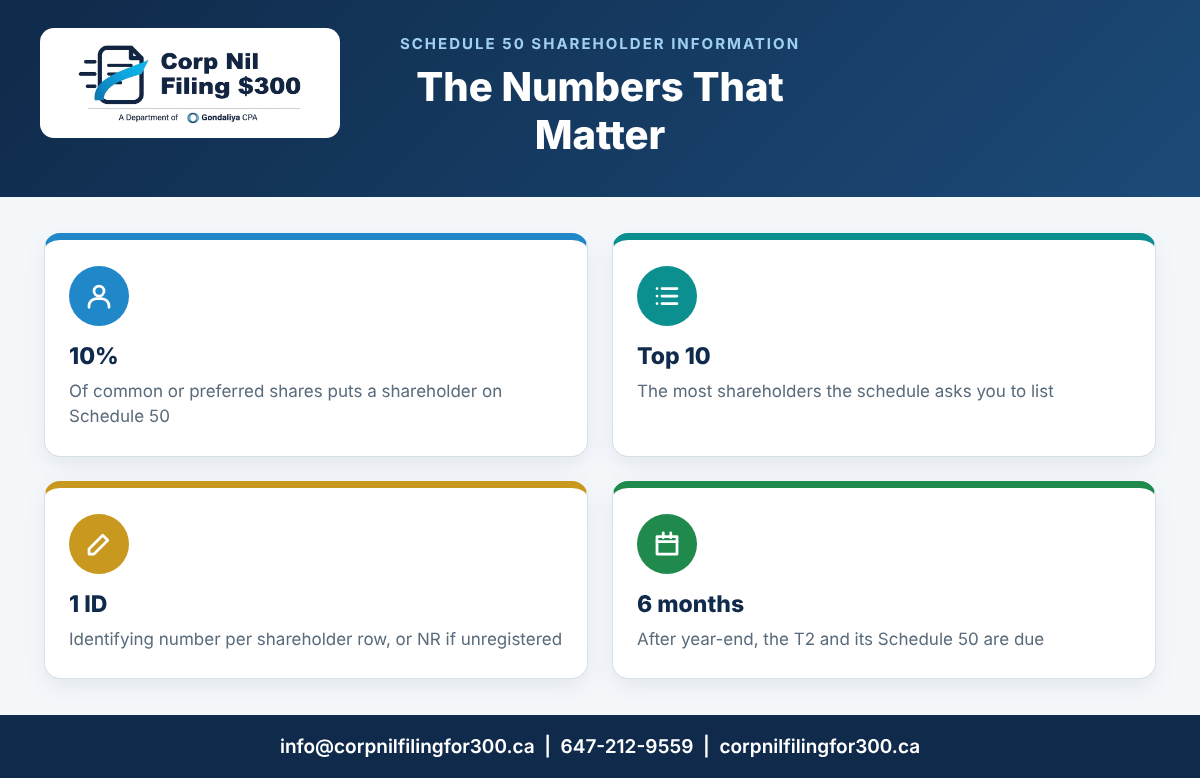
Schedule 50 is the shareholder information schedule on the T2 return. A private corporation completes it when any shareholder holds 10% or more of its common shares, its preferred shares, or both, and it goes with every T2 while that is true, including a nil return. Each row names the registered holder, gives one identifying number, and records the common and preferred percentages as they stood in the tax year being filed.
- Common and preferred shares are tested separately against the 10% mark.
- List up to the ten largest qualifying shareholders.
- One identifying number per shareholder, or “NR” where the holder is not registered.
- Use the share register as it stood in the year being filed, not today’s.
Reading time: 27 minutes.
Table of Contents
The Numbers That Matter
This article covers Canada, with Ontario and Toronto context, and reflects CRA guidance current to 2026. It is written for owners of Canadian private corporations — particularly inactive, dormant and holding companies filing nil T2 returns — who need to know what the shareholder schedule asks for. CorpNilFiling is a department of Gondaliya CPA Professional Corporation, which performs compilation engagements under CSRS 4200 and does not offer audit or review engagements. This is educational information only and not tax or legal advice.
What is Schedule 50?
What is Schedule 50?
The Basics
Schedule 50, also called the T2 Schedule 50 in Canada, is a form every private corporation must file with their T2 income tax return. It shows key info about shareholders who own at least 10% of common or preferred shares.
Here’s what you need to include on Schedule 50:
- Share Register: Lists all shareholders and how many shares they own.
- Business Number (BN): The CRA’s unique ID for your corporation.
- Trust Number: If trusts hold shares, this number identifies them.
- Social Insurance Number (SIN): For individuals, their SIN is needed to verify identity.
This form helps keep ownership clear and meets Canadian tax rules.
Why is Schedule 50 Important?
Schedule 50 matters for private corporations filing a T2 return for several reasons:
- The 10% shareholder rule Canada says if any shareholder owns 10% or more of shares, you must fill out this schedule. This applies even if the company made no money that year.
- It’s a mandatory schedule filed with every T2 corporation income tax return. Skipping it can cause problems with the CRA.
- Not following the rules can lead to issues like:
- CRA sending follow-up questions
- Penalties for late or incomplete filings
- There’s a late filing penalty if you miss deadlines for your T2 return or Schedule 50 specifically. The longer you wait, the higher the fees.
- CRA often sends follow-up requests if information is missing or wrong on Schedule 50. This can slow down your tax processing and create extra hassle.
Filing Schedule 50 properly avoids these troubles and keeps things running smoothly with the CRA.
Two spouses incorporated a company, each took 50 common shares, and the business never opened. Its nil T2 showed zero on every income line, yet Schedule 50 still carried two rows: each spouse named as an individual, with a social insurance number and 50% in the common column. Figures changed for privacy.
Eligibility Criteria for Completing Schedule 50 Shareholder Information
Eligibility Criteria
Who Files
Corporations Required to File Schedule 50
Private corporations filing T2 returns in Canada have to fill out Schedule 50 shareholder information every time they file their tax return. This includes nil filings too. The CRA wants all private Canadian corporations to list shareholders who meet the ownership threshold on Schedule 50 as part of their T2 return.
Public corporations don’t need to file Schedule 50. They report shareholder details in other ways. But private companies, even if they didn’t do any business or make money, must file this schedule each year to follow CRA’s rules.
Dormant and inactive holding companies also must file Schedule 50 when they send nil T2 returns. Just because a company didn’t operate doesn’t mean it skips this step. The report shows who owned shares during the fiscal year, not whether the company was active.
Key point: Any private corporation with at least one shareholder owning ten percent or more of common or preferred shares completes Schedule 50 yearly with their T2 return (CRA Guide T4012).
The 10% Shareholder Rule Explained
The main rule for completing Schedule 50 is called the “10% shareholder rule” in Canada. If a person or group owns exactly ten percent or more of either common or preferred shares, they qualify as a significant shareholder.
Here’s what that means:
- Holding exactly ten percent of common shares counts—even if preferred shares are less.
- Owning over ten percent of preferred shares counts, even if common shares are less.
- Common and preferred shares are checked separately.
- Meeting the ten percent mark on either class means you must be listed on Schedule 50.
The CRA looks at shareholdings recorded during the reported fiscal year. It doesn’t check today’s numbers or voting rights unless specified.
Exactly hitting ten percent works; there’s no rounding down. That keeps things clear and fair for everyone filing.
Tip: Keep good records showing how much you hold in each share type throughout the year to avoid mistakes on your filing.
| Holding | On Schedule 50? | Row Entry |
|---|---|---|
| 50% common, 0% preferred | Yes | 50 in the common column, 0 in the preferred column |
| 5% common, 40% preferred | Yes | Both percentages recorded |
| 9% common, 0% preferred | No | Not listed |
| Exactly 10% common | Yes | The threshold is 10% or more |
| 100% held by a holding company | Yes | One row: the holding company, with its business number |
| 60% held by a family trust | Yes | One row: the trust, with its trust number |
Situations Triggering Schedule 50 Filing
You need to file Schedule 50 whenever certain ownership info comes up during the tax year:
- Change-of-ownership events: If someone’s stake passes ten percent because of transfers, you must update disclosures even mid-year.
- Who counts as shareholders? It’s not just people. Corporations (holdcos), partnerships with qualifying stakes, and trusts with IDs all count. Each gets its own line on Schedule 50 with a number like BN, SIN, partnership account number, trust number, or “NR” if unregistered.
- Ownership percentages for common and preferred shares go in separate fields. These reflect how registers looked during that tax year—not when you file.
Non-resident voting shareholders don’t appear here; they’re listed only on other schedules like Schedule 19 (Schedule 19 Instructions).
Filing is required even if no trading happened that year because ownership alone needs reporting under Canadian law (Income Tax Act s150(1)).
Key Features and Components of Schedule 50 Shareholder Information
Key Features and Components
The Fields
Schedule 50 T2 Canada makes private corporations list their shareholder info on every corporate tax return, even if it’s a nil return. The CRA wants to see who owns what, under the Income Tax Act rules. This helps keep things clear and follows T2 shareholder disclosure requirements. The form uses the share register as it was during the tax year to show owners holding at least 10% of common or preferred shares.
Essential Fields and Details Required
Each line on Schedule 50 shows one registered holder from the company’s share register for that year. You need to fill out:
- Shareholder Name: Full legal name plus type in brackets (individual, corp., part., trust).
- Identification Number: Only one ID per shareholder row:
- Business Number (BN) for companies,
- Social Insurance Number (SIN) for people,
- Partnership Account Number (PAN) for partnerships,
- Trust account number for trusts.
If the shareholder has no ID number, write “NR” for not registered. Don’t put more than one ID per line. This keeps things clear and fits CRA Schedule 50 filing rules CRA Guide T4012. It stops confusion about who owns what. Residency is not reported here — that goes on Schedule 19 if needed.
Understanding Shareholder Percentages and Identification
The 10% shareholder rule Canada applies separately to common and preferred shares. Someone hits the threshold if they hold 10% or more in either class:
- Common Shares Percentage: Reported only if it reaches or passes ten percent.
- Preferred Shares Percentage: Also reported separately; can be zero if none are owned.
Percentages come from the share register as it stood during the year — not based on voting rights or changes after year-end. Different voting classes don’t change how you read this rule but might need notes elsewhere following CRA instructions T4012 Corporate Tax Guide.
This means a person with nine percent common shares but fifteen percent preferred shares shows up since they cross ten percent in one class.
A founder owned all the shares of a numbered company until 30 common shares went to a business partner in the third of five unfiled years. The catch-up batch carried a one-row Schedule 50 for the first two years and a two-row Schedule 50 for the last three, because each year reports the register as it stood that year. Figures changed for privacy.
Different Versions of the Schedule 50 Form
The latest Schedule 50 follows what the CRA says in its T4012 Corporate Tax Guide. The form includes six main fields:
- Registered Holder Name
- Type Bracket
- Identifier
- Common Share Percentage Held
- Preferred Share Percentage Held
- Notes field (used rarely)
Companies must use this exact format when sending T2 returns electronically or by paper through approved services like Corp Nil Filing.
Changes starting with tax years from January first, two thousand twenty-six require sticking to these fields exactly CRA instructions. There are no extra columns here like residency info — that’s only on other forms like Schedule 19.
Even if you file a nil return with no business activity, you still have to complete Schedule 50 accurately if shareholders meet the thresholds.
You can start your nil T2 filing today with CPA help at Corp Nil Filing— for $300 plus HST per tax year— covering all schedules including proper Schedule 50 submissions across Ontario and Canada-wide service areas.
Suggested internal links: nil T2 filing | dormant corporation filing | inactive holding corporation T2 filing | catch-up nil T2 filing | first return after incorporation | GIFI guide
Step-by-Step Guide to Completing and Submitting Schedule 50
Completing and Submitting Schedule 50
Step by Step
How to Access and Download the Schedule 50 Form
Schedule 50 is a must-have form for every T2 corporation income tax return, even if you file nil returns. You can get the official Schedule 50 T2 Canada form from the Canada Revenue Agency (CRA) website. Just head to their Forms and Publications section. The form is a PDF, so it works on most devices.
If you use services like Corp Nil Filing for $300, you might get Schedule 50 already filled in or ready to fill out as part of your package. This helps with T2 Schedule 50 filing and makes sure you follow CRA rules without paying extra.
Always grab the latest Schedule 50 from CRA. Using old forms can cause mistakes. Remember, you must file this schedule every year with your corporate tax return, no matter what your business activity looks like.
Completing the Form Using PDF Tools and Acrobat Reader
You need to fill in detailed shareholder info on Schedule 50. There are six main parts:
- Shareholder name
- Type (individual, corporation, partnership, trust)
- One ID number per shareholder (business number, social insurance number, partnership account number, or “NR” if not registered)
- Percentage of common shares held
- Percentage of preferred shares held
- Any notes about voting rights
Use Adobe Acrobat Reader or similar PDF tools that let you type right into the form. Filling it electronically cuts down errors and helps with smooth electronic transmission.
Make sure you list ownership percentages as they were during the fiscal year reported—not when you fill out the form — don’t include residency here; non-resident shareholders go on other schedules like Schedule 19.
Fill out rows for up to ten shareholders who hold at least ten percent of either common or preferred shares separately. Double-check everything before submitting.
Digital Submission Options and Mailing Instructions
The CRA prefers electronic transmission for all T2 filings, including those with attached forms like Schedule 50. You can file electronically through EFILE service providers such as licensed CPA firms that offer nil return packages including this schedule.
Electronic filing speeds things up and lowers the chance of lost paperwork compared to mailing paper forms. But if you want to send a paper copy:
- Mail your completed return plus signed authorization forms to your tax centre
- Include all fully filled schedules
- Keep proof of mailing date because CRA penalties apply if you’re late —
Even if no taxes are owed, late filing can bring penalties since reporting duties remain under Canadian law no matter your revenue or trading status.
Important Deadlines and Processing Times
Private corporations must file their annual T2 corporate income tax returns within six months after their fiscal year-end —. This includes sending an accurate Schedule 50 shareholder information report showing ownership for that period—even if your return is nil.
Missing this deadline means late-filing penalties. These are based on unpaid taxes but still apply even when your balance is zero due only to missing documents like incomplete Schedules —.
Processing times depend on how you submit:
| Submission Method | Typical Processing Time |
|---|---|
| Electronic Transmission | About two weeks |
| Paper Filing | Four to eight weeks |
Times are rough estimates based on recent CRA data and may vary by season.
Filing early helps in case CRA asks for fixes related to shareholder info in Schedule 50. Mistakes here often cause audits or requests for amended returns for that year.
Common Errors, Compliance, and Security Considerations
Common Errors, Compliance and Security
Common Errors
Filing Schedule 50 for your T2 Canada return means you need to get shareholder info right. Missing or wrong details often cause CRA to ask questions. If you forget to file on time or correct mistakes, expect penalties. Fix errors fast and add any missed schedules quickly to avoid trouble.
Frequent Mistakes When Filling Out Schedule 50
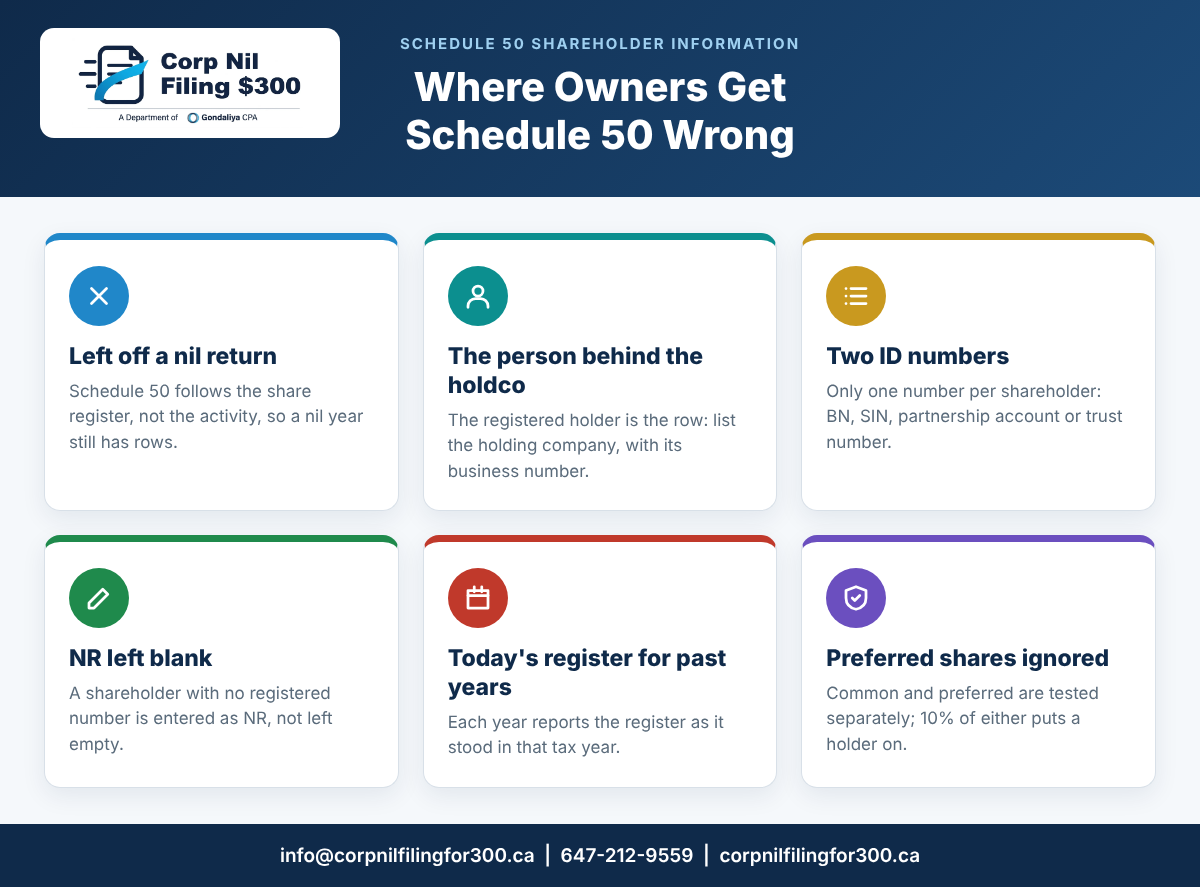
Here are some usual slip-ups with Schedule 50:
- Forgetting to attach necessary documents like shareholder registers or transfer logs.
- Putting in wrong shareholder info, such as the wrong type of owner—individual, trust, or company.
- Using more than one ID per shareholder row instead of just one.
- Reporting ownership percentages incorrectly by mixing up common and preferred shares.
- Copying today’s share register into past years without showing changes from transfers.
These mistakes confuse CRA and can lead to follow-up questions. Be careful with dates and details.
Tips to Avoid Errors and Delays
Try these tips for smoother Schedule 50 filings:
- Keep a yearly snapshot of your share register as it was at fiscal year-end.
- Track all share transfers with exact dates in a detailed log.
- Use only one valid ID per shareholder: business number, SIN, trust number, or “NR” if none.
- Check ownership percentages carefully for common and preferred shares separately.
- Follow CRA’s instructions for fields 100–500 closely.
- Attach all needed schedules—even if you file a nil return—and never skip Schedule 50 just because your company was inactive.
Use this checklist before filing:
| Item | What to Check |
|---|---|
| Shareholder Register | Matches fiscal year-end |
| Transfer Log | Complete with correct dates |
| Identifiers | One valid ID per shareholder |
| Ownership Percentages | Correctly figured by share type |
| Required Attachments | Everything included |
Data Privacy, Security Measures, and Regulatory Compliance
Handling corporate data means serious privacy care. Canadian laws like PIPEDA set rules you must follow. Only authorized staff should see personal IDs when prepping or sending your T2 filing electronically.
Keep physical copies locked up tight. Digital files need strong protection from hacking or leaks. Electronic submissions must use secure encryption that meets CRA EFILE standards.
Your company is responsible for making sure your CPA firm keeps info confidential throughout the whole filing process, including Schedule 50 details.
Handling Sensitive Shareholder Information Safely
Social Insurance Numbers (SINs) only appear on Schedule 50 when they’re the single valid ID for an individual shareholder. Don’t mix in other numbers on the same row—that confuses CRA.
For trusts owning shares, provide just the trust number. Don’t include beneficiary info here since other reporting rules cover that separately.
Balance accuracy with privacy by keeping personal IDs limited to what’s required under Canadian rules. This avoids exposing sensitive info while staying compliant.
CRA Requirement: Private corporations must file Schedule 50 every year if any shareholder owns ten percent or more of common or preferred shares. List up to ten largest holders and use one ID per row [CRA Guide T4012].
Risk Warning: Skipping attachments or submitting wrong ownership info causes CRA amendment requests that slow things down and may bring late-filing penalties [Income Tax Act s230].
Pro Tip: Save snapshots of your share register as it stood on each fiscal year-end before starting your return prep. This helps keep historical records correct even for nil returns including dormant companies.
File your nil T2 return with confidence by avoiding these common errors that mess up shareholder details on corporate tax returns.
Additional Resources, Related Forms, and Support Services
Additional Resources and Related Forms
Resources
Schedule 50 T2 Canada is a key part of filing corporate taxes. It shows shareholder information that must be accurate. Knowing the related forms and support services helps you follow the rules for T2 Schedule 50 filing.
Related Federal and Provincial Corporate Tax Forms
Some federal and provincial forms work with Schedule 50 in T2 filings:
- Schedule 19 reports non-resident voting shareholders. It’s different from Schedule 50, which focuses on ownership percentages for common and preferred shares but doesn’t show residency CRA Guide T4012.
- Schedule 9 shows associated corporations under Canadian tax law. It’s about connections between companies, separate from Schedule 50’s shareholder data Income Tax Act section 256.
- Nil Return means a corporation with no activity still files a return. If needed, it must include Schedule 50. Not having revenue does not remove this duty CRA Filing Requirements.
Together, these forms give a full picture of who owns what and the company’s activities.
| Requirement | Test or Trigger | Who Receives It |
|---|---|---|
| T2 Schedule 50 | 10% or more of common or preferred shares | CRA, with the T2 |
| T2 Schedule 19 | A non-resident held a voting share in the year | CRA, with the T2 |
| T2 Schedule 9 | Related or associated corporations | CRA, with the T2 |
Online Business Tax Services and Profile Management
The CRA offers online tools to make corporate tax filing easier:
- CRA Electronic Transmission lets companies file their T2 returns electronically using EFILE. This includes sending Schedule 50 with other forms for faster processing CRA EFILE Program.
- CRA My Business Account is an online portal where businesses manage their tax details safely. They can check filed returns, see notices about missing schedules like Schedule 50, update info, and contact CRA directly Canada.ca My Business Account.
Using these digital tools keeps filings smooth and on time.
Contact Information for Assistance and Formal Disputes
Businesses can get help or settle disputes through official CRA channels:
- CRA Helpline provides answers about T2 returns or issues with Schedule 50 info. Agents understand the rules and offer guidance Canada.ca Contact CRA.
- Formal Dispute Resolution Process lets corporations challenge assessments or missing schedule issues by filing objections. Following CRA steps reduces risks from incomplete filings ITA sections relevant.
Reaching out early clears up confusion and protects your rights.
Updates, Version Control, and Continuous Compliance Guidance
Tax laws change, so companies must stay current on filing rules:
- The Income Tax Act section 89(1) says private corporations must file annual returns every year—even if they have no business activity.
- You can fix errors like missing or wrong schedules after filing without penalties if you act fast. This includes corrections to Schedule 50 based on new amendments CRA Adjustment Requests Guidelines.
Keeping track of past filings helps meet evolving tax requirements in coming years.
For more help with nil returns including necessary schedules like Schedule 50, check out our detailed pages at Corp Nil Filing for $300. Ontario CPAs review everything before sending to avoid mistakes along the way.
A holding company owned all the shares of an operating company, and the owner listed himself on the operating company’s Schedule 50. The registered holder was the holding company, so its row, with its business number, was the one that belonged there; he appeared on the holding company’s own return instead. Figures changed for privacy.
FAQs on Schedule 50 T2 Canada and Shareholder Filing
Frequently Asked Questions
FAQ
What is the maximum number of shareholders I can list on Schedule 50?+
You can list up to ten shareholders who each own 10% or more of common or preferred shares on Schedule 50.
When is the filing deadline for Schedule 50 with my T2 return?+
The filing deadline is six months after your corporation’s fiscal year-end.
Can I use multiple identification numbers for one shareholder on Schedule 50?+
No, only one identification number per shareholder row is allowed, such as BN, SIN, PAN, or trust number.
What penalties apply if I file Schedule 50 late?+
CRA applies late filing penalties based on T2 penalty rules, even if no tax is owed.
How long should I keep records related to Schedule 50 filings?+
Keep all shareholder records and supporting documents for six years from the filing date.
Is electronic transmission mandatory when filing Schedule 50 through Corp Nil Filing?+
Yes, Corp Nil Filing requires electronic transmission for all T2 returns and schedules including Schedule 50.
How does the Income Tax Act define a private corporation for filing purposes?+
A private corporation is defined under Income Tax Act section 89(1) and must file Schedule 50 if applicable.
What is a specified shareholder according to Income Tax Act section 248(1)?+
A specified shareholder owns at least 10% of any class of shares in a private corporation during the fiscal year.
What does a nil return mean in corporate tax filing?+
A nil return means a corporation files a T2 return showing no income or activity but still discloses required info like Schedule 50.
Industry Spotlights: Sectors With Nil Years
Industry Spotlights
Nil years turn up in every sector, and so does Schedule 50. Whatever the business, the schedule follows the share register, not the activity, so a quiet year still lists every shareholder at 10% or more.
| Sector | Why a Nil Year Happens | Schedule 50 Point |
|---|---|---|
| Real estate holding companies | A property company between purchases | Co-investors at 10% or more each get a row |
| Property developers holding land | Land held before construction starts | Partner corporations are listed by business number |
| Physician and dental professional corporations | A corporation opened before practice income starts | Family shareholders are listed if they reach 10% |
| Technology startups before revenue | Incorporated before launch | Founder splits are recorded as they stood that year |
| E-commerce brands not yet launched | Set up before the store opens | The founding register is the baseline |
| Consultants between contracts | A year with no billings | A one-shareholder company still has one row |
| Skilled trades | A company paused between jobs | Dormancy changes nothing on Schedule 50 |
| Restaurants not opened or closed | A lease that never started, or a closed location | Partners stay listed until the final return |
| Transportation owner-operators | A truck sold and the company parked | The owner’s row continues each year |
| Family investment holding companies | A company holding shares and nothing else | A family trust is one row with its trust number |
| Non-resident-owned Canadian companies | A Canadian company with foreign owners | Foreign owners at 10% or more are listed here too |
- Real estate holding companies: A property company between purchases may report no income, but each co-investor at 10% or more still has a row.
- Property developers holding land: Land held ahead of construction often sits in a company owned by other corporations, each listed by its business number.
- Physician and dental professional corporations: Where family members hold shares permitted by the profession’s rules, each one at 10% or more is listed.
- Technology startups before revenue: Founder share splits go on Schedule 50 as they stood in each year, before any later financing changes them.
- E-commerce brands not yet launched: The register set up on incorporation is the baseline every later year is compared against.
- Consultants between contracts: A one-shareholder company files a one-row Schedule 50 in a year with no billings.
- Skilled trades: A company paused between jobs is dormant, and dormancy changes nothing about who is listed.
- Restaurants not opened or closed: Partners stay on Schedule 50 every year through to the final return.
- Transportation owner-operators: A truck sold and a company parked still leaves the owner’s row on each annual return.
- Family investment holding companies: A family trust holding the shares is one row, identified by its trust number.
- Non-resident-owned Canadian companies: Foreign owners at 10% or more are listed on Schedule 50 like any other shareholder, and residency is dealt with separately.
Professional Guidance & Quick Reference
Quick Reference
Best Practices for Accurate Schedule 50 Filing
- List only up to ten shareholders meeting the ownership threshold.
- Include one valid ID per row: BN, SIN, PAN, or trust number.
- File your return with Schedule 50 within six months of fiscal year-end.
- Retain records for six years from the date of filing.
- Use electronic transmission for faster CRA processing.
- Clearly split ownership percentages by share classes (common vs preferred).
- Record ownership changes during the year; split periods if needed.
- Attach notes in field 500 only when required.
- Use share class description field 400 correctly.
- Check GIFI schedules omission conditions (100, 125, and 141) carefully.
- Include loss continuity schedules if applicable to your corporation.
- Prepare Schedule 24 Opening Balance Sheet for first-time filers.
Common Errors and How to Prevent Them
- Avoid listing multiple IDs for one shareholder; use only one per line.
- Don’t mix ownership percentages across share classes inaccurately.
- Never miss the six-month post-year-end filing deadline.
- Keep an updated significant control register distinct from Schedule 50 info.
- Do not forget to file catch-up returns for unfiled years promptly.
Data Privacy and Security Measures
- Protect all sensitive shareholder data in compliance with PIPEDA.
- Limit access to personal identification numbers to authorized staff only.
- Use secure encryption methods when submitting filings electronically.
- Do not disclose beneficiary details of trusts on Schedule 50; use trust numbers only.
Why Choose Corp Nil Filing and Gondaliya CPA?
- We provide reliable nil return filings with full compliance checks.
- Our $300 plus HST fee includes expert preparation of all necessary schedules including Schedule 50.
- Electronic transmission ensures timely CRA acceptance and fewer errors.
- We manage amendments and follow-up communications efficiently to reduce stress.
How to Decide Between Filing Yourself or Hiring a CPA Firm
| Option | Considerations |
|---|---|
| File Yourself | Lower cost but risk errors and penalties |
| Use CPA Firm | Expert review reduces mistakes, offers peace of mind |
For peace of mind and full compliance with Schedule 50 T2 Canada, contact Corp Nil Filing today at info@corpnilfilingfor300.ca or call 647-212-9559.
Quick Answers
At a Glance
| Question | Answer |
|---|---|
| Who files Schedule 50 | Every private corporation with a shareholder at 10% or more |
| Threshold | 10% or more of common or preferred shares, each tested on its own |
| Maximum rows | The ten largest qualifying shareholders |
| Identifier | One number per shareholder, or “NR” if unregistered |
| Nil return | Still required when the threshold is met |
| Holding company owner | The holding company is the row, with its business number |
| Which year’s register | The register as it stood in the tax year being filed |
| Deadline | With the T2, six months after year-end |
Who This Is For / Not For
Fit Check
- For: owners of Canadian private corporations filing nil, dormant, holding company or catch-up T2 returns who need Schedule 50 prepared for each year.
- For: corporations with older share registers, or filing a final return before dissolution.
- Not for: public corporations, which do not complete Schedule 50.
- Not for: operating corporations with revenue, payroll or GST/HST activity, which need a full T2 rather than a nil filing.
People Also Ask
Related Questions
What is Schedule 50 on a T2 return?+
It is the shareholder information schedule. A private corporation uses it to list each shareholder holding 10% or more of its common or preferred shares, with an identifying number and the percentage held.
Do I need my shareholders’ SINs to file a T2?+
For each individual shareholder at 10% or more, the social insurance number is the identifying number on Schedule 50. Corporate shareholders are identified by business number instead.
If a holding company owns my company, who goes on Schedule 50?+
The holding company, as the registered shareholder, with its business number. The people who own the holding company appear on the holding company’s own Schedule 50.
Does a T2 Short return still need Schedule 50?+
Where a corporation qualifies for the T2 Short return, Schedule 50 may still need to be attached when a shareholder holds 10% or more.
What if the share register is missing or out of date?+
Bring the register up to date first, then prepare Schedule 50 from it, so the schedule matches the corporation’s own records for each year.
Glossary of Key Terms
Definitions
- Schedule 50: The T2 shareholder information schedule listing each shareholder at 10% or more.
- Private corporation: A corporation that is not a public corporation; the type that completes Schedule 50.
- Common shares: The ordinary class of shares, usually carrying votes and the residual equity.
- Preferred shares: A class with preferential rights, often used in estate freezes.
- Share register: The corporation’s record of who holds which shares, kept in the minute book.
- Business number: The CRA’s nine-digit identifier for a business, used for corporate shareholders.
- Trust number: The CRA’s identifier for a trust, used when a trust holds shares.
- Schedule 19: The T2 schedule reporting non-resident shareholders with voting shares.
- Schedule 9: The T2 schedule reporting related and associated corporations.
- T2 Short: The simplified T2 return available to corporations that meet its conditions.
Want a checklist to work from? You can download the free Schedule 50 checklist before you start your filing.
This quick self-check shows what your Schedule 50 is likely to need. Please answer the five questions below.
Schedule 50 Readiness Check
Five quick questions on your shareholders. No fee shown.
Points to raise with us:
This is a general prompt, not tax or legal advice or a quote. Your position depends on your full facts and your share register.
Treat Schedule 50 as a copy of the share register, made fresh for each year. Every private corporation with a shareholder at 10% or more of its common or preferred shares files it with every T2, nil years included. List up to the ten largest qualifying shareholders, each with its type in brackets and one identifying number, and record the common and preferred percentages separately, as they stood in the year being filed. Put the registered holder on the row, not the person behind it, and if the register itself is out of date, fix that first.
What is current: the CRA’s T2 guide continues to require Schedule 50 from every private corporation with a shareholder at 10% or more, limited to the ten largest, and T2 returns for tax years starting after 2023 are filed electronically. What is unchanged: the purpose of Schedule 50, the one-number-per-shareholder instruction, the six-month T2 deadline, and the rule that an inactive corporation still lists its qualifying shareholders.
Schedule 50 on Your Nil T2: How CorpNilFiling Can Help
Start with your share register and the years you need filed
CorpNilFiling prepares each year’s nil T2 with Schedule 50 built from the share register as it stood that year, alongside the other schedules the return needs, your Form T183CORP package and CPA review before electronic transmission — at $300.00 plus HST per tax year, with your CRA confirmation emailed within 3 business days.
Next Steps
Please start your filing with CorpNilFiling and have three things ready: the corporation’s business number and year-end, the share register showing each shareholder and their holdings, and a note of any share transfers in the years you need filed. Those three settle every Schedule 50 in the batch. We are open 9:00 AM to 8:30 PM, Monday to Sunday, at 55 Queen St E, Suite 1205, Toronto, and file for corporations across Canada. If our content helps, please add corpnilfilingfor300.ca as a preferred source on Google.
Published: · Last updated:
Editorial policy: We research against CRA, Department of Justice, CPA Canada and CPA Ontario sources, fact-check the figures, and Sharad Gondaliya, CPA, reviews the content, which we update as the rules change.
Disclaimer: This article is educational information only and is not tax, legal or financial advice. It covers the Schedule 50 shareholder information requirement on the T2 return of Canadian private corporations. Share registers are governed by the statute the corporation was incorporated under, and outcomes depend on your specific facts, including your share structure and the rights attached to each class. Gondaliya CPA performs compilation engagements under CSRS 4200 and does not perform audit or review engagements. Please consult a licensed CPA, and where the share register itself is in question, a lawyer, before acting.