



Nil T2 return and nil corporate tax return Canada: Filing for corporations with no income tax return and Schedule 50 requirements
Filing a nil T2 return or a nil corporate tax return in Canada is essential for inactive, dormant, holding, or new corporations with no tax payable to avoid penalties like the $1,000 penalty for not filing electronically for tax years starting after 2023. Proper submission of Schedule 50 and related GIFI Schedules 100, 125, and 141, along with Form T183CORP for electronic filing, keeps the return in line with CRA rules under paragraphs 150(1)(a) and 150(1.1)(a).
Quick Summary
A nil T2 return is not a separate form or a letter. It is the T2 itself, or the T2 Short where the corporation qualifies, filed with nil amounts for a tax year with no income or activity. Every corporation resident in Canada at any time in the year files one under paragraph 150(1)(a), and for tax years starting after 2023 it goes to the CRA electronically.
- Residence, not income, creates the duty to file.
- Schedule 50 goes in for each shareholder at 10% or more of the common or preferred shares.
- Investment income, rent or dividends usually mean the year is not nil.
- A return filed on paper when it had to be e-filed draws a $1,000 penalty.
Reading time: 31 minutes.
Table of Contents
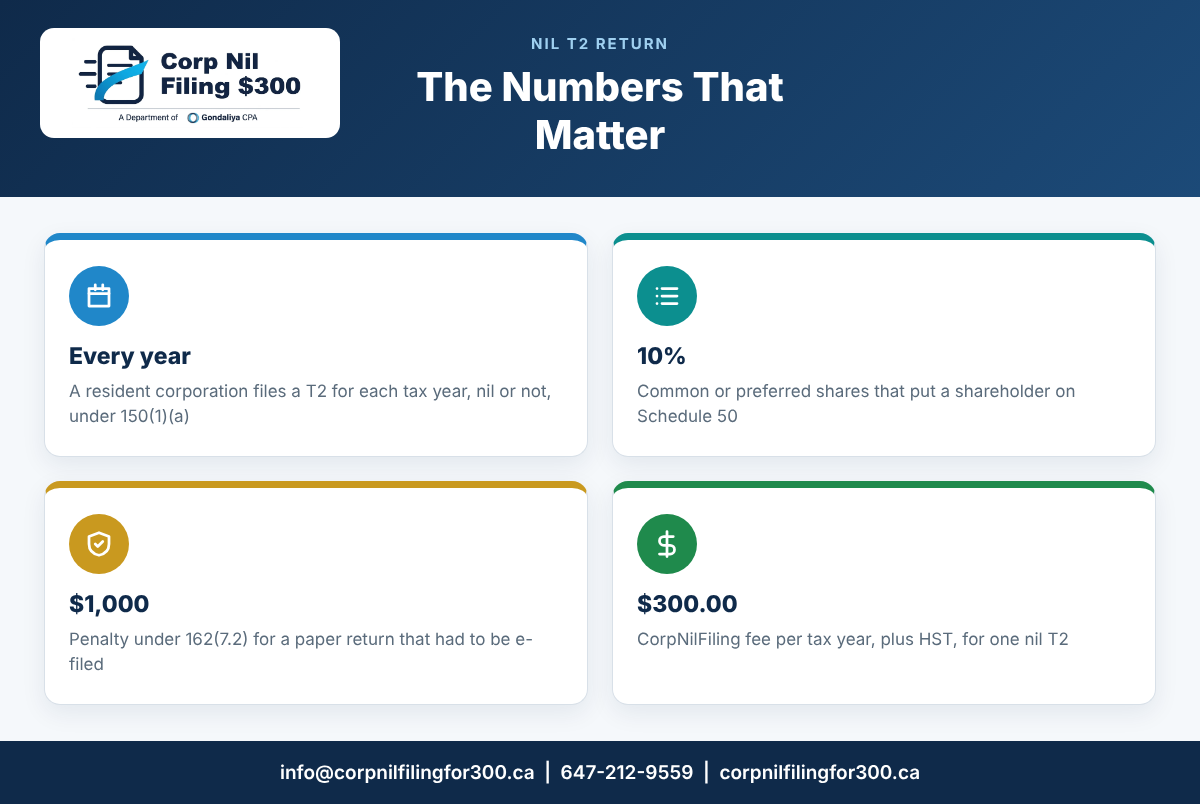
The Numbers That Matter
This article covers Canada, with Ontario and Toronto context, and reflects CRA guidance current to 2026. It is written for owners of inactive, dormant, holding and new corporations asking what a nil T2 return is and whether their corporation must file one. CorpNilFiling is a department of Gondaliya CPA Professional Corporation, which performs compilation engagements under CSRS 4200 and does not offer audit or review engagements. This is educational information only and not tax or legal advice; whether a year is nil depends on the corporation’s facts, and the CRA assesses every return.
What Is a Nil Corporate Tax Return in Canada?
What a Nil T2 Return Is
The Return
A nil corporate tax return, also called a nil T2 return, is the T2 form Canadian companies file when they have no income or activity in the year. It shows the corporation didn’t make money and doesn’t owe taxes. Think of it as telling the Canada Revenue Agency (CRA), “Hey, nothing happened here financially.”
Even if all amounts are zero, some schedules must be included. For example, Schedule 50 goes in if any shareholders own 10% or more. Missing this filing can lead to CRA penalties.
Who Must File a Nil T2 Return?
Paragraph 150(1)(a) of the Income Tax Act says every Canadian resident corporation must file a T2 return every tax year, even with no income or activity. There are exceptions under paragraph 150(1.1)(a) for certain corporations like tax-exempt Crown corporations, Hutterite colonies and corporations that were registered charities throughout the year.
Non-resident corporations also have to file if they do business in Canada or earn taxable capital gains from Canadian property sales.
Here’s a quick summary:
- Canadian Resident Corporations: Must file nil T2 returns regardless of income.
- Non-Resident Corporations: Must file when doing business in Canada or disposing taxable Canadian property.
Knowing these rules helps avoid penalties for not filing on time with CRA.
Differences Between Nil Return, Loss Return, and Active Filing
It’s easy to mix up different corporate filings. Here’s how they differ:
| Type | Description |
|---|---|
| Nil Return | Filed when no income or activity happens; reports zeros across the board. |
| Loss Return | Filed when expenses are more than income; shows losses to carry forward later. |
| Active Filing | Filed by businesses operating regularly; includes detailed financial data. |
A nil return means no business took place but still follows legal rules. Loss returns track losses for future use. Active filings cover normal operations with full details.
Common Corporations Required to File a Nil Return: Inactive, Dormant, Holding, and New Corporations
Certain types of corporations often need to file a nil T2 return:
- Inactive Corporations: These don’t do business but keep their registration active.
- Dormant Corporations: They may hold assets but don’t generate income during the year.
- Holding Companies: Usually just hold investments and don’t trade actively; still must file yearly returns even if inactive.
- New Corporations: Start dormant before business begins but need to file from day one.
Filing right keeps these companies in good standing with CRA and avoids future issues related to missing returns or penalties.
An owner in Markham had a numbered company that was incorporated for a project that never started, and had assumed nothing needed filing. The corporation had no bank account and nothing on its balance sheet, so we filed its first T2 with nil amounts, Schedule 24 and Schedule 50 for its one shareholder, and left the GIFI schedules off as the CRA allows for a corporation inactive all year. Figures changed for privacy.
CRA Requirements for Nil Corporate Tax Returns
CRA Requirements and Key Forms
The Rules
A nil T2 return means you file a full corporate tax return showing zero amounts. This happens when your corporation has no income or activity during the year. In Canada, every corporation that lives here at any time during the year must file a T2 return. This rule comes from paragraph 150(1)(a) of the Income Tax Act. You must file even if you owe no tax. That includes corporations with no income tax return to report, like inactive or dormant companies.
Some exceptions exist but only for certain groups. Registered charities, some Hutterite colonies, and tax-exempt Crown corporations don’t have to file, based on paragraph 150(1.1)(a). If you don’t fit these groups, you still need to send either a nil corporate tax return Canada or a regular T2 showing your finances.
Filing keeps you in line with CRA rules and maintains your good standing. Even if your corporation has no revenue Canada, residency creates a filing duty.
Key fact: Every Canadian resident corporation files yearly under paragraph 150(1)(a), even if it submits nil returns.
Mandatory Electronic Filing for T2 Returns After 2023
Starting with tax years after 2023, all T2 returns—nil ones included—must be filed electronically. This is set by subsection 150.1(2.1) of the Income Tax Act. Paper returns are accepted only from the corporations the CRA exempts: insurance corporations, non-resident corporations, corporations reporting in a functional currency and corporations exempt from tax under section 149.
If you don’t follow this rule, you face penalties under subsection 162(7.2). The penalty is $1,000 for each return that had to be filed electronically and was not.
This e-filing rule applies to every corporation outside those categories that must file a T2 in Canada—even those without taxable income or payable taxes. It helps the CRA process returns faster and avoid mistakes.
You need Form T183CORP before filing electronically (more on this below). Many use authorized filers like CorpNilFiling’s CPA firm to handle this at an affordable price.
Warning: Not filing electronically for tax years starting after 2023 risks a $1,000 penalty.
Understanding Key Forms and Schedules: Schedule 50, Schedule 24, GIFI Schedules 100, 125, and 141
When filing nil corporate tax returns Canada or regular ones, some forms and schedules matter:
- Schedule 50 – Shareholder Information: A private corporation fills this out for each shareholder holding at least 10% of its common or preferred shares.
- Schedule 24 – First-Time Filer: Used on your corporation’s first federal income tax return after incorporation, and on the first return after an amalgamation or the wind-up of a subsidiary into its parent. It identifies the predecessor or subsidiary corporations involved.
- GIFI Schedules (General Index of Financial Info):
- Schedule 100 shows your balance sheet.
- Schedule 125 covers income statements.
- Schedule 141 is the notes checklist, which records who prepared the financial statements and the type of engagement.
These GIFI schedules provide financial data required for most filings but can be skipped if your corporation had no balances during the year—a condition accepted by CRA but not mandatory.
Together these forms help keep records right while meeting legal demands—even when reporting zeros common in nil filings.
| Item | When Required | Source |
|---|---|---|
| Schedule 50 | Shareholders ≥10% ownership | Income Tax Act / CRA Guide |
| Schedule 24 | Corporation’s first federal corporate year | Income Tax Act / CRA Guide |
| GIFI Schedules | Unless fully inactive with no balances | RC4088 GIFI guide |
Completing Form T183CORP for E-Filing Compliance
Form T183CORP lets accountants or CPA firms file your corporate tax return electronically with CRA securely.
For every nil corporate tax return Canada that a tax preparer files online, the corporation must complete Form T183CORP. This confirms taxpayer consent for electronic filing done by licensed pros like CorpNilFiling’s team members Sharadkumar Gondaliya CPA and Vandana Goel CPA who check everything before submitting.
Without Form T183CORP properly signed through secure digital methods following current rules, your preparer cannot transmit the return—and a return that goes in late risks the late-filing penalty under subsection 162(1).
Tax Legislation Impacting Nil Returns: Paragraphs 150(1)(a), 150(1.1)(a), Subsections 150.1(2.1) and 162(7.2)
The laws that say who files which type of corporate taxes—including nil returns—are mostly found in Canada’s Income Tax Act:
- Paragraph 150(1)(a) says every Canadian-resident corporation must file an annual federal income-tax-return no matter what.
- The exception at paragraph 150(1.1)(a) applies only to:
- Registered charities that keep their status all year,
- Certain Hutterite colonies,
- Specific Crown corporations exempt from tax.
- All other resident corporations have to file even if they report zero income called “nil” returns using normal forms—not special ones just labeled “nil.”
Electronic filing rules come from:
- Subsection 150.1(2.1) requiring mandatory e-filing for tax years starting after December 31, 2023;
- Not following this causes penalties found in:
- Subsection 162(7.2) imposing a $1,000 penalty for each return that had to be filed electronically and was not (CRA guidance on completing your T2 return).
These rules make sure all corporations handle yearly duties right—whether active or not—across Canada including Ontario firms served by CorpNilFiling’s expert team.
[Sources:]
- Canada Revenue Agency — Who Has To File A Corporate Income-Tax Return?
- Income Tax Act, R.S.C. 1985, c. 1 (5th Supp.), ss. 149–151
- CRA Guide RC4088 General Index Of Financial Information (GIFI)
- Form T183CORP Information Return for Corporations Filing Electronically
Step-by-Step Guide to Filing a Nil T2 Return in Canada
Filing a Nil T2 Step by Step
How to File
Every corporation living in Canada must file a T2 return, even if it made no money or owes no tax. A nil corporate tax return Canada means sending in the T2 form with all zeros for that year. This keeps your company on the CRA’s good list.
First, check if your corporation really had no reportable income or taxable events. Then, get the T2 nil return Canada ready and file it online with all needed forms unless you have a special reason not to.
Eligibility and Use of the T2 Short Return for Nil Filings
Some corporations can use the easier T2 Short form when filing nil returns. To qualify, these rules usually apply:
- The corporation must be a Canadian-controlled private corporation (CCPC) all year, or a corporation exempt from tax under section 149.
- It must have nil net income or a loss for income tax purposes.
- It must have a permanent establishment in only one province or territory.
- No refundable tax credits claimed (other than a refund of instalments), no taxable dividends paid or received, and amounts reported in Canadian dollars.
If your company is neither a CCPC nor tax-exempt under section 149, you cannot use the T2 Short and must file the full form even if nothing happened financially.
The T2 Short makes filing simpler but still needs info like shareholder details on Schedule 50 when needed. Check carefully if you qualify to avoid penalties or having to redo the return (CRA: Completing your T2 return).
Essential Documents and Information Needed for Nil Return Filing
Filing a nil corporate tax return Canada means more than just putting zeros on lines. You also need these papers:
- Schedule 50 – Shareholder Information: Lists each shareholder holding 10% or more of the corporation’s common or preferred shares.
- Schedule 24 – First-Time Filer: Used on a corporation’s first return after incorporation, and on the first return after an amalgamation or the wind-up of a subsidiary into its parent, to identify the corporations involved.
- GIFI Schedules 100 (Balance Sheet), 125 (Income Statement), and 141 (Notes Checklist): These go with most returns unless your company did nothing all year with no balance sheet or income statement amounts—then you might skip them (RC4088 GIFI guide).
- Form T183CORP – Electronic Authorization: Needed for e-filing so your CPA firm can send returns securely under subsection 150.1(2.1).
Make sure everything is right before you send it to avoid CRA asking for fixes later.
Filing Deadlines and Avoiding the $1,000 Penalty Post-2023
For tax years starting after 2023, every corporation must file its nil corporate tax return Canada online. This rule is in subsection 150.1(2.1) of the Income Tax Act (ITA). Paper forms won’t work except for the categories the CRA exempts.
If you don’t file electronically, CRA will charge a $1,000 penalty under subsection 162(7.2)—even if you owe no tax (CRA Notice).
To avoid this penalty:
- File your nil T2 return online well before due dates.
- Sign Form T183CORP before your preparer transmits the return; the preparer keeps it on file, so EFILE can accept the return from trusted filers like CorpNilFiling.
Following these rules keeps your company free from fines while staying right with CRA everywhere in Ontario and beyond.
Handling Special Cases: Corporations With Investment, Rental Income, or Taxable Dividends
Some things stop your return from being “nil.” Watch out if your company had any of these:
Investment Income
If you earned interest, got taxable dividends from other companies, or made capital gains—even small ones—you must report it. This makes your return non-nil (ITA section 3).
Rental Income
If you collected rent, report it on GIFI Schedule 125 with your full return. Don’t leave this out thinking it’s zero; rental income counts as taxable revenue (CRA Guide: Completing Your Corporate Tax Return).
Paid or Received Taxable Dividends
Dividends paid out by your holding company or received from subsidiaries are reported on Schedule 3, and dividends paid to individual shareholders also need T5 slips. This means no zeroed-out “nil” filing for those years under ITA rules about distributions.
So basically:
If investment income, rental money, or dividends show up in the year, file a full non-nil corporate tax return—not a simple zero one.
Benefits of Filing a Nil Corporate Tax Return
Benefits and Risks
Why It Matters
Filing a nil T2 return matters even when your corporation shows no income tax payable in Canada. It proves you follow the Income Tax Act rules and keeps your record clean with the CRA. If your company didn’t do any business, sending in a nil corporate tax return Canada still meets your filing duties on time.
Even companies with no income must file to avoid trouble or fines. A nil T2 return acts as proof that your revenue or taxable amount is zero for the year. This stops tax authorities from thinking you ignored your responsibilities and helps when business picks up again.
Here’s why filing a nil return helps:
- Shows official zero activity
- Avoids penalties for missing returns
- Keeps records accurate for future filings
- Maintains good standing with CRA
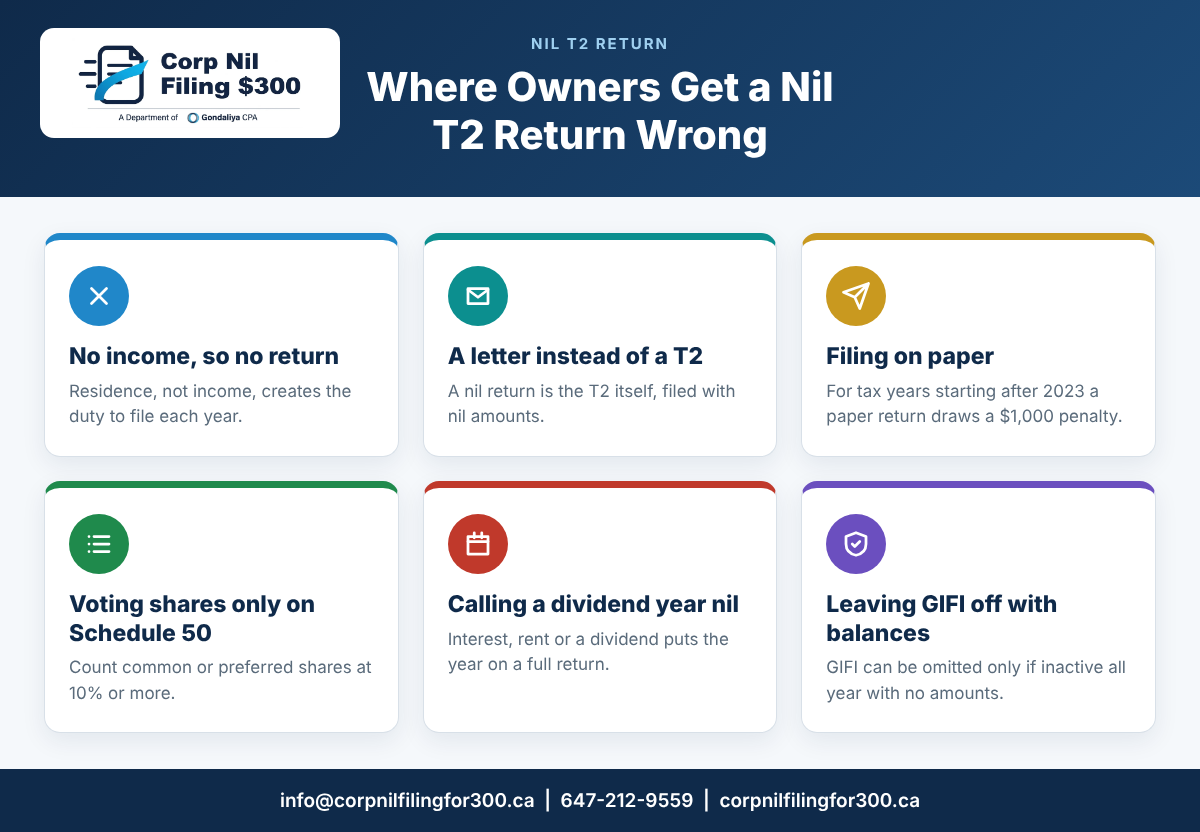
How Filing Nil Returns Supports Loss Continuity and Tax Credit Claims
Filing a nil T2 return helps protect loss continuity under Canadian tax laws. Non-capital losses can generally be carried forward 20 years to offset future income, and filing every return, even nil ones, keeps the loss record on Schedule 4 complete so a later claim is easy to support.
Refundable credits also need correct reporting. Refundable credits are claimed only on a filed return, some within their own deadlines, so filing a zero income corporate tax return on time keeps the filing record complete. Without it, the CRA might delay or reject your claims.
In short:
- Keeps the loss carryforward record complete
- Keeps refundable credit claims alive
- Prevents delays from missing paperwork
Skipping filings during quiet times can delay the use of past losses, and a refund is generally paid only if the return is filed within three years after the end of the tax year.
Risk and Consequences of Not Filing Nil Returns Timely
For tax years starting after 2023, all T2 returns, including nil ones, must be filed electronically (subsection 150.1(2.1)). If not, a $1,000 penalty applies per return filed on paper when it had to be filed electronically (subsection 162(7.2)).
Missing deadlines brings the late-filing penalty under subsection 162(1), which is a percentage of unpaid tax and so is nil when no tax is due; the duty to file and the $1,000 e-filing penalty remain. E-filing is mandatory unless you meet rare exceptions.
Key points to avoid penalties:
- File every annual T2 return electronically
- Don’t assume inactivity excuses you
- File electronically to avoid the $1,000 penalty
Every resident corporation must file its T2 return regardless of business activity (paragraphs 150(1)(a), (1.1)(a)).
Compliance Obligations for Corporations Without Bank Accounts or Assets
Not having a bank account or assets doesn’t remove your filing duties as a resident corporation CRA “Who Has To File”. Inactive companies must still send complete nil T2 returns yearly.
Just being inactive isn’t enough to skip filings. The CRA expects official forms showing zero activity instead of informal notes about dormancy or no assets.
This applies across Ontario and Canada where CorpNilFiling operates—rules are the same everywhere.
Remember:
- No bank account ≠ no filing
- No assets ≠ no filing
- File yearly nil returns regardless
Reporting Currency Considerations for Non-Canadian-Dollar Filings
If your corporation reports in a currency other than Canadian dollars, you can’t just file fully nil returns. Currency conversion changes balances on GIFI schedules RC4088 GIFI Guide.
Exchange rate effects often show non-zero amounts, so simple zero declarations don’t meet CRA rules defining “nil.”
What this means:
- Foreign currency filings may show amounts due to exchange changes
- Annual reports may need full details beyond zeros on key schedules (like Balance Sheet) T4012 Chapter 4
- Companies outside CAD should check if their filing truly counts as “nil” before submitting simplified returns
Otherwise, incomplete filings could lead to CRA reviews or questions later.
A family holding company had filed nil returns for three quiet years, then received a $4,200 dividend from an operating company it owned. That year was not nil: the dividend went on Schedule 3, the GIFI schedules went back in, and the return moved from the T2 Short to the full T2. The following year, with no dividend, it returned to a nil filing. Figures changed for privacy.
Pricing Options for Nil T2 Filing Services Starting at $300
Pricing and Expert Help
Pricing
The fee for nil T2 return service starts at $300 plus HST each tax year. It covers one corporation’s electronic filing with all needed schedules included. This price fits corporations with no income tax return activity in Canada.
You get the full T2 or eligible T2 Short, Schedule 50 (for shareholders with 10%+ ownership), Schedule 24 for first returns, loss continuity schedules, and the Form T183CORP signing package. A CPA reviews everything before it is sent securely to CRA.
This flat rate has no hidden fees for extra forms or filings. It works well for dormant companies, inactive holding corporations, numbered companies that never started, and other firms needing a corporation with no income tax return filed right under paragraph 150(1)(a) of the Income Tax Act CRA source.
Comparison of Do-It-Yourself vs. Professional Nil Return Filing Assistance
You can file a nil T2 return yourself, but it takes knowing tricky CRA rules about when a return is not nil and which schedules must go in even if values are zero. Missing Schedule 50 for big shareholders, skipping loss continuity details, or ignoring mandatory electronic filing may cause fines.
Here’s a quick look at DIY vs CPA firm help:
- Knowledge Needed: DIY requires strong understanding; CPA firms have experts.
- Error Risk: Higher chance of mistakes on your own; CPAs reduce errors.
- Electronic Filing: You must register and file online alone; firms handle this.
- Time: DIY takes lots of time; firm does most work.
- Cost: DIY costs vary (software + time); firms charge fixed fee ($300 plus HST).
- Support: Limited help if you DIY; full support with corrections if using firm.
For owners with corporations with no income tax return activity in Canada, CPA help means fewer worries and better accuracy. At CorpNilFiling, we do everything—from first review to final e-filing—making sure your nil corporate tax return Canada meets all CRA rules without stress.
Advantages of Online Corporate Tax Filing Platforms for Nil Returns
For tax years starting after 2023, electronic filing becomes mandatory under subsection 150.1(2.1) Income Tax Act. You must file through CRA-certified tax software, either directly through Corporation Internet Filing or through a registered EFILE transmitter, to avoid penalties like the $1,000 penalty under subsection 162(7.2).
Using online platforms makes filing easier:
- Immediate confirmation when you submit
- Built-in checks to catch common mistakes
- Automatic updates following CRA rules
- File anytime from anywhere without paper hassles
The CRA issues a confirmation number when it accepts the return, which proves timely filing, and CorpNilFiling emails that confirmation to you within three business days. This helps avoid any dispute about meeting deadlines.
Security and Privacy Measures in Electronic Tax Filing
When a preparer files electronically, Form T183CORP is signed by an authorized signing officer of the corporation, who authorizes the preparer to send the return this way following CRA rules. This form keeps your info safe by letting only proper parties file.
- Encrypted data protects your financial details
- Secure logins handled by licensed professionals
- Audit trails keep track of all steps taken
- Firms like CorpNilFiling follow strict privacy and CPA Ontario ethics
These steps reduce risks in digital filings while keeping transparency between clients and authorities.
How to Access Expert Help with Nil Corporate Tax Returns
If you want expert help, reach out to licensed Ontario CPA firms focusing on nil corporate filings. CorpNilFiling is part of Gondaliya CPA Professional Corporation recognized by CPA Ontario (verify license here).
Sharad Gondaliya, CPA leads this team offering affordable service for dormant or inactive Canadian corporations around Toronto including Mississauga, Brampton, Vaughan, and across Canada.
Start your nil T2 filing professionally for $300 plus HST per year. Call 647‑212‑9559 or email info@corpnilfilingfor300.ca today.
Summary of Nil Corporate Tax Return Filing Requirements and Processes
Summary and Next Steps
Summary
A nil T2 return means a corporation files a tax return even if it had no income or expenses. In Canada, every corporation that lives here at any point in the year must file a T2 return. This rule comes from paragraph 150(1)(a) of the Income Tax Act. It applies even if the company did nothing or earned no money.
Filing a nil corporate tax return in Canada means sending in the full T2 form or the T2 Short version with zero amounts where needed. Some key schedules might be needed too. For example: Schedule 50 for shareholder info, Schedule 24 for first-time filers, and GIFI Schedules 100 (balance sheet), 125 (income statement), and 141 (notes checklist). If the company was totally inactive with no data, some schedules might be skipped.
The filing duty exists whether or not there is taxable income or tax to pay. A nil year ends if things like investment income show up. Also, taxable dividends paid or received, permanent establishments in more than one province or territory, refundable credits, a non-Canadian reporting currency, Ontario transitional tax debits, or section 34.2 amounts mean the corporation cannot use the T2 Short.
Encouraging Compliance: Next Steps for Corporations with No Tax Payable
For tax years after 2023, companies must e-file their nil T2 returns in Canada. This comes from subsection 150.1(2.1) of the Income Tax Act. Not doing this can cost $1,000 under subsection 162(7.2). The CRA enforces this rule strictly; paper returns are accepted only from the categories the CRA exempts, such as non-resident and insurance corporations.
Corporations should prepare returns using approved software that creates Form T183CORP with electronic signatures. All required schedules and GIFI reports must be included when needed. Shareholder records help fill Schedule 50 correctly when shareholders own ten percent or more of the common or preferred shares.
To avoid penalties:
- File electronically on time
- Make sure all lines are filled properly
- Show inactivity clearly with complete reporting
Remember: Nil doesn’t mean incomplete paperwork but full disclosure of no activity.
Contact Information for Professional Nil T2 Return Support
Corp Nil Filing offers to prepare and e-file nil corporate tax returns for $300 plus HST per year anywhere in Ontario—from Toronto to Mississauga, Markham, Ottawa, and Hamilton.
We provide:
- Full review before filing
- Preparation of all necessary schedules
- Secure e-signing via Form T183CORP
- One corrected resubmission if CRA rejects
- Confirmation email within three business days
Call 647‑212‑9559 or email info@corpnilfilingfor300.ca to start your nil T2 filing without penalty risk and get support backed by 1300+ 5-star Google reviews.
Additional Resources for Corporation Income Tax Return Filing in Canada
| Item | Reference | Notes |
|---|---|---|
| Mandatory filing | Paragraphs 150(1)(a) & 150(1.1)(a) | All Canadian-resident corporations must file yearly; few exceptions |
| Electronic filing mandate | Subsection 150.1(2.1); Penalty §162(7.2) | E-filing required for tax years starting after 2023; $1,000 penalty if you fail |
| Shareholder disclosure | Schedule 50 | Needed if shareholders hold ≥10% of common or preferred shares |
| First-time filer schedule | Schedule 24 | Required on the first return after incorporation, amalgamation or a subsidiary wind-up |
| Financial statements | GIFI Schedules | |
| – Balance Sheet | – Schedule 100 | – Can be omitted only if inactive all year with no balance sheet or income statement amounts |
| – Income Statement | – Schedule 125 | – Same omission rule |
| – Notes Checklist | – Schedule 141 | – Same omission rule |
These resources show what you must include so your nil return is proper and doesn’t trigger extra CRA checks due to activity beyond “nil.”
See related guides on finishing your nil T2 filing correctly under current CRA rules.
User Engagement: How to Start Your Nil T2 Filing Today
Starting your nil corporate income tax return is easy with expert help at $300 plus HST per year. This price covers electronic filing and a CPA review before submission.
Steps to begin:
- Gather company info like Business Number (BN) and fiscal period dates
- Prepare shareholder list showing who owns ≥10% of the common or preferred shares
- Collect past notices if you have them
- Contact Corp Nil Filing by phone (647‑212‑9559) or email (info@corpnilfilingfor300.ca)
Our team will guide you through what’s needed so we can prepare your full federal package—including GIFI schedules—and send it securely online on time to avoid costly late-filing penalties or issues with non-electronic submissions.
Verdict: A corporation resident in Canada files a T2 every year whether or not anything happened, and a nil return is that T2 with nil amounts, Schedule 50 where a shareholder holds 10% or more, and electronic filing for tax years starting after 2023. The year stops being nil the moment investment income, rent or a dividend appears.
2026 Update: For returns filed in 2026, the electronic filing rule for tax years starting after 2023 applies to nil returns as it does to any other T2, and the $1,000 penalty under subsection 162(7.2) is the one for a return filed on paper. Unchanged: the duty to file every year under paragraph 150(1)(a), the exceptions in paragraph 150(1.1)(a), the 10% Schedule 50 threshold and the GIFI omission for corporations inactive all year.
Frequently Asked Questions About Nil T2 Returns
Frequently Asked Questions
FAQ
What is loss continuity and how does it affect nil T2 returns?+
Loss continuity is the record of losses carried forward, kept on Schedule 4. Filing nil returns on time keeps that record complete, so past losses can be supported when they are claimed.
When is the first-time filer declaration required in nil corporate tax returns?+
Schedule 24 goes on a corporation’s first return after incorporation, and on the first return after an amalgamation or a subsidiary wind-up, to identify the corporations involved.
How does having more than one permanent establishment impact T2 filing?+
Corporations with permanent establishments in more than one province or territory allocate income among them on Schedule 5 and cannot use the T2 Short.
What is the effect of Ontario transitional tax debit on filing a nil return?+
If an Ontario transitional tax debit or section 34.2 amounts exist, the corporation cannot use the T2 Short and files the full T2.
Who must file Schedule 50 when submitting a nil T2 return?+
Schedule 50 must be filed by a private corporation for each shareholder holding 10% or more of its common or preferred shares.
How do refundable credits claimed influence the nil status of a corporate return?+
Claiming refundable tax credits, other than a refund of instalments, rules out the T2 Short; the full T2 is filed with the credit claims.
What are the criteria for T2 Short eligibility regarding non-CCPC corporations?+
Corporations that are not CCPCs cannot use the T2 Short unless they are exempt from tax under section 149, and file the full T2 even when reporting no income.
How does using non-Canadian-dollar reporting currency affect nil T2 filing?+
A corporation reporting in a functional currency cannot use the T2 Short, and exchange rate fluctuations often leave non-zero amounts, so the return is usually not nil.
When should Form T183CORP signing package be completed?+
Form T183CORP must be signed before a preparer transmits any return electronically, including nil filings; the preparer keeps it on file to show the corporation authorized the transmission.
What penalties apply for failing electronic submission under subsection 150.1(2.1)?+
Failing to e-file as required for tax years starting after 2023 triggers a $1,000 penalty for each return filed on paper under subsection 162(7.2).
Industry Spotlights: Sectors With Nil Years
Industry Spotlights
Nil years turn up in every sector, usually at the start, between projects or at the end of a corporation’s life. In each case the question is the same: is the year truly nil, and the answer to whether a return is due is always yes.
| Sector | Nil Year | Trigger to Watch |
|---|---|---|
| Real estate holding companies | Between property purchases | Rent collected makes the year not nil |
| Property developers holding land | Land held before construction | Interest or a sale ends the nil year |
| Physician and dental professional corporations | Opened before practice income starts | The first billing ends it |
| Technology startups before revenue | Incorporated before launch | Grants, interest or first sales |
| E-commerce brands not yet launched | Set up before the store opens | The first sale |
| Consultants between contracts | A year with no billings | Interest on cash left in the company |
| Skilled trades | A company paused between jobs | Equipment sold during the pause |
| Restaurants not opened or closed | A lease that never started, or a closed location | Assets sold on closing |
| Transportation owner-operators | A truck sold and the company parked | The gain on the truck sale |
| Family investment holding companies | Shares held with no income | Any dividend received |
| Non-resident-owned Canadian companies | A Canadian company with foreign owners | Residence still triggers the return |
- Real estate holding companies: A property company between purchases can have a nil year, but the first month of rent puts the year on a full return.
- Property developers holding land: Land held ahead of construction can leave several quiet years, each needing its own return; interest earned or a sale ends the nil run.
- Physician and dental professional corporations: A corporation opened before practice income starts files a nil first return, with Schedule 24, until the first billing.
- Technology startups before revenue: A pre-launch year can be nil, but grants, interest or first sales end it, and the return is due either way.
- E-commerce brands not yet launched: A brand set up before the store opens files a nil return until the first sale.
- Consultants between contracts: A year with no billings can be nil, though interest on cash left in the company is income.
- Skilled trades: A company paused between jobs files each year, and equipment sold during the pause can end the nil year.
- Restaurants not opened or closed: Returns stay due until the corporation is dissolved, and assets sold on closing usually mean a full return.
- Transportation owner-operators: A parked company still files, and the year the truck is sold is not nil.
- Family investment holding companies: A company holding shares and nothing else can be nil, but any dividend received puts that year on a full return.
- Non-resident-owned Canadian companies: A corporation resident in Canada files every year whoever owns it, and owners abroad should keep the mailing address current.
Professional Guidance & Quick Reference
Quick Reference
Key Filing Considerations for Nil Corporate Tax Returns
- Permanent Establishment: PEs in more than one province or territory require income allocation and rule out the T2 Short.
- Dividend Reporting: Taxable dividends paid or received rule out the T2 Short; full returns are required.
- Refundable Tax Credits: Claiming these ends eligibility for the T2 Short.
- Ontario Transitional Tax Debit: Presence rules out the T2 Short; report fully with schedules.
- Loss Continuity: Timely filing keeps the loss carryforward record complete; losses still expire on their own carryforward periods.
- Non-CCPC Status: Requires standard full T2 filing, no short form option despite inactivity unless tax-exempt under section 149.
- Foreign Currency Use: Exchange impacts require fuller financial reporting beyond zeros.
- Schedule 50 Mandate: Must include shareholder details for each shareholder holding ≥10% of the common or preferred shares.
- Form T183CORP Authorization: Essential for e-filing via authorized filers like Corp Nil Filing team members.
- Penalty Avoidance Strategies: File electronically on time, include all mandatory schedules, and properly sign Form T183CORP.
Quick Answers
At a Glance
| Question | Answer |
|---|---|
| What a nil T2 is | The ordinary T2, or the T2 Short where eligible, filed with nil amounts |
| Who must file | Every corporation resident in Canada at any time in the year, under paragraph 150(1)(a) |
| The exceptions | Tax-exempt Crown corporations, Hutterite colonies and registered charities throughout the year |
| Schedule 50 | Each shareholder holding 10% or more of the common or preferred shares |
| Schedule 24 | First return after incorporation, amalgamation or a subsidiary wind-up |
| GIFI | May be left off only if inactive all year with no balance sheet or income statement amounts |
| How it is filed | Electronically for tax years starting after 2023 |
| Paper filing | $1,000 penalty under subsection 162(7.2), outside the exempt categories |
Who This Is For / Not For
Fit Check
- For: owners of inactive, dormant, holding and new corporations with a tax year that had no income or activity.
- For: corporations winding up that need a nil final return before dissolution.
- Not for: corporations with investment income, rent or dividends in the year, which file a full return.
- Not for: individuals filing a personal T1 return.
People Also Ask
Related Questions
Is a nil T2 return a separate form?+
No. It is the ordinary T2, or the T2 Short where the corporation qualifies, filed with nil amounts. A letter to the CRA saying the corporation was inactive does not replace it.
When is a nil T2 return due?+
The same as any T2: six months after the end of the tax year. A nil return gets no extra time.
Can a nil T2 be filed on paper?+
Not for tax years starting after 2023, unless the corporation is in one of the exempt categories, such as non-resident or insurance corporations.
Do I need GIFI schedules for a nil return?+
Only if the corporation had balance sheet or income statement amounts. A corporation inactive all year with none may leave them off.
Does a holding company with no activity file a nil return?+
Yes, for any year with no income. A year with a dividend, interest or a capital gain is reported on a full return instead.
Glossary of Key Terms Related to Nil T2 Returns
Definitions
- Nil Return: A T2 filed with nil amounts for a tax year with no income or activity.
- T2: The federal corporation income tax return every corporation resident in Canada files each tax year.
- T2 Short: A shorter version of the T2 for eligible CCPCs and section 149 tax-exempt corporations.
- GIFI: The General Index of Financial Information, the coded format for financial statements on Schedules 100, 125 and 141.
- Schedule 50: Shareholder information for each shareholder holding 10% or more of the common or preferred shares.
- Schedule 24: First-time filer schedule after incorporation, amalgamation or a subsidiary wind-up.
- Loss Continuity: The record of losses carried forward and applied, kept on Schedule 4.
- CCPC: A Canadian-controlled private corporation.
- Permanent Establishment: A fixed place of business that decides which province or territory taxes the corporation’s income.
- Form T183CORP: The form a corporation signs to authorize a preparer to file its return electronically.
- EFILE: The CRA service registered preparers use to transmit returns electronically.
Want a checklist to work from? You can download the free nil T2 return checklist before you start your filing.
This quick self-check shows what your return is likely to need. Please answer the five questions below.
Nil T2 Return Check
Five quick questions on your tax year. No fee shown.
Points to raise with us:
This is a general prompt, not tax or legal advice or a quote. Whether a year is nil depends on your full facts.
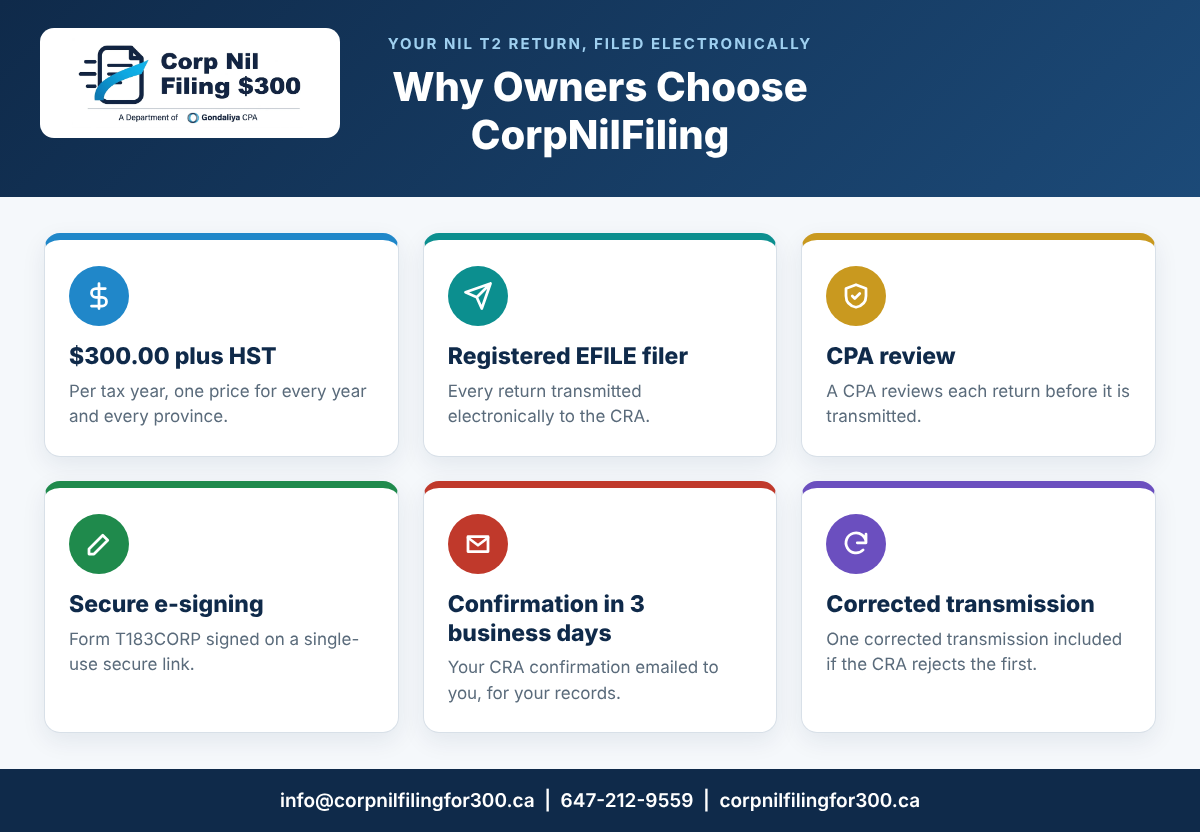
Filing Your Nil T2 Return: How CorpNilFiling Can Help
Start with your business number, your year-end and your shareholder list
CorpNilFiling confirms whether your year is nil, prepares the T2 with Schedule 50, Schedule 24 where it is a first return and GIFI where required, sends you Form T183CORP to sign securely, and has a CPA review each return before it is transmitted electronically — at $300.00 plus HST per tax year, with your CRA confirmation emailed within 3 business days.
Next Steps
Please start your filing with CorpNilFiling and have three things ready: the corporation’s business number and year-end, the share register showing who holds 10% or more, and any notices the CRA has sent. Those three tell us whether the year is nil and which schedules go in. We are open 9:00 AM to 8:30 PM, Monday to Sunday, at 55 Queen St E, Suite 1205, Toronto, and file for corporations across Canada. If our content helps, please add corpnilfilingfor300.ca as a preferred source on Google.
Published: · Last updated:
Editorial policy: We research against CRA, Department of Justice, CPA Canada and CPA Ontario sources, fact-check the figures, and Sharad Gondaliya, CPA, reviews the content, which we update as the rules change.
Disclaimer: This article is educational information only and is not tax or legal advice. Whether a year is nil, whether the T2 Short applies and whether a penalty applies depend on the facts and current law, and the CRA assesses every return. Gondaliya CPA performs compilation engagements under CSRS 4200 and does not perform audit or review engagements. Please consult a licensed CPA before acting.