



Mandatory Electronic Filing for Corporations Canada: Understanding T2 E-file After 2023 with Corporation Nil Filing
Mandatory electronic filing corporations Canada rules require all businesses to submit their T2 returns electronically after 2023, and Corporation Nil Filing supports this transition with hassle-free T2 e-filing services. Their $300 offering helps meet the T2 electronic filing requirement efficiently, ensuring compliance with new CRA regulations.
Quick Summary
For every tax year that starts after 2023, a corporation sends its T2 to the CRA electronically. The test is the date the tax year begins, not the date the return is filed, so a late return for a covered year is still an electronic return. No activity, no income and a nil return change nothing. Only the four categories the CRA lists sit outside the rule.
- A covered year is any tax year that starts after 2023.
- Nil, dormant and holding company returns are filed electronically too.
- A paper return for a covered year draws a $1,000 penalty for the corporation.
- Keep the CRA confirmation number with the signed Form T183CORP.
Reading time: 31 minutes.
Table of Contents
- Understanding Mandatory T2 Electronic Filing Requirements for Corporations in Canada
- Who Must File a T2 Corporation Income Tax Return?
- Resident Corporations Filing Obligations
- Non-Resident Corporations and Filing Requirements
- Exceptions to Mandatory Electronic Filing of T2 Returns
- How to File Your T2 Return Electronically
- Deadlines and Timelines
- Penalties for Non-Compliance
- After You File: Enquiries and Reassessments
- Additional Resources, Forms and Publications
- Frequently Asked Questions
- Industry Spotlights
- Professional Guidance & Quick Reference
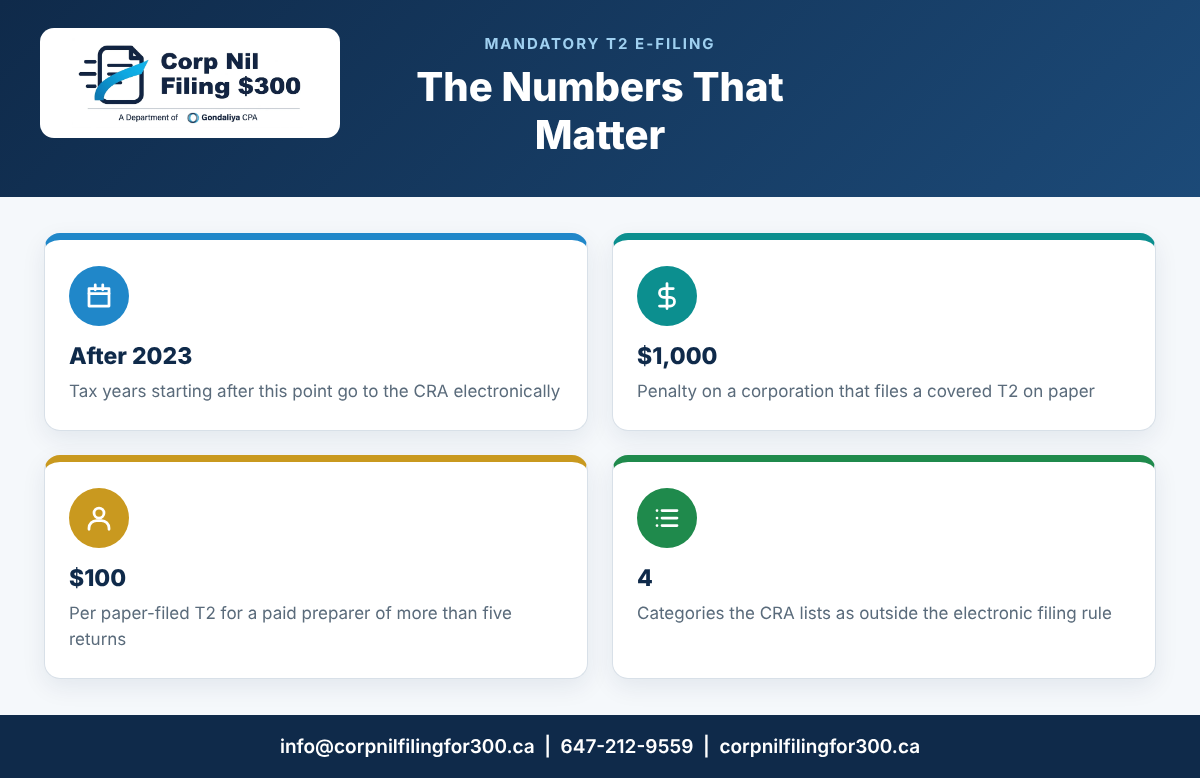
The Numbers That Matter
This article covers Canada, with Ontario and Toronto context, and reflects CRA guidance current to 2026. It is written for owners of Canadian corporations — particularly inactive, dormant and holding companies filing nil T2 returns — who need to know how the electronic filing rule applies to them. CorpNilFiling is a department of Gondaliya CPA Professional Corporation, which performs compilation engagements under CSRS 4200 and does not offer audit or review engagements. This is educational information only and not tax or legal advice.
Understanding Mandatory T2 Electronic Filing Requirements for Corporations in Canada
Understanding Mandatory T2 Electronic Filing Requirements
The Rule
Mandatory T2 e-filing is now required for corporations in Canada, especially for tax years starting after 2023. The CRA says that eligible companies must file their income tax returns electronically. This helps make the whole process faster and more accurate.
The electronic filing rule aims to cut down wait times and reduce errors in submissions. So, it’s smart for business owners to know these rules well to avoid any fines or penalties.
- Every corporation must follow mandatory electronic filing.
- This rule starts applying to tax years after 2023.
- Missing the deadline or ignoring this can lead to penalties.
Who Must File a T2 Corporation Income Tax Return?
All corporations registered in Canada need to file a T2 Corporation Income Tax Return every year. It doesn’t matter if they made no money or did no business during the year.
Resident Corporations Filing Obligations
Resident corporations are those incorporated under Canadian laws. They must follow the mandatory T2 e-filing rules no matter what. Even if they have zero income or did nothing (called nil returns), they still have to file electronically.
This also includes companies that are dormant or only hold assets but don’t run active businesses. They must report their status by filing on time.
- Resident corporations must e-file every year.
- Nil returns count too.
- Applies even to holding or dormant companies.
A numbered company incorporated to buy a building that never closed sat untouched for its first three tax years. Each of those years started after 2023, so each nil T2 went to the CRA electronically, with nothing on the return but the share capital and a single shareholder. Figures changed for privacy.
Non-Resident Corporations and Filing Requirements
Non-resident corporations that do business in Canada also have filing duties. If they have any presence or operations inside Canada, they must meet mandatory electronic filing requirements too.
These foreign entities need to follow Canadian tax rules closely and file by the deadlines. Missing these can mean fines or extra audits from authorities.
- Non-residents with Canadian operations must e-file.
- Compliance with CRA deadlines is key.
- Penalties apply for late or missing returns.
Exceptions to Mandatory Electronic Filing of T2 Returns
Not all corporations have to file electronically though. The CRA allows some exceptions, including:
- Insurance Companies: These firms might not need to e-file because their reporting rules differ.
- Non-resident Corporations: Under certain conditions, some non-residents may skip e-filing based on legal details.
- Functional Currency Reporters: Companies using only functional currency reporting may qualify for exemptions.
- Corporation Exempt Under Section 149: Some entities under this section might not have to e-file depending on how they operate and earn income.
If you think your company qualifies for an exception, it’s best to check with a tax expert who knows current CRA rules well before skipping electronic filing.
| Corporation | Covered Year Filed | Basis |
|---|---|---|
| Dormant resident corporation | Electronically | No activity is not an exception |
| Inactive holding company | Electronically | Holding assets is not an exception |
| First-year corporation | Electronically | A first return is not an exception |
| Corporation filing years late | Electronically | The tax-year start decides, not the filing date |
| Insurance corporation | Listed exception | One of the four CRA categories |
| Corporation exempt under section 149 | Listed exception | One of the four CRA categories |
How to File Your T2 Corporation Income Tax Return Electronically
How to File Your T2 Return Electronically
Filing Methods
Starting with tax years after 2023, all corporations in Canada must file their T2 returns electronically. This is called mandatory T2 e-filing. It applies even if your corporation had no activity or income, including nil returns. The CRA set this T2 electronic filing requirement to ensure consistency and compliance.
This rule is based on when your tax year begins, not when you file or the size of your company. You can’t send paper returns for these years without risking a $1,000 penalty per return. That comes from section 162(7.3) of the Income Tax Act. Some companies don’t have to follow this rule though:
- Insurance companies
- Non-resident corporations
- Those using a functional currency
- Others exempt under section 149
Before you submit online, make sure your info is ready and accurate. Use CRA-approved software or online services that meet their standards.
Using CRA-Certified Tax Preparation Software
Certified software approved by the CRA lets authorized users file T2 returns via EFILE securely. This certified software meets CRA’s rules for safe data transmission.
EFILE is popular with tax pros handling many corporate filings every year. It can include schedules like Schedule 50 or Schedule 24 when needed. The software also lets you attach documents digitally during submission CRA: EFILE program.
Only licensed firms or individuals registered as EFILE filers may use certified software for electronic filing on clients’ behalf. This helps them follow mandatory T2 e-filing rules while keeping proof of filing through confirmation numbers.
Certified software cuts down mistakes with built-in validation checks that match CRA’s pre-filing requirements.
Overview of Corporation Internet Filing Options
Corporation Internet Filing allows eligible corporations or their reps to file returns online without extra software. This method supports direct entry into CRA-certified vendor portals.
With electronic transmission included, you get instant confirmation when your return is received. That helps you keep good records CRA: Corporation Internet Filing.
This option suits smaller filers who want to handle their own filings but still meet the mandatory electronic filing requirement starting after 2023 across Canada, including Ontario.
It works for nil filings too and doesn’t add government fees beyond any service charges from providers.
| Route | Who Uses It | Signing |
|---|---|---|
| EFILE | A preparer registered as an EFILE filer | Form T183CORP signed by the corporation |
| Corporation Internet Filing | The corporation or its representative, through certified software | Per the CRA’s filing instructions |
| Paper | Only the four listed categories for a covered year | Signed paper return |
Understanding T2 Auto-fill, Attach-a-doc, and Pre-Filing Validation Services
T2 auto-fill services pull prior year info like financial data into current forms automatically. This reduces typing errors and keeps things consistent CRA: Auto-fill my return.
The attach-a-doc feature lets you upload supporting files such as election forms or notes right with your digital submission. That way, all paperwork goes in at once instead of waiting later.
Pre-filing validation services run automatic checks before you submit to catch common errors early on. These checks match the rules for mandatory T2 e-filing starting from tax years in 2023 CRA: Pre-file validation tool.
Together, these tools improve accuracy and lower the chance your return gets rejected or delayed.
Filing Without a Web Access Code: Alternative Options
You can file without a web access code mainly if an authorized representative uses EFILE credentials linked to your account instead of logging in with business number codes from CRA portals CRA guidance on alternative e-filing methods.
Alternatives include using CPA firms registered as EFILE filers who handle authentication internally but still follow all mandatory electronic filing rules after 2023 across Canada (except those exempt).
These options keep filings on time even if you don’t have your access code handy. But note, they do not allow paper filing nor skip any legal deadlines for digital submissions in provinces like Ontario where CorpNilFiling professionals operate.
Importance of Accurate NAICS Code Reporting in T2 Filing
Reporting the right NAICS code on your T2 return matters a lot. It classifies what type of business activity you do for federal stats and helps policymakers understand industries better Statistics Canada & CRA alignment.
Wrong NAICS codes often trigger flags during pre-filing validations and slow down processing with extra reviews requested later on. This can push back important deadlines tied to mandatory electronic filing starting after 2023 nationwide—including Ontario companies serviced at CorpNilFilingfor300.ca.
Correct NAICS codes also ensure proper application of any sector-specific deductions (if relevant). Just remember this classification doesn’t affect exemptions tied only to business activity levels under current law requiring digital filing for nil returns too.
Deadlines and Timelines for Filing and Payment
Deadlines and Timelines
Dates
Starting with tax years after 2023, all corporations must file their T2 returns electronically. This is a mandatory rule, no matter if the company made money or not. The deadline to file is six months after the tax year ends. CRA follows this rule based on the Income Tax Act, section 150(1).
Corporations have to use approved e-filing methods. This includes EFILE by a registered preparer or Corporation Internet Filing through certified software. If you miss the deadline, you may face late-filing penalties. Also, paper filing when electronic filing is required can lead to a $1,000 penalty (CRA: Completing your corporation income tax (T2) return).
When to File Your T2 Return and Avoid Penalties
If your corporation’s tax year starts after 2023, you must file your T2 return electronically in Canada. Filing on paper causes an automatic $1,000 penalty per return under Income Tax Act section 162(7.3). This applies even if you owe no taxes.
Paid preparers who file more than five paper returns each year get charged an extra $100 penalty for every paper return beyond five (CRA: Mandatory Electronic Filing for Tax Preparers). These rules help keep things in line for both companies and tax professionals.
To stay clear of penalties:
- Check your corporation’s exact tax year start date.
- Use only authorized electronic filing methods.
- Keep proof of submission like confirmation numbers.
If you don’t follow these steps, CRA might audit your filings or ask you to fix errors.
An owner brought us six unfiled years at once, two of which began before the rule and four after it. We mapped every year by its start date first, so the batch was split by the rule that applied to each year rather than by the date we filed it. Figures changed for privacy.
Instalment Payment Due Dates and Balance-Due Day Rules
The T2 return deadline is six months after your fiscal year ends, but instalment payments follow different schedules. These depend on how much tax you owed in previous years. You should check CRA’s instalment due date rules that apply to your company.
You must pay any balance due within two months after your fiscal year ends unless CRA sends a notice saying otherwise. Paying on time avoids interest charges but does not affect the rule about mandatory e-filing deadlines.
Re-appropriation of T2 Statute-Barred Credits
Statute-barred credits happen when claims become too old for reassessment under Income Tax Act rules. This mostly matters during audits. But these credits don’t change the deadlines or requirements to file T2 returns electronically.
It’s smart to keep good records of any credit claims you make. Still, follow all filing rules closely and submit returns on time using electronic methods.
Where to Submit Paper Returns When Electronic Filing Is Not an Option
Some corporations are exempt from mandatory electronic filing, like insurance companies recognized by CRA (Income Tax Act section 149; CRA exemptions list). These companies can still send paper returns without penalties.
For all other corporations in Canada:
- Paper filings aren’t allowed unless there’s a technical problem with e-filing.
- If you must file on paper due to issues, get explicit CRA approval first.
Insurance companies usually mail their returns to special addresses listed in CRA instructions for that sector. Every other corporation has to use approved electronic channels for filings starting after 2023.
Key Stat: A $1,000 penalty applies if a corporation files its T2 return on paper during a covered year Income Tax Act sections 162(7.3); CRA Completing your corporation income tax (T2) return.
CRA Requirement: Corporations with tax years starting after 2023 must file their annual T2 electronically except for four narrow categories including insurance companies Canada.ca.
Risk Warning: Sending nil or active corporate returns on paper during these years leads right away to large fines—even if no taxes are owed Department of Justice – ITA.
Pro Tip: Track your corporation’s exact tax-year start date carefully; it decides which filings need online submissions CPA Ontario / Gondaliya CPA experience.
Penalties for Non-Compliance with Mandatory Electronic Filing
Penalties for Non-Compliance
Penalties
In Canada, corporations must file their T2 returns electronically if they meet the mandatory T2 e-filing requirement for tax years starting after 2023. If a corporation files on paper instead, it faces a $1,000 penalty per return. This penalty applies no matter if the return shows income or not. The Income Tax Act and CRA rules make this clear: resident corporations, unless exempt, must follow this rule.
The $1,000 fine applies across all mandatory electronic filing corporations Canada-wide. Size or inactivity does not excuse anyone. If a paper return is mailed, the CRA spots it and issues the penalty quickly. So, knowing and following the T2 electronic filing requirement matters.
Here’s what to remember:
- All resident corporations must file electronically unless exempt.
- Paper filing triggers a $1,000 penalty per return.
- The rule applies regardless of income or inactivity.
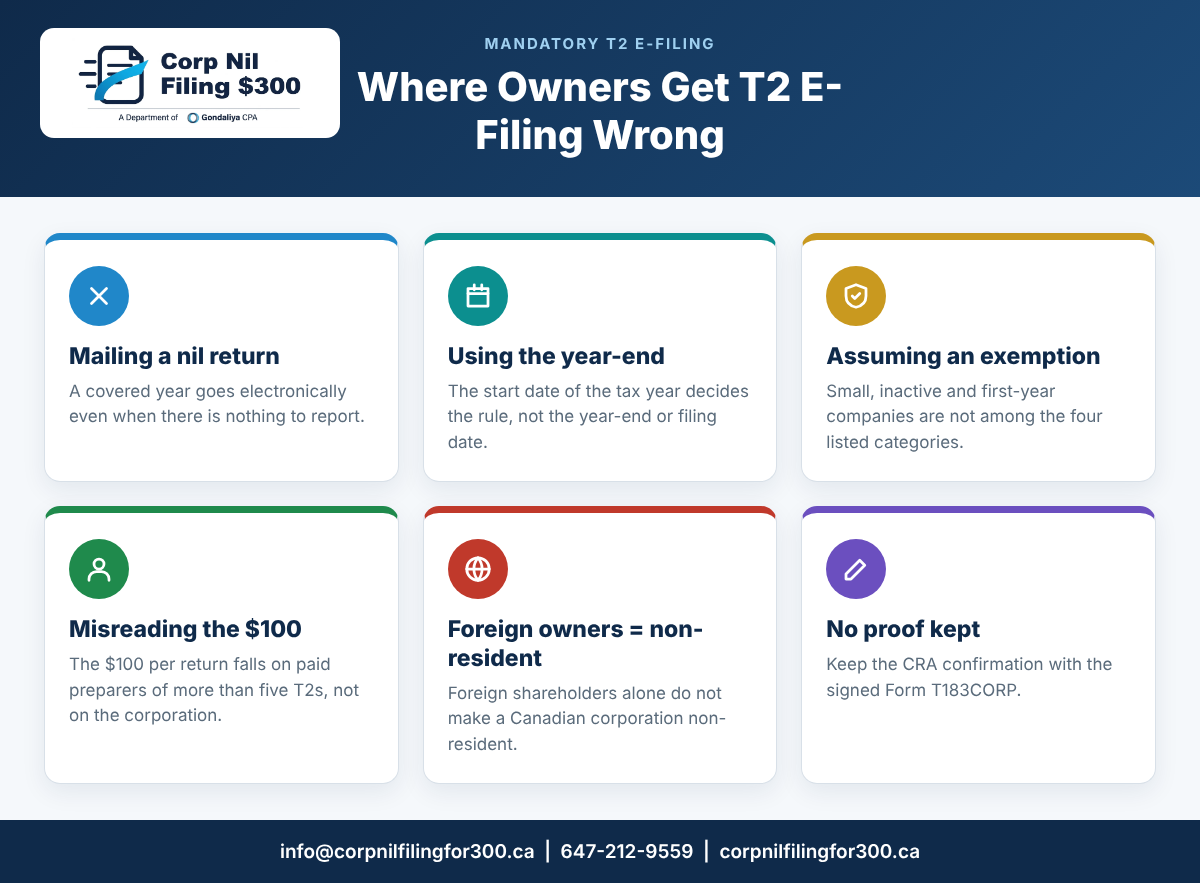
Late Filing Penalties for Resident and Non-Resident Corporations
Late filing penalties are separate from paper filing penalties but just as serious. Resident and non-resident corporations must file their T2 returns within six months after their fiscal year-end. If they miss this deadline, CRA charges late-filing penalties based on any unpaid taxes.
These late-filing penalties do not cancel out the electronic filing rule. Both deadlines matter: you need to file on time and file electronically if required.
Key points:
- File T2 returns within six months after fiscal year-end.
- Late filings get penalties based on taxes owed.
- Paper filing penalties can add up if combined with late filings.
A dormant company mailed a nil return for a covered year because it had always filed on paper before the rule. Nothing was owed and nothing was reported, but the return was still in the wrong form for that year. It was refiled electronically. Figures changed for privacy.
Consequences of Failing to Report Income or Providing False Statements
Failing to report income or submitting false info on your T2 can cause extra problems with CRA. Usually, CRA confirmation time after electronic filing takes up to three business days. But mistakes or missing data may cause CRA to dig deeper or ask for audits.
Wrong info makes your records look bad and raises flags during CRA checks. Automated systems match your return data with other sources. If they find gaps, expect follow-up prompts.
To avoid trouble:
- Report income accurately.
- Keep thorough records.
- Respond promptly to any CRA requests.
Penalties Related to Misrepresentation and Tax Debt Avoidance
Penalties get worse when corporations try to hide info or avoid tax debts by misrepresenting facts in their filings. Some entities are exempt from mandatory e-filing rules—these appear on the CRA Exemptions List. Examples include insurance companies, non-resident corporations, functional currency reporters, and section 149 exempt entities.
But these exemptions don’t protect against penalties for false statements or misrepresentation. Deliberate misreporting leads to fines under Income Tax Act sections 162(7.2) and 162(7.3). These fines go beyond regular penalties.
Remember:
- Some corporations are exempt from e-filing.
- Exemptions don’t shield against false statements penalties.
- Intentional misrepresentation carries heavy fines.
Procedures to Cancel or Waive Penalties and Interest
You can ask for cancellation or waiver of penalties or interest under Section 150(1) of the Income Tax Act if you have good reasons like serious problems that stopped you from complying on time. Success depends on keeping detailed records for at least six years after your assessment finishes — this is the legal minimum.
Good documentation showing your efforts helps your case when asking for relief. It also shows strong management around T2 filings.
Here’s how it works:
- Request waiver under Section 150(1) with valid reasons.
- Keep records for at least six years.
- Show proof of voluntary corrections if possible.
Overview of the Voluntary Disclosures Program for Penalty Relief
The Voluntary Disclosures Program (VDP) lets corporations fix past mistakes without usual penalties — but only if they come forward before CRA starts enforcement actions.
VDP requires:
- Disclosure must be voluntary.
- Submit full details including any unreported amounts.
- Apply before an audit begins.
Even under VDP, deadlines still count: filings are due six months after fiscal year-end. Acting early improves chances for penalty relief while keeping up with mandatory T2 e-filing rules.
After You File Your T2 Return: CRA Enquiries and Reassessments
After You File: Enquiries and Reassessments
After Filing
When you file your T2 return, remember that CRA may ask questions or reassess it later. This is normal under the mandatory T2 e-filing rule. All corporations in Canada must file electronically, even if they have no activity or a nil return. Knowing what to expect from CRA after you submit helps you stay ready and follow the rules.
Understanding the Normal and Extended Reassessment Periods
For returns filed electronically after 2023, CRA usually has three years from the assessment date to review them. This is called the normal reassessment period, set by Income Tax Act section 152(4). Filing online helps speed things up.
Sometimes, CRA can extend this to four years. This happens if income was left out or there’s more than $100 in unpaid tax (ITA s.152(5)). Filing your T2 electronically often reduces delays during these reviews.
Example:
A holding company with no activity files a nil return online within six months of its fiscal year ending January 1, 2024. Normally, CRA can reassess for three years unless they find issues that stretch that time longer. Figures changed for privacy.
Circumstances Leading to Unlimited Reassessment Periods
Certain situations let CRA reassess a return anytime without limit, even if you meet the mandatory electronic filing corporations Canada rule:
- Fraud or carelessness causing wrong info (ITA s.152(6))
- Not filing required info linked directly to income
- Non-resident corporations not making required disclosures
This applies regardless of whether you file on paper or use mandatory T2 e-filing. Still, electronic filing lowers risks by ensuring timely data delivery through approved systems.
Important: Unlimited reassessment mostly applies when serious non-compliance like fraud happens Canada.ca.
How to Request a Reassessment or File a Formal Dispute
If you disagree with an assessment after your electronic filing, you can ask for a reassessment. Send Form RC4288 – Notice of Objection within 90 days from the date CRA mails your assessment notice. This rule applies to all corporations following the T2 electronic filing requirement.
Many companies use professionals who know Corporation Nil Filing for $300 to get objections done right and on time. Keeping good records helps support your dispute.
Tip: Save all confirmation numbers and copies of filings from EFILE. They prove when and what you sent if CRA asks questions.
Keeping Records to Support Your T2 Return
Keeping records matters a lot if you file under Canada’s mandatory T2 e-filing rules. The Income Tax Act says keep them at least six years after the tax year ends (ITA s.230).
Your records should include financial statements, schedules like Schedule 50 when needed, any letters with CRA, and confirmations from Corporation Internet Filing software. Hold onto tools used in preparing your returns too.
Good records help respond quickly if CRA checks your return later. They protect you from penalties caused by missing documents rather than mistakes on nil returns filed after 2023 electronically.
Sources:
- Canada.ca – Completing your corporation income tax (T2) return
- Income Tax Act sections: 152(4), 152(5), 152(6), 230 — Department of Justice Laws Website https://laws-lois.justice.gc.ca/eng/acts/I-3.3/index.html
Additional Resources, Forms, and Publications for T2 Filers
Additional Resources, Forms and Publications
Resources
Corporations that must file T2 electronically can find helpful resources from the Canada Revenue Agency (CRA). The CRA offers a guide called Completing your corporation income tax (T2) return. It explains the rules about mandatory electronic filing corporations Canada-wide. The guide also points out which corporations need to follow these rules and any exceptions.
You can get key forms like Form T183CORP, which authorizes electronic submission of returns, right from CRA’s website. Publications such as the T4012 Corporation Income Tax Guide show the accepted ways to file under the current system.
Remember, all corporations with tax years starting after 2023 have to follow the new T2 electronic filing requirement. This applies even if there’s no income or activity. Nil returns must also be sent electronically unless the CRA says otherwise CRA: Completing your corporation income tax (T2) return.
Key CRA Contacts and Support Services
Once you file your T2 electronically, you usually get confirmation within three business days. The CRA sends it by email or secure message if you use My Business Account or EFILE. This confirmation acts as proof that they got your return.
Keep this confirmation safe along with your signed Form T183CORP. You’ll need these for your records under legal rules Income Tax Act s.230.
The CRA may contact you if they spot problems. For example, if you send paper returns when e-filing is required or if they don’t get a filing at all. They might ask you to fix errors or warn about penalties for not filing electronically CRA: Mandatory Electronic Filing Penalties.
Staying Informed on Updates to T2 Filing Requirements After 2023
The rule for mandatory T2 e-filing started with tax years beginning after 2023. This change comes from new laws meant to modernize how corporate taxes are handled in Canada.
Whether a corporation must e-file depends on when its fiscal year starts—not the year it ends or when it files. This ensures fair and consistent rules everywhere Income Tax Act s.150(1).
Check the CRA website often for updates. Rules about how to file, exceptions, and penalties will keep changing through 2026 and beyond.
Knowing why “the start of the tax year decides it” helps avoid mistakes. Some filers use old rules based on past laws instead of current ones that require electronic filing CRA: Corporation Internet Filing.
How Corporation Nil Filing Supports Compliance with Mandatory T2 E-filing
Even if a corporation has no income, it must still file a nil return electronically to meet Canadian law requirements.
Nil filings typically cost $300 plus HST per year when handled by CPA firms who review and securely send them on your behalf.
Deciding whether to file yourself or use a CPA depends on how well you know certified software approved by the CRA versus needing professional help.
Hiring experts lowers risks of mistakes and missed deadlines while making sure you get confirmations required by federal tax laws CorpNilFiling service details.
This way, even nil filers stay in line with all mandatory electronic filing rules without hassle.
Call to Action: Access Certified Software and Start Your T2 E-Filing Today
Corporations must submit their T2 returns electronically using EFILE through an authorized preparer or via certified software under Corporation Internet Filing. Both require signing authorization with Form T183CORP before sending. CRA: How To File Electronically.
Begin your mandatory T2 e-filing now to comply with Canada’s tax laws after 2023 changes.
If you want low-cost professional help just for nil returns, including CPA checks every time at $300 plus HST yearly, contact CorpNilFiling at info@corpnilfilingfor300.ca or call 647-212-9559 Monday through Sunday from 9 AM to 8:30 PM local time.
Frequently Asked Questions (FAQs)
Frequently Asked Questions
FAQ
What penalty applies for paper filing T2 returns after 2023?+
Corporations face a $1,000 penalty per return for paper filing when electronic filing is mandatory. This rule follows Income Tax Act section 162(7.3).
Are preparers penalized for filing multiple paper T2 returns?+
Yes. Preparers filing over five paper returns annually pay $100 per additional paper return, under CRA Tax Preparer Rules.
When is the deadline to file a T2 return?+
The deadline is six months after the corporation’s tax year-end, as per Income Tax Act section 150(1).
What is Form T183CORP used for?+
Form T183CORP authorizes electronic filing of T2 returns by an authorized preparer or software.
Can nil or inactive corporations skip mandatory e-filing?+
No. Nil or inactive corporations must file electronically unless exempt under specific CRA rules.
What are the CRA reassessment periods for T2 returns filed electronically?+
CRA has a normal reassessment period of three years and can extend to four years if tax discrepancies arise.
When can CRA reassess a return indefinitely?+
Unlimited reassessment occurs in cases of fraud or carelessness, under Income Tax Act section 152(6).
How long must records supporting a T2 return be kept?+
Corporations must retain records for six years following the tax year-end, according to Income Tax Act s.230.
What schedules may be included in T2 electronic filings?+
Schedule 50 and Schedule 24 (First Year Adjustment) are common attachments required during e-filing.
Industry Spotlights: Sectors With Nil Years
Industry Spotlights
Nil years turn up in every sector, usually for one of three reasons: the company was set up before the business started, it holds an asset and does nothing else, or it has stopped trading but has not been dissolved. In each case the year still goes to the CRA electronically when it starts after 2023.
| Sector | Why a Nil Year Happens | E-Filing Point |
|---|---|---|
| Real estate holding companies | A property company between purchases | Holding nothing active is not an exception |
| Property developers holding land | Land held before construction starts | Every covered year goes electronically |
| Physician and dental professional corporations | A corporation opened before practice income starts | A first return is still electronic |
| Technology startups before revenue | Incorporated before launch | No revenue is not an exception |
| E-commerce brands not yet launched | Set up before the store opens | No sales is not an exception |
| Consultants between contracts | A year with no billings | A nil year is still electronic |
| Skilled trades | A company paused between jobs | Dormancy is not an exception |
| Restaurants not opened or closed | A lease that never started, or a closed location | The final return is electronic too |
| Transportation owner-operators | A truck sold and the company parked | Each year to dissolution is filed electronically |
| Family investment holding companies | A company holding shares and nothing else | Holding companies follow the same rule |
| Non-resident-owned Canadian companies | A Canadian company with foreign owners | Foreign owners alone do not make the company non-resident |
- Real estate holding companies: A property company between purchases often has no income for a year. That year still goes electronically, with the property on the balance sheet.
- Property developers holding land: Land bought ahead of construction can sit for several tax years. Each covered year is filed electronically, however quiet it is.
- Physician and dental professional corporations: A corporation opened before practice income starts files its first return electronically like any other.
- Technology startups before revenue: A startup incorporated before launch still has a T2 each year, and no revenue is not one of the four exceptions.
- E-commerce brands not yet launched: A brand set up before the store opens files a nil year electronically, even with no sales at all.
- Consultants between contracts: A year with no billings is a nil year, not a year off from filing.
- Skilled trades: A company paused between jobs is dormant, and dormancy changes nothing about the filing method.
- Restaurants not opened or closed: A lease that never started, or a location that has closed, still leaves a corporation that files electronically through to its final return.
- Transportation owner-operators: A truck sold and a company parked leaves annual returns due until the corporation is dissolved.
- Family investment holding companies: A company holding shares and nothing else follows the same electronic filing rule as an operating company.
- Non-resident-owned Canadian companies: Foreign shareholders do not by themselves make a Canadian corporation non-resident, so its covered years are reviewed against the rule rather than assumed exempt.
Professional Guidance & Quick Reference
Quick Reference
Key Compliance Points for Mandatory T2 E-Filing
- Sharad Gondaliya, CPA, leads CPA Ontario Registered Firm CorpNilFiling with 1300+ 5-star Google reviews.
- Filing deadlines require submissions within six months after tax year-end under Income Tax Act section 150(1).
- Paper filings cause a $1,000 penalty; preparers face $100 per paper return after five annual filings.
- EFILE access is restricted to preparers submitting more than five returns yearly.
- Corporation Nil Filing guarantees CRA confirmation within three business days post-submission.
- Use CRA pre-filing validation tool and attach-a-doc feature to reduce errors and improve submission accuracy.
- Reporting accurate NAICS codes is essential to prevent processing delays and reassessment flags.
- Maintain proper documentation to meet record retention rules for six years following filing.
- Late filing penalties apply separately from electronic filing compliance fines.
- Follow CRA guidance on alternative e-filing methods if Web Access Codes are unavailable.
Essential Technical Features in Mandatory E-Filing
- Schedule 24 assists with first-year adjustments; Schedule 50 discloses shareholder info as required by CRA regulations.
- Form T183CORP authorizes electronic transmission by certified software or preparers registered with CRA EFILE program.
- The CRA’s pre-file validation tool checks for errors before submission to minimize rejections and delays.
- Attach-a-doc allows uploading supporting documents alongside the digital return to satisfy disclosure requirements efficiently.
Penalties and Enforcement Overview
- Section 162(7.2) of the Income Tax Act addresses penalties related to false statements and misrepresentation in filings.
- Late filing penalties are imposed based on outstanding taxes owed, separate from electronic filing penalties.
- Suspensions and refusals of EFILE access occur if preparers repeatedly fail to comply with mandatory electronic filing requirements or submit inaccurate information.
Contact Information for Professional Assistance
Corporation Nil Filing offers expert CPA-reviewed T2 e-filing services at $300 plus HST per year. Reach us at info@corpnilfilingfor300.ca or call 647-212-9559 for prompt support from Sharad Gondaliya’s CPA Ontario Registered Firm with trusted expertise.
Helpful Resources
Refer to “CRA: Completing your corporation income tax (T2) return” for detailed guidelines on mandatory electronic filing procedures, exemptions, penalties, and official forms required during submission.
Visit Canada.ca and consult Department of Justice – ITA sections mentioned above to stay updated on legislative changes impacting corporate tax filings after 2023.
Quick Answers
At a Glance
| Question | Answer |
|---|---|
| Which years must be filed electronically | Every tax year that starts after 2023 |
| What decides it | The date the tax year begins, not the filing date |
| Nil or inactive return | Filed electronically, like any other covered year |
| Late return for a covered year | Still filed electronically |
| Who is outside the rule | Insurance corporations, non-resident corporations, functional currency reporters and section 149 exempt corporations |
| Paper return for a covered year | $1,000 penalty for the corporation |
| Signing an electronic return | Form T183CORP, kept with the confirmation |
| Filing deadline | Six months after the tax year ends |
Who This Is For / Not For
Fit Check
- For: owners of inactive, dormant and holding corporations whose tax years started after 2023 and who need each nil T2 transmitted electronically.
- For: corporations catching up several unfiled years, or filing a final return before dissolution.
- Not for: corporations in one of the four categories the CRA lists outside the rule, whose filing method should be confirmed on their own facts.
- Not for: operating corporations with revenue, payroll or GST/HST activity, which need a full T2 rather than a nil filing.
People Also Ask
Related Questions
Can I still mail a T2 return to the CRA?+
For a tax year that starts after 2023, not unless the corporation falls in one of the four categories the CRA lists outside the rule. Every other corporation transmits the return electronically, including a nil return.
Does a nil return count for mandatory e-filing?+
Yes. A nil return is a T2 like any other. Having no income or activity does not move a corporation outside the electronic filing rule.
I am filing an old year late. Which rule applies?+
The rule for the year being filed. A year that started after 2023 goes electronically however late it is filed; an earlier year follows the rule in force for that year.
Is a T2 Short return covered by the rule?+
The rule covers the T2 for each covered year, whatever form the return takes. Where a corporation qualifies for the T2 Short return, it is still transmitted electronically.
What proof do I keep that the return was filed?+
The CRA confirmation number for the transmission, kept with the signed Form T183CORP and a copy of the return as filed.
Glossary of Key Terms
Definitions
- Mandatory electronic filing: The requirement to transmit the T2 to the CRA electronically for each tax year starting after 2023.
- Covered year: A tax year that starts after 2023 and so falls under the electronic filing rule.
- EFILE: The CRA service a registered preparer uses to transmit returns for clients.
- Corporation Internet Filing: The CRA service for transmitting a T2 through certified software.
- Certified software: Tax preparation software the CRA has certified for electronic T2 filing.
- Form T183CORP: The corporation’s authorization for a preparer to file its T2 electronically.
- Nil return: A T2 for a corporation with no income or activity in the year.
- Functional currency reporter: A corporation that has elected to report in a currency other than the Canadian dollar.
- Section 149 exemption: The Income Tax Act provision listing corporations exempt from tax.
- T2 Short: The simplified T2 return available to corporations that meet its conditions.
Want a checklist to work from? You can download the free T2 e-filing checklist before you start your filing.
This quick self-check shows what your filing is likely to need. Please answer the five questions below.
T2 E-Filing Check
Five quick questions on your corporation. No fee shown.
Points to raise with us:
This is a general prompt, not tax or legal advice or a quote. Your position depends on your full facts.

Start with the date each tax year began. Every year that starts after 2023 goes to the CRA electronically — on time or late, active or nil, first return or final return. Only the four categories the CRA lists sit outside the rule, and no activity, no income or a small company is not one of them. A paper return for a covered year draws a $1,000 penalty on the corporation, whether or not anything is owed. Sign Form T183CORP, keep the confirmation, and file the year in the form the rule requires.
What is current: the CRA continues to require electronic filing of the T2 for tax years starting after 2023, with insurance corporations, non-resident corporations, corporations reporting in functional currency and corporations exempt under section 149 listed outside the rule, and a $1,000 penalty for non-compliance. Paid preparers of more than five T2 returns continue to file electronically. What is unchanged: the six-month T2 filing deadline, the need for a signed Form T183CORP when a preparer transmits the return, and the rule that a nil return is filed like any other.
Mandatory T2 E-Filing: How CorpNilFiling Can Help
Start with your business number, your year-end and the years you need filed
CorpNilFiling maps each year by the date it started, prepares each nil T2 with the schedules it needs, sends you Form T183CORP to sign securely, and has a CPA review the return before it is transmitted electronically — at $300.00 plus HST per tax year, with your CRA confirmation emailed within 3 business days.
Next Steps
Please start your filing with CorpNilFiling and have three things ready: the corporation’s business number, its year-end and incorporation date, and a list of the years still to be filed. Those three tell us which years fall under the electronic filing rule. If any return has already gone in on paper, say so at the outset. We are open 9:00 AM to 8:30 PM, Monday to Sunday, at 55 Queen St E, Suite 1205, Toronto, and file for corporations across Canada. If our content helps, please add corpnilfilingfor300.ca as a preferred source on Google.
Published: · Last updated:
Editorial policy: We research against CRA, Department of Justice, CPA Canada and CPA Ontario sources, fact-check the figures, and Sharad Gondaliya, CPA, reviews the content, which we update as the rules change.
Disclaimer: This article is educational information only and is not tax, legal or software advice. It covers the electronic filing requirement for the T2 return of Canadian corporations. Whether a corporation falls within one of the categories outside the rule, and whether a penalty applies, depends on the facts and current law. Forms, services and guidance change, and outcomes depend on your specific facts. Gondaliya CPA performs compilation engagements under CSRS 4200 and does not perform audit or review engagements. Please consult a licensed CPA before acting.